

Quick Summary
- South Korea announced $950 billion in AI initiatives involving Samsung Electronics, SK Group and major U.S. technology companies.
- The headline package includes a $500-billion-plus NVIDIA–SK Group partnership focused on AI factories and next-generation memory.
- SK Telecom plans a 2-gigawatt AI data center using NVIDIA Vera Rubin infrastructure and SK hynix HBM4 memory, with the first facility planned for 2027.
- Samsung signed a memorandum of understanding with Broadcom covering up to $200 billion in memory, foundry and advanced packaging cooperation.
- The figures represent announced initiatives, partnerships and planned investments—not a single immediate cash payment.
Today’s biggest technology story is a massive South Korean push to expand the infrastructure behind artificial intelligence. On July 25, 2026, Reuters reported that South Korea had announced $950 billion in new AI initiatives involving Samsung Electronics, SK Group and U.S. technology companies. The announcement follows an AI summit in San Francisco and highlights how quickly the competition for advanced chips, high-bandwidth memory and data-center capacity is accelerating.
The largest individual component is a $500-billion-plus strategic partnership between NVIDIA and SK Group. The plan spans large-scale AI factories, cloud infrastructure and long-term development of next-generation memory. Samsung Electronics separately signed an agreement with Broadcom covering up to $200 billion across memory chips, foundry manufacturing and advanced packaging.
Important context: The $950 billion headline is an aggregate value attached to several initiatives and agreements. Some elements are letters of intent or memoranda of understanding, so the final investment timing, scope and spending can change.
What Happened in the $950 Billion AI Announcement?
South Korea used the San Francisco AI summit to position itself as a central supplier and builder in the global AI economy. The country already plays a critical role in memory chips through Samsung Electronics and SK hynix. The new announcements extend that strength into AI data centers, advanced packaging, foundry services and AI accelerator development.
According to Reuters, SK Group’s announced deals were valued at about $750 billion, including the NVIDIA partnership worth more than $500 billion. Samsung’s agreement with Broadcom covers up to $200 billion. Together, these announcements form the reported $950 billion package.
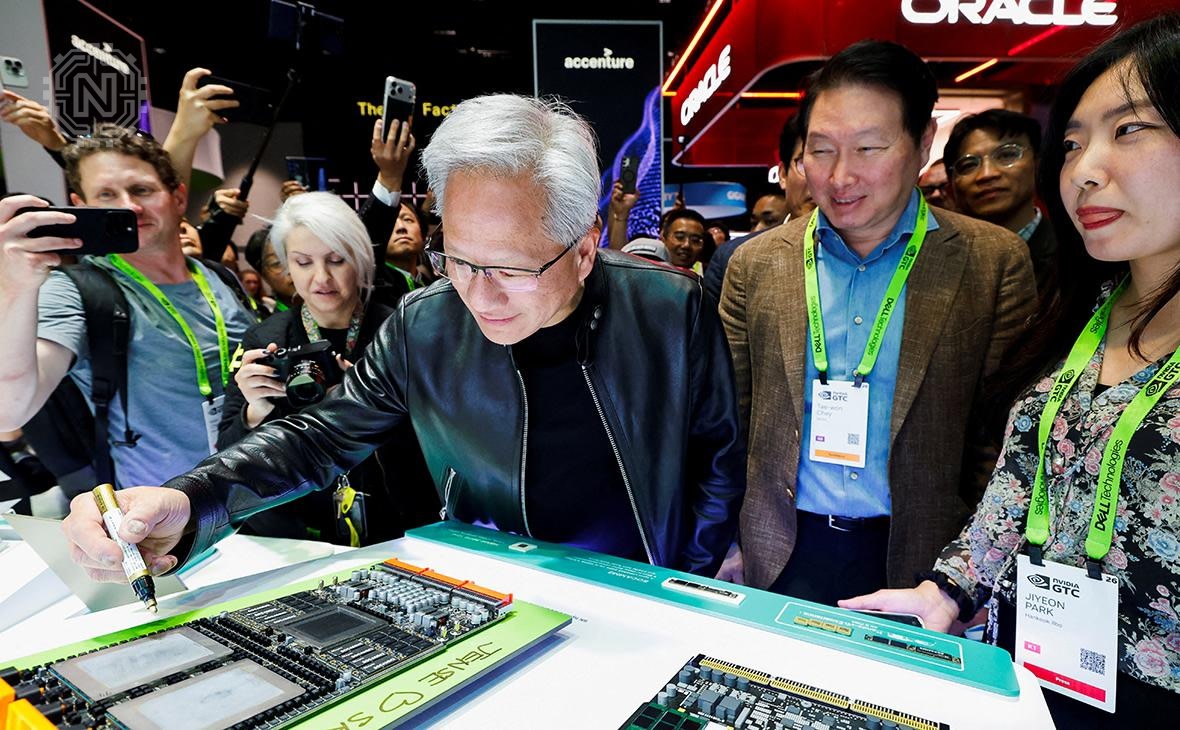
The summit also produced a “San Francisco AI Declaration,” outlining South Korea’s intention to deepen technological cooperation with the United States. Executives from NVIDIA, OpenAI, Anthropic and Broadcom joined Korean technology leaders at the event, showing that the race for AI capacity now depends on partnerships across chip design, memory, manufacturing, networking and cloud operations.
What NVIDIA and SK Group Are Building
The NVIDIA–SK initiative is designed around a simple but urgent problem: AI companies need far more computing power and memory than the current supply chain can comfortably deliver. Modern AI systems require large clusters of accelerators, fast networking and high-bandwidth memory, or HBM, to train models and run increasingly complex AI agents.
A 2-Gigawatt AI Factory
SK Telecom plans to build an AI cloud and data-center platform with capacity of up to 2 gigawatts. NVIDIA says the infrastructure will use its Vera Rubin accelerated-computing platform and SK hynix HBM4 memory. The first AI factory is planned to come online in 2027.
A facility of this scale is not simply a conventional server farm. It is intended to operate as an “AI factory”—a tightly integrated system that converts electricity, data and advanced chips into model training, inference and AI services. The partnership is expected to support sovereign AI, enterprise AI, physical AI and agentic AI workloads across South Korea and the wider Asia-Pacific region.
Long-Term HBM Cooperation
SK hynix and NVIDIA also plan to secure and co-develop next-generation AI memory. HBM is one of the most important components in advanced AI accelerators because it can move large amounts of data quickly between memory and processors. As models become larger and AI agents perform longer tasks, memory bandwidth and capacity become major performance bottlenecks.
Why it matters: NVIDIA may design leading AI accelerators, but those chips still depend on memory suppliers, foundries, packaging companies, power infrastructure and data-center operators. The partnership connects several of those layers under one long-term plan.
Samsung and Broadcom’s AI Chip Partnership
Samsung Electronics announced a memorandum of understanding with Broadcom covering up to $200 billion. Reuters reported that the cooperation spans memory chips, foundry services and advanced packaging. Samsung also plans to work with Broadcom on a next-generation AI accelerator based on Samsung HBM technology.
The agreement could strengthen Samsung’s position across multiple parts of the AI semiconductor stack. Unlike a company focused on only one chip category, Samsung can potentially contribute memory, logic-chip manufacturing and packaging technologies. Reuters reported that Samsung would offer sub-2-nanometer foundry processes and advanced packaging solutions as part of the collaboration.
Why This Matters for the Global AI Race
The AI industry’s biggest constraint is increasingly physical. Software breakthroughs attract attention, but every new model still requires chips, memory, data centers, electricity, cooling and network capacity. The latest South Korean agreements show that technology companies are trying to secure those resources years in advance.
| Initiative | Reported Scale | Main Focus | Expected Impact |
|---|---|---|---|
| NVIDIA and SK Group | $500 billion-plus | AI factories, cloud compute and next-generation memory | More large-scale AI infrastructure and long-term HBM supply |
| SK Telecom AI Factory | Up to 2 gigawatts | NVIDIA Vera Rubin systems with SK hynix HBM4 | Regional compute capacity for enterprise, sovereign and agentic AI |
| Samsung and Broadcom | Up to $200 billion | HBM, foundry manufacturing, AI accelerators and packaging | Broader supply options for custom AI chips |
The agreements also reinforce South Korea’s strategic importance. The country is home to two of the world’s leading memory-chip manufacturers and has significant expertise in advanced semiconductor production. By connecting that manufacturing base with U.S. AI companies, South Korea is seeking a larger role in the infrastructure that will power the next generation of AI services.
What It Could Mean for Consumers and Businesses
These deals will not immediately make smartphones cheaper or AI subscriptions faster. However, additional infrastructure and memory supply could gradually reduce bottlenecks that currently limit AI deployment. More capacity may help cloud providers offer larger models, faster inference and more reliable enterprise AI services.
For businesses, the most important development is the planned expansion of agentic AI and enterprise AI infrastructure. AI agents can perform multi-step tasks such as coding, research, customer support and workflow automation, but they often require sustained computing resources. Large AI factories could make these services more widely available, although final pricing will depend on energy costs, chip supply, competition and demand.
For developers and startups in Asia, a major regional AI cloud could reduce dependence on distant data centers and improve access to advanced computing. That outcome is not guaranteed, but it is one of the clearest potential benefits of the SK Telecom and NVIDIA plan.
Key Risks and Unanswered Questions
The scale of the announcements is extraordinary, but several details remain uncertain. Letters of intent and memoranda of understanding are not the same as completed purchases. Construction schedules, financing, regulatory approvals, electricity supply and chip availability could all affect the final outcome.
- Execution risk: Building multi-gigawatt AI infrastructure requires enormous capital, power and construction capacity.
- Energy pressure: AI data centers may face scrutiny over electricity use, grid connections and cooling requirements.
- Supply-chain risk: Advanced AI systems depend on foundries, packaging, memory and networking components arriving on schedule.
- Market risk: AI demand is growing quickly, but future model economics and customer spending remain difficult to predict.
- Geopolitical risk: Semiconductor partnerships are increasingly influenced by export controls, national-security policy and regional competition.
Key takeaway: The real story is not only the $950 billion headline. It is the formation of a deeper AI supply chain linking NVIDIA’s computing platforms, SK hynix memory, SK Telecom data centers, Samsung manufacturing and Broadcom chip design.
Conclusion
The NVIDIA, Samsung and SK Group AI deals are among the largest infrastructure announcements of the current AI boom. They show that the next phase of artificial intelligence will be shaped as much by factories, memory and power systems as by software models.
For now, the agreements should be viewed as ambitious long-term plans rather than fully completed investments. Still, the direction is clear: leading technology companies are racing to secure the chips and data centers needed for AI agents, enterprise automation and physical AI. South Korea intends to be one of the central hubs of that expansion.
Frequently Asked Questions
What is the $950 billion South Korea AI announcement?
It is the combined reported value of multiple AI initiatives involving Samsung Electronics, SK Group and U.S. technology companies, including NVIDIA and Broadcom.
How large is the NVIDIA and SK Group partnership?
NVIDIA and SK Group described their initiative as worth more than $500 billion, covering AI factories and next-generation memory cooperation.
What will the SK Telecom AI factory use?
The planned 2-gigawatt AI infrastructure will use NVIDIA Vera Rubin accelerated computing and SK hynix HBM4 memory, with the first factory planned for 2027.
What is Samsung doing with Broadcom?
Samsung signed a memorandum of understanding covering up to $200 billion in memory, foundry services, advanced packaging and next-generation AI accelerator development.
Has the full $950 billion already been spent?
No. The figure includes announced initiatives, planned partnerships, letters of intent and memoranda of understanding. Final spending and timing may change.
Why is HBM4 important for AI?
HBM4 is designed to provide the high memory bandwidth needed to feed data rapidly to advanced AI accelerators, helping large models and AI agents run efficiently.
Sources
This report was verified using Reuters reporting published July 25, 2026 and the official NVIDIA–SK Group announcement published July 24, 2026.
Related Topics
Follow Newtechzy for verified updates on AI, semiconductors, smartphones and the world’s biggest technology stories.
Explore More Tech News


