


Quick Summary
- NVIDIA Vera Rubin entered full production in 2026, with partner systems scheduled for the second half of the year.
- AMD launched the Instinct MI455X on July 23, 2026, as part of its CDNA 5-based MI400 family.
- Cerebras WSE-3 remains a distinctive wafer-scale alternative, although it was introduced before 2026.
- The biggest hardware gains now come from complete rack-scale systems, high-bandwidth memory, faster interconnects, liquid cooling and mature software.
- Performance figures should not be compared without checking precision, workload, power envelope and whether the number describes one chip or a full rack.
- For buyers, software compatibility, deployment cost, power capacity and model requirements can matter as much as peak compute.
AI chip advancements in 2026 are no longer defined by a single faster processor. The industry is shifting toward tightly integrated systems that combine accelerators, CPUs, high-bandwidth memory, networking, storage, cooling and software into one AI infrastructure platform.
This change matters because modern generative AI and reasoning models place pressure on more than raw compute. They require large memory capacity, rapid movement of data between chips, dependable scaling across many accelerators and efficient inference at production volume.
Three important names illustrate the direction of the market: NVIDIA Vera Rubin, AMD Instinct MI455X and Cerebras WSE-3. They are not identical products, and their headline performance figures are not directly interchangeable, but each shows how AI hardware is becoming more specialized.
What changed in AI chips in 2026?
The main development in 2026 is the move from individual accelerator comparisons to rack-scale AI systems. Vendors increasingly design the GPU or accelerator together with the host CPU, memory subsystem, networking fabric, cooling architecture and software stack.
NVIDIA says its Vera Rubin platform is in full production, with partner availability planned for the second half of 2026. AMD launched the Instinct MI455X on July 23, 2026, positioning it inside the Helios rack-scale platform. Cerebras continues to offer a different approach through the WSE-3, a wafer-scale processor that places an unusually large amount of compute and on-chip memory on one device.
Key AI Hardware Trends in 2026
- Rack-scale co-design is replacing isolated chip-level optimization.
- HBM4 and other high-bandwidth memory technologies are becoming central to large-model performance.
- Interconnect bandwidth is critical for scaling training and inference across dozens of accelerators.
- Direct liquid cooling is becoming common in high-density AI infrastructure.
- Lower-precision formats such as FP4 are increasingly used to improve inference throughput and efficiency.
- Software ecosystems remain a major factor in real-world adoption.
The Semiconductor Industry Association and Deloitte reported in 2026 that semiconductors account for a major share of the value inside modern AI data-center infrastructure. That broader stack includes compute accelerators, CPUs, memory, networking, storage, power-management chips and other supporting components.
NVIDIA Vera Rubin: a rack-scale AI platform
NVIDIA Vera Rubin is designed as a complete AI factory platform rather than a standalone GPU launch. The Vera Rubin NVL72 configuration combines 72 Rubin GPUs and 36 Vera CPUs with NVLink 6, ConnectX networking and BlueField data-processing components.
NVIDIA states that the platform is aimed at large-scale training and high-volume inference for advanced reasoning and agentic AI workloads. The company also claims substantial improvements in inference throughput per watt and cost per token compared with its previous Blackwell platform. These are vendor claims, so buyers should validate performance using their own models, precision settings and deployment conditions.
NVIDIA Vera Rubin Highlights
- Full platform co-design across GPU, CPU, networking and data processing.
- NVL72 rack configuration with 72 Rubin GPUs and 36 Vera CPUs.
- NVLink 6 fabric for high-speed communication inside the system.
- Direct liquid cooling for dense AI data-center deployments.
- Strong integration with NVIDIA CUDA and its existing software ecosystem.
Rubin’s strongest advantage is likely to be ecosystem continuity. Organizations already using NVIDIA infrastructure can evaluate the new platform without changing every layer of their software workflow. The trade-off is that large rack-scale systems require substantial capital, power, cooling and data-center planning.
AMD Instinct MI455X and the MI400 series
AMD Instinct MI455X launched on July 23, 2026, as part of the MI400 series. AMD lists the accelerator with its fifth-generation CDNA architecture, 432GB of HBM4 memory and very high memory bandwidth for large AI training, fine-tuning and inference workloads.
The MI455X is designed for AMD’s Helios rack-scale platform. AMD says a Helios rack connects 72 MI455X accelerators and provides a large shared pool of HBM4 memory through an open networking approach based on UALink and UALoE technologies.
Why AMD MI455X Matters
- It gives cloud providers and enterprises another high-end option for frontier AI infrastructure.
- Its large HBM4 capacity is suited to memory-intensive models and longer context windows.
- AMD continues to build around the open-source ROCm software platform.
- The Helios design emphasizes rack-scale deployment rather than a single accelerator card.
- Competition with NVIDIA can improve buyer choice, software investment and pricing pressure.
AMD’s biggest opportunity is to convert strong hardware specifications into broad, predictable software support. ROCm has improved significantly, but organizations should still test the frameworks, kernels, model libraries and deployment tools used in their own production environment.
Cerebras WSE-3 and wafer-scale computing
Cerebras WSE-3 was introduced in 2024, so it should not be described as a new 2026 launch. However, it remains relevant in 2026 because its architecture is fundamentally different from conventional GPU clusters.
The WSE-3 uses a wafer-scale design with 4 trillion transistors, 900,000 AI-optimized cores and 44GB of on-chip SRAM. Cerebras lists 125 petaflops of peak AI compute for the processor. The WSE-3 powers the company’s CS-3 system, which is intended for large-model training and high-speed inference.
Did You Know?
A conventional semiconductor wafer is normally cut into many separate chips. Cerebras instead uses nearly the entire wafer as one processor, reducing some of the communication overhead associated with moving data between separate accelerator packages.
The wafer-scale approach can simplify certain large AI workloads, but it is not a direct one-for-one substitute for every GPU deployment. Procurement model, software compatibility, workload type, scaling method and availability all need to be evaluated.
How modern AI accelerators work
AI accelerators are optimized for the repeated matrix and tensor operations used in neural networks. Unlike general-purpose CPUs, they devote more silicon to parallel arithmetic, high-throughput data movement and specialized numerical formats.
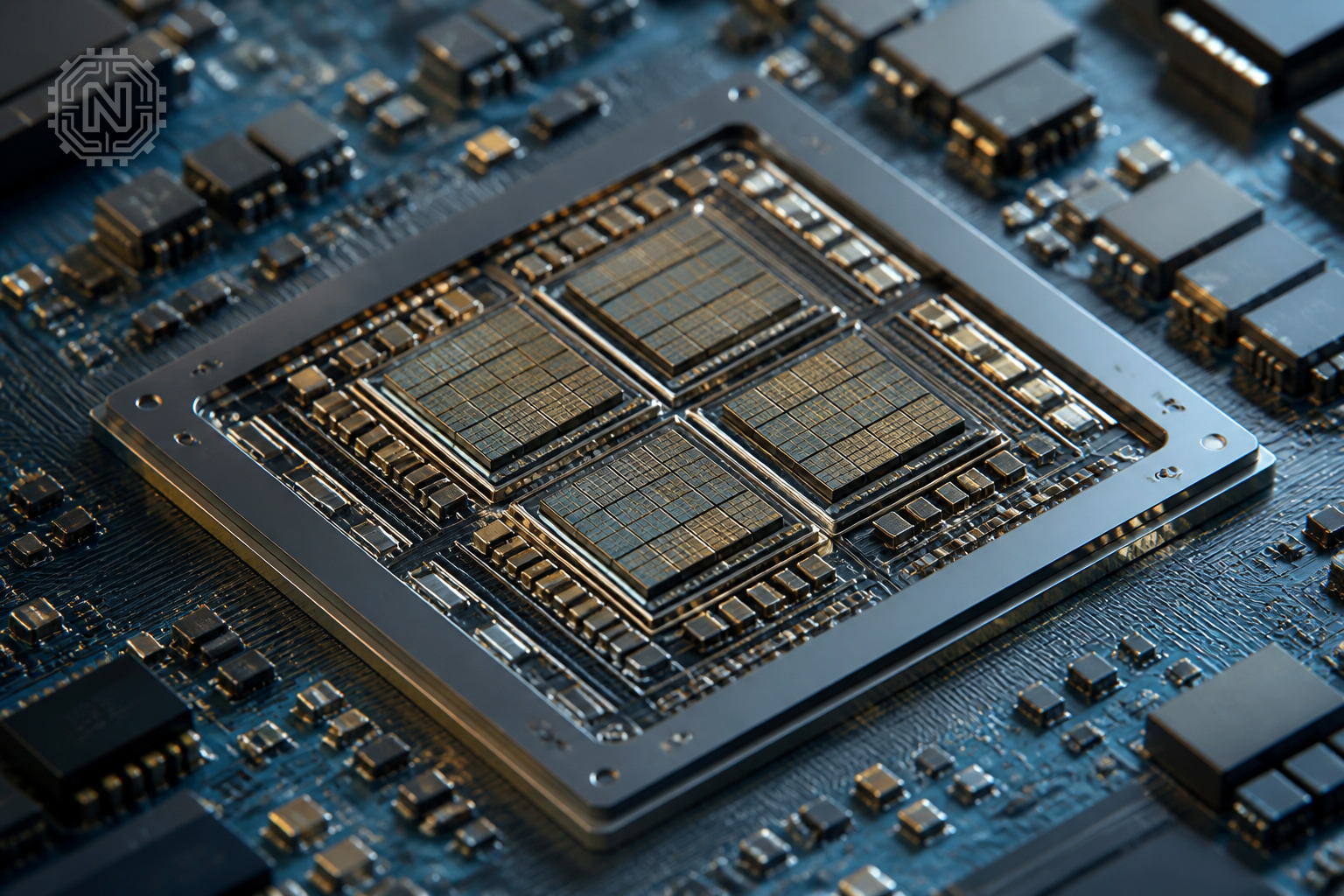
Specialized compute units
Modern accelerators contain tensor or matrix engines that process large blocks of AI calculations in parallel. Lower-precision formats such as FP8 and FP4 can increase throughput for suitable training and inference workloads, although accuracy and model behavior must be tested.
High-bandwidth memory
Large AI models frequently move enormous volumes of parameters and activation data. HBM places multiple memory dies close to the accelerator, providing far more bandwidth than ordinary server memory. Capacity is equally important because models that do not fit in memory may require additional communication or partitioning.
Fast interconnects
One accelerator is rarely enough for frontier-scale models. Proprietary and open interconnect technologies allow dozens or hundreds of devices to exchange data with lower latency and higher bandwidth. The quality of this fabric can strongly influence scaling efficiency.
Cooling and power delivery
High-density AI racks can consume enormous amounts of electricity and produce significant heat. Direct liquid cooling, advanced power conversion and careful facility design are therefore part of the computing platform, not optional accessories.
Benefits and Limitations of Modern AI Accelerators
- Benefits: faster model training, higher inference throughput, support for larger models and better performance per workload than general-purpose processors.
- Limitations: high purchase cost, major power and cooling requirements, software migration work, supply constraints and difficult cross-vendor comparisons.
AI chip comparison for 2026
Peak performance numbers can be misleading when products use different numerical precision, sparsity assumptions, cooling limits or system sizes. The table below focuses on architecture and market position rather than presenting incompatible figures as a simple ranking.
| Platform | 2026 Status | Important Hardware Detail | Software / Scaling Approach | Best Fit |
|---|---|---|---|---|
| NVIDIA Vera Rubin NVL72 | In full production; partner systems planned for the second half of 2026 | 72 Rubin GPUs, 36 Vera CPUs and NVLink 6 in a liquid-cooled rack design | CUDA ecosystem with NVIDIA networking and system software | Large AI factories, frontier model training and high-volume inference |
| AMD Instinct MI455X / Helios | MI455X launched July 23, 2026 | 432GB HBM4 per MI455X; Helios connects 72 accelerators | ROCm software with UALink and UALoE-based rack-scale connectivity | Cloud, enterprise, sovereign AI, training and inference |
| Cerebras WSE-3 / CS-3 | Introduced in 2024 and still relevant in 2026 | Wafer-scale processor with 4 trillion transistors, 900,000 cores and 44GB on-chip SRAM | Cerebras software and wafer-scale system architecture | Specialized large-model training and high-speed inference |
How to Read AI Chip Benchmarks
- Check whether the result is for training, prefill, decoding or end-to-end inference.
- Confirm the numerical precision, sparsity assumptions and model used.
- Separate single-chip results from server, rack or cluster results.
- Compare power consumption and cooling requirements alongside speed.
- Look for independently reproducible benchmarks when available.
- Measure cost per completed workload, not only theoretical operations per second.
Business impact and buying factors
More capable AI hardware can reduce model-training time, serve more users and make advanced AI features practical. However, the best platform depends on the workload and the organization’s existing infrastructure.
Software compatibility
A chip is useful only when the required frameworks, models, kernels and management tools run reliably. Teams should test representative production workloads before making a large commitment.
Total cost of ownership
Purchase price is only one part of the cost. Power, cooling, networking, storage, data-center space, support contracts, engineering time and utilization rate can materially change the final economics.
Memory and model size
Memory capacity and bandwidth influence which models can run efficiently. Larger HBM pools can reduce model partitioning and data movement, but application design still matters.
Availability and deployment timing
A product announcement, full production milestone and broadly available customer system are different stages. Buyers should confirm actual delivery schedules, qualified system partners and regional availability.
Practical Buying Checklist
- Benchmark your own model and data pipeline.
- Verify framework and library support.
- Calculate power, cooling and networking requirements.
- Compare rack-level throughput and utilization.
- Review support, supply and deployment timelines.
- Plan for model growth over the next two to three years.
What comes next in 2027 and beyond?
The next phase of AI hardware will likely continue the same system-level direction: more memory, faster scale-up networking, better power efficiency, denser liquid-cooled racks and increasingly specialized accelerators for training, reasoning and long-context inference.
Chiplet designs, advanced packaging, optical interconnects and improved power-delivery technologies are expected to play larger roles. Edge AI will also continue growing, but data-center accelerators and on-device AI chips solve different problems and should not be evaluated with the same criteria.
Quantum computing and experimental materials may influence long-term research, but they should not be presented as near-term replacements for mainstream AI accelerators. For the immediate future, the most meaningful progress will come from improving conventional semiconductor architectures, memory systems, networking, packaging, cooling and software.
Conclusion
AI chip advancements in 2026 show that the market has moved beyond a simple race for the fastest standalone GPU. NVIDIA Vera Rubin and AMD MI455X highlight the rise of integrated rack-scale platforms, while Cerebras WSE-3 demonstrates a specialized wafer-scale alternative.
For businesses and developers, the most important lesson is to avoid choosing hardware from headline specifications alone. Real-world value depends on model performance, memory capacity, software maturity, scaling efficiency, power consumption, deployment availability and total cost of ownership.
Frequently Asked Questions
What is the biggest AI chip advancement in 2026?
The biggest shift is toward rack-scale co-designed systems that combine accelerators, CPUs, high-bandwidth memory, networking, cooling and software.
Is NVIDIA H100 a new 2026 AI chip?
No. H100 belongs to an earlier generation. NVIDIA’s major 2026 platform is Vera Rubin, while Blackwell remains part of the company’s installed and shipping product base.
When did AMD launch the Instinct MI455X?
AMD lists July 23, 2026, as the launch date for the Instinct MI455X.
How much memory does the AMD MI455X have?
AMD lists 432GB of HBM4 memory for each MI455X accelerator.
Is Cerebras WSE-3 a 2026 launch?
No. Cerebras introduced WSE-3 in 2024, but the wafer-scale processor remains relevant to the 2026 AI hardware market.
Can NVIDIA, AMD and Cerebras performance numbers be directly compared?
Not reliably without normalizing the model, workload, numerical precision, sparsity, system size, power limit and software configuration.
Why is high-bandwidth memory important for AI?
HBM provides the capacity and bandwidth needed to feed large numbers of compute units and hold more model data close to the accelerator.
What should companies check before buying AI hardware?
They should test their own workloads, verify software support, calculate power and cooling needs, confirm delivery schedules and compare total cost of ownership. For more coverage, visit Tech News or learn more About Newtechzy.
Editorial Sources
Related Topics
Explore More AI Hardware Coverage
Follow Newtechzy for clear analysis of AI processors, data-center infrastructure, semiconductor trends and emerging computing platforms.
Read More Tech News


