The landscape of retirement planning in the United States has reached a major milestone on March 31, 2026, as the final 'mandatory' provisions of the SECURE 2.0 Act and the first waves of SECURE 3.0 take effect. These changes are redefining how Americans save for the future, with a heavy emphasis on Roth accounts and expanded access for gig workers. For those managing their own 401(k) or IRA, the rules of the game have shifted significantly this year, requiring a tactical review of contribution sources and catch-up strategies to avoid compliance errors and maximize tax-free growth.
The headline change for 2026 is the mandatory Roth catch-up rule for high earners. As of January 1, 2026, any participant in a 401(k), 403(b), or governmental 457(b) plan who earned more than $150,000 in the prior year must make their catch-up contributions (available to those age 50 and older) into a Roth account. This means you can no longer get an upfront tax deduction for that portion of your savings; however, the money will grow and be withdrawn tax-free in retirement. This change has caught many high-income professionals off guard, and if your employer's plan does not yet offer a Roth option, you are currently barred from making catch-up contributions at all.
For 2026, the IRS has also announced higher baseline contribution limits to keep pace with the moderate inflation seen over the last year. The standard employee contribution limit for 401(k) and similar plans has risen to $24,500. For those aged 50 and older, the standard catch-up limit is now $8,000, bringing the total potential annual contribution to $32,500. IRA limits have also seen a boost, with the maximum contribution now set at $7,500 for those under 50 and $8,600 for those over 50. These higher limits provide a powerful tool for those looking to accelerate their path to financial independence in 2026.
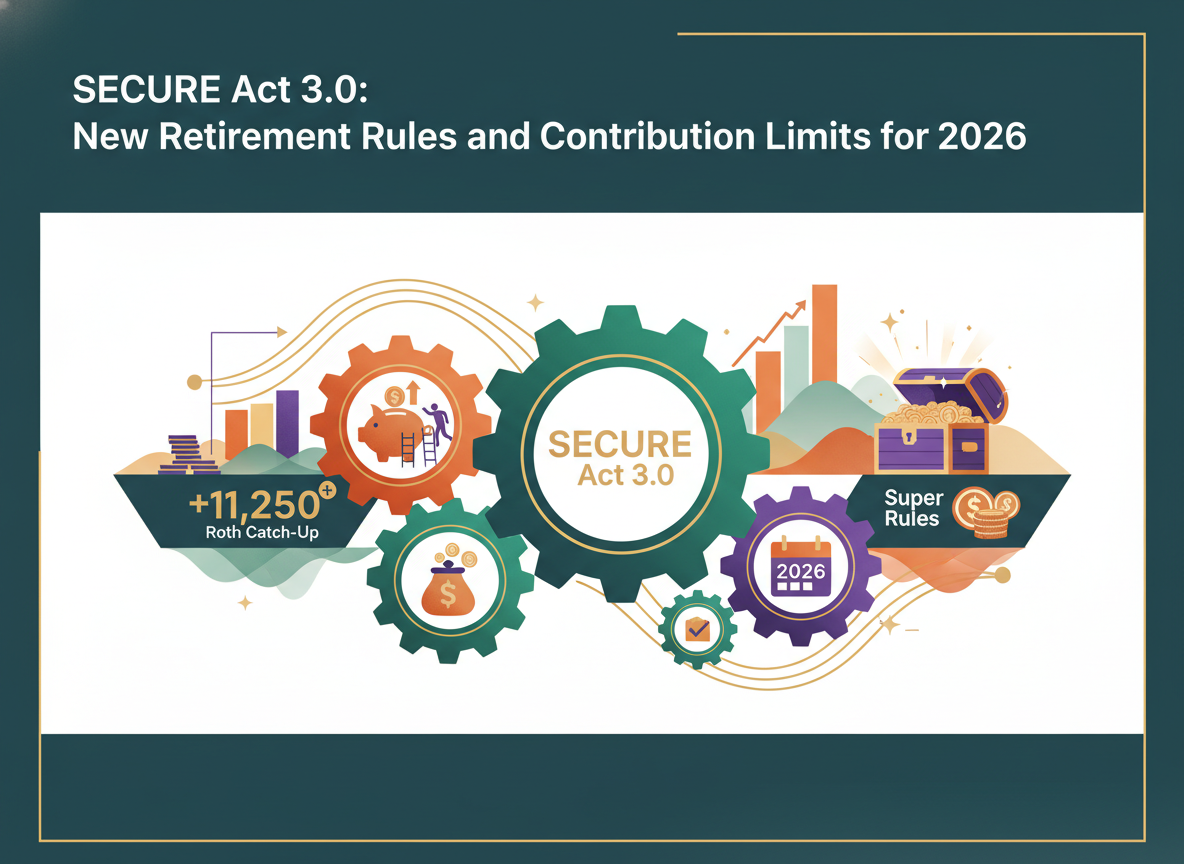
A particularly exciting development in 2026 is the 'super catch-up' provision for workers aged 60 to 63. Under the new rules, individuals in this specific age bracket can now contribute up to $11,250 in catch-up contributions (or 150% of the standard catch-up limit), bringing their total 401(k) contribution capacity to $35,750. This 'pre-retirement sprint' is designed to help those who may have started saving late or had a career interruption. Financial planners are advising clients in this age group to maximize this window, as it represents one of the most generous tax-advantaged saving opportunities in the current code.
Small businesses are also seeing unprecedented incentives to start retirement plans in 2026. Very small businesses (50 or fewer employees) can now claim a tax credit for 100% of their qualified plan start-up costs, up to $5,000 per year for three years. Furthermore, there is a new 'employer matching contribution credit' of up to $1,000 per employee for those earning less than $100,000. These incentives are part of a broader 2026 effort to close the 'coverage gap' for the millions of Americans who currently lack access to an employer-sponsored plan. If you are a small business owner, this is the most cost-effective year in history to launch a 401(k).
For the gig economy and part-time workers, 2026 marks the full implementation of the 'Long-Term Part-Time' (LTPT) eligibility rules. Employers must now allow employees who have worked at least 500 hours for two consecutive years to participate in the company 401(k) plan. This is a massive win for the 'side-hustle' generation, allowing them to gain access to institutional-grade investment options and, in many cases, employer matching funds that were previously reserved for full-time staff. It is essential for part-time workers to check their eligibility with HR departments this month, as many are now eligible who were not in 2025.
Required Minimum Distributions (RMDs) are also in the news this March, as the starting age has officially moved to 75 for those born in 1960 or later. This allows retirees to keep their money in tax-deferred accounts longer, providing additional years of potential growth. However, for those who *must* take distributions, the penalty for failing to do so has been slashed from 50% to 25% (and potentially as low as 10% if corrected quickly). This 'kinder, gentler' IRS approach to RMD errors is a welcome change for 2026, though experts still advise setting up automatic distributions to avoid the headache entirely.
Looking ahead at the rest of 2026, the theme of retirement planning is 'diversification of tax buckets.' With the SECURE legislation pushing more people toward Roth contributions and the OBBB law keeping tax rates low for now, the smart money is on building a mix of traditional, Roth, and taxable brokerage accounts. This provides 'tax flexibility' in retirement, allowing you to choose which bucket to draw from depending on future tax laws. As we move into Q2 2026, take the time to audit your contribution types; the decisions you make today regarding these new rules will dictate your lifestyle decades from now.