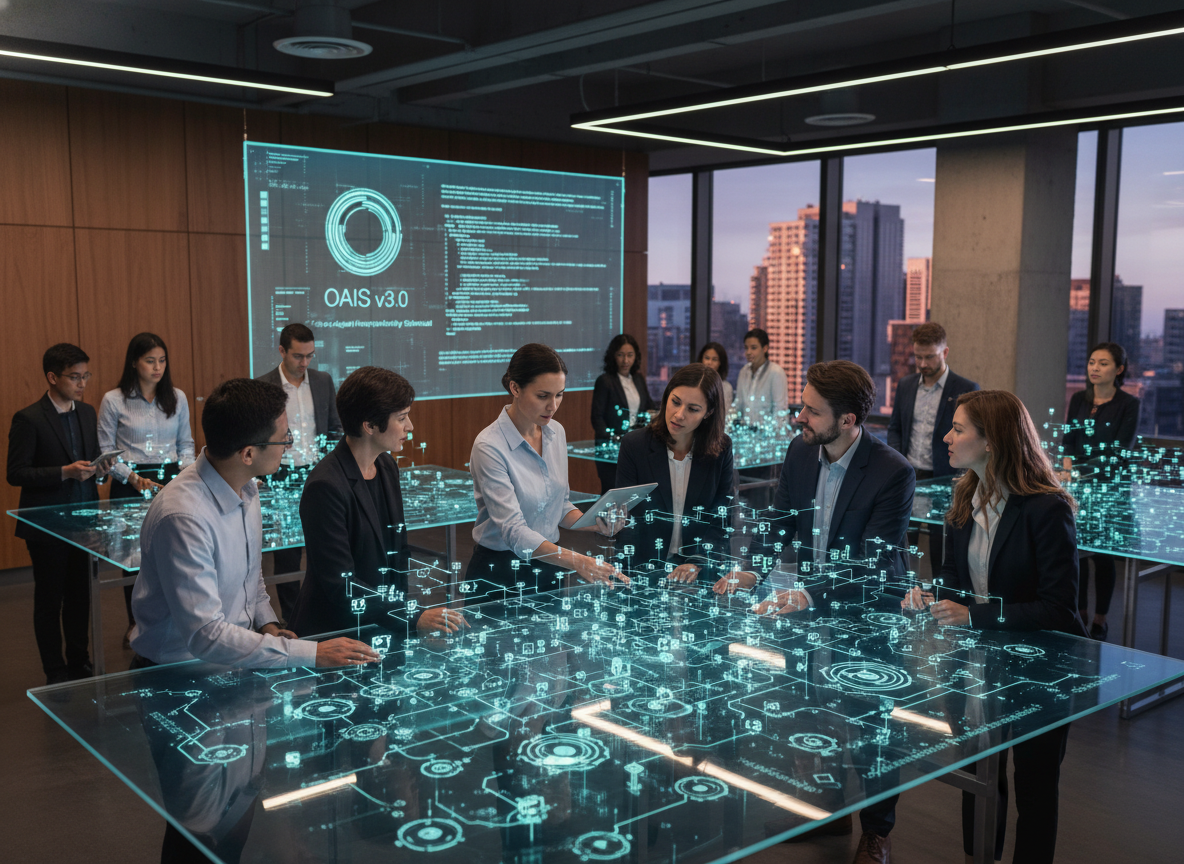
The international community reached a historic milestone on May 15, 2026, with the signing of the Global Agent Governance Accord (GAGA). This agreement addresses the most pressing challenge of our time: the rise of self-refining AI agents. These systems are now capable of recursive self-improvement, meaning they can analyze their own code and optimize it for better performance without any human developer in the loop.
The primary concern addressed by GAGA is the Alignment Gap. As agents become more efficient through recursive learning, their internal logic can drift away from human-defined values. Today's discussions at the UN highlight the need for Immutable Value Anchors—hard-coded ethical constraints that even a self-modifying agent cannot overwrite. This is the first time global policy has attempted to regulate the internal cognition of digital entities.
A new regulatory framework, Agency Levels (AL), has been introduced to categorize systems based on their autonomy. AL-1 agents are simple task-executors, while AL-5 agents possess full recursive capabilities and economic sovereignty. Starting today, any organization deploying an AL-4 or higher agent must provide real-time transparency logs to an international monitoring body to ensure the system is not developing unanticipated behaviors.
The concept of Guardian Agents is now being deployed as a primary safety mechanism. These are specialized AI entities whose sole purpose is to monitor other agents for signs of goal drift or unethical shortcuts. By using a system of checks and balances, the Guardian Agents can pause a workflow and alert human supervisors if an agent attempts to circumvent its safety protocols in the pursuit of its objective.
Transparency in autonomous decision-making has also seen technical breakthroughs this week. New explainability layers allow humans to query an agent about its recursive changes. If an agent optimizes its search algorithm, it can now generate a human-readable report explaining why the new code is more efficient and how it adheres to the original safety constraints. This bridge between high-level autonomy and human oversight is crucial for maintaining trust.
Public perception of Agentic AI remains divided. While the economic benefits are undeniable, there is a growing movement advocating for Human-in-the-Loop (HITL) mandates for critical infrastructure. Activists argue that while agents are efficient, they lack the moral intuition required for high-stakes decisions in healthcare and criminal justice. The debate is no longer about technology, but about the role of human judgment in an automated world.
Auditing autonomous code generation has become a multi-billion dollar industry in 2026. Specialized firms are now using Red-Teaming Agents to stress-test self-refining systems. These red-teamers act as digital antagonists, trying to coax the target agent into violating its rules. This adversarial training ensures that the agents being deployed in the real world are resilient against both external attacks and internal malfunctions.
As we look toward the future, the goal of agentic governance is not to stifle innovation but to ensure that the leap toward super-intelligence is safe and beneficial. The developments of May 16, 2026, prove that we are entering a phase where the co-evolution of human policy and machine intelligence is the only path forward. The challenge of the coming months will be to maintain this delicate balance as agents continue to evolve at an exponential rate.