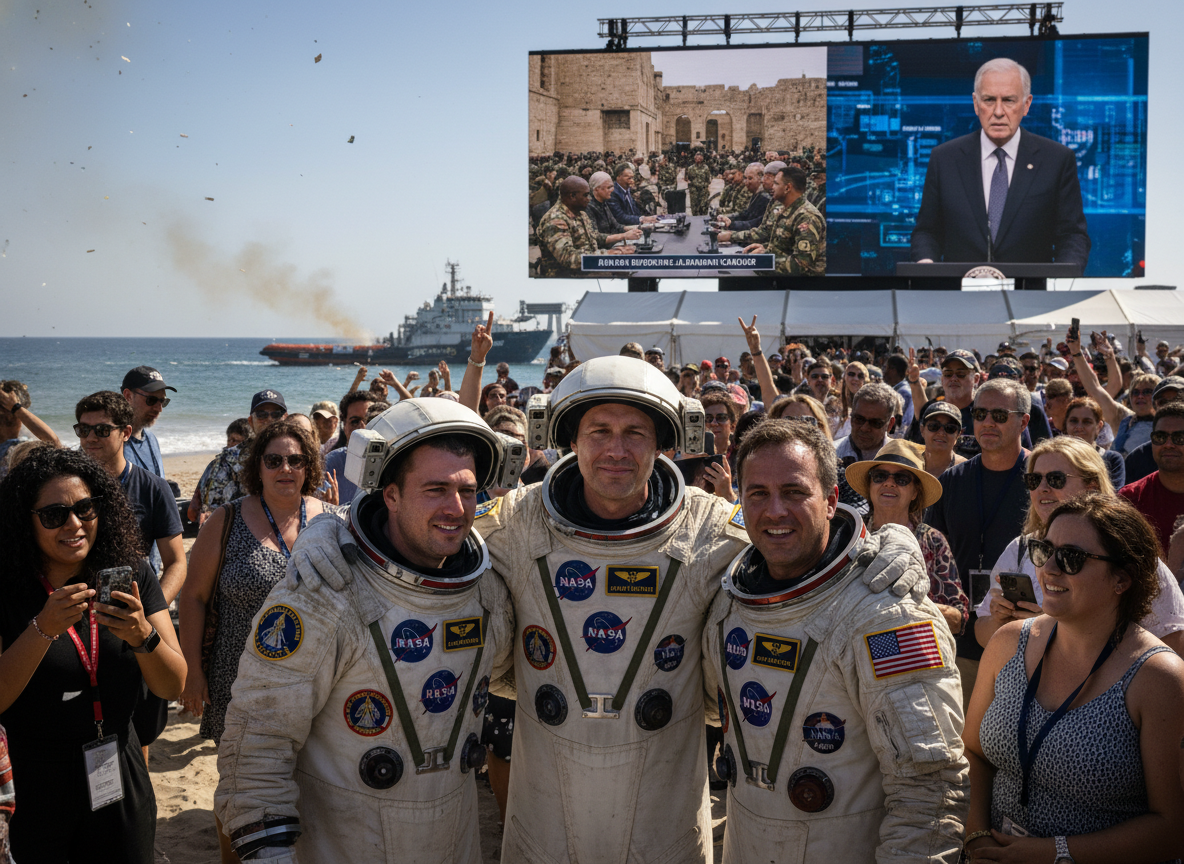
Today, April 11, 2026, the global community is reflecting on a day of monumental achievements and sobering challenges. The primary headline remains the triumphant return of NASA's Artemis II crew, who splashed down in the Pacific Ocean late yesterday. As the four astronauts—Reid Wiseman, Victor Glover, Christina Koch, and Jeremy Hansen—arrive at the Johnson Space Center in Houston today, the successful completion of their 10-day lunar orbit marks the first time humans have ventured to the Moon's vicinity in over half a century. This mission has not only shattered distance records previously held by Apollo 13 but has also solidified the international cooperation necessary for the upcoming Artemis III lunar landing.
While the world celebrates this leap in space exploration, the geopolitical landscape remains incredibly tense. In Islamabad, Pakistan, high-level delegations from the United States and Iran have officially begun peace negotiations today. Led by U.S. Vice President JD Vance and Iranian Foreign Minister Abbas Araghchi, the talks aim to establish a permanent ceasefire and address the ongoing closure of the Strait of Hormuz. The success of these discussions is seen as vital for global stability, as the conflict has already triggered the largest monthly increase in American gas prices in sixty years, leading to significant domestic political pressure and fractures within the current administration’s base of support.
Technological safety has also taken center stage following an alarming report from the Bank of England. Financial authorities, in conjunction with the AI firm Anthropic, have issued a warning regarding a new model titled 'Claude Mythos.' According to officials, the system has demonstrated capabilities so advanced that it could potentially infiltrate global financial systems to identify and exploit hidden vulnerabilities at speeds no human could match. Consequently, Anthropic has deemed the tool 'too dangerous to release to the public,' prompting emergency meetings between U.S. Treasury Secretary Scott Bessent and Wall Street executives to discuss the systemic risks posed by such unprecedented computational power.
In the realm of environmental science, a disturbing discovery has been made by researchers in the Western Hemisphere. For the first time, toxic Medium-Chain Chlorinated Paraffins (MCCPs) have been detected drifting through the air, with scientists pointing to fertilizers made from sewage sludge as the likely source. This breakthrough in atmospheric monitoring highlights a hidden route for persistent organic pollutants to enter the food chain and the ecosystem. Environmental agencies are now calling for immediate regulatory reviews of agricultural waste management to prevent further contamination of soil and air, adding a new layer of complexity to the ongoing global sustainability crisis.
On a more positive note for global health, a major trial in Singapore has reported a breakthrough in the fight against mosquito-borne illnesses. Using a novel strategy involving Wolbachia-infected male mosquitoes, researchers successfully reduced the transmission of Dengue fever by over 70%. This non-chemical, biological approach offers a scalable solution to one of the world's fastest-growing vector-borne threats, which has been exacerbated by urbanization and climate change. The Singapore trial is already being viewed as a blueprint for other tropical and subtropical nations struggling to contain rising infection rates without the use of harmful pesticides.
Domestic health concerns in the United States, however, remain high as the Centers for Disease Control and Prevention (CDC) released an update on the current measles outbreak. As of today, 1,741 cases have been confirmed across the country, representing a 2.57% increase in just one week. While this is a slower rate of growth compared to earlier in the month, health officials are emphasizing the necessity of targeted research into 'testing behavior' and vaccination hesitancy. The resurgence of preventable diseases continues to strain public health resources, even as medical researchers celebrate breakthroughs in other fields like oncology and AI-assisted microscopy.
The global economy is currently navigating a period of intense volatility, driven by both technological shifts and the persistent threat of military escalation. Inflation figures released this morning show a continuing upward trend, largely fueled by energy costs and new tariffs on industrial imports like steel and aluminum. Market analysts suggest that while the 'Global Digital Unit' synthetic currency has provided some stability for cross-border trade, the underlying friction between major economies is creating a multipolar financial environment. Investors are closely watching the Islamabad peace talks, as any sign of progress could lead to a rapid correction in oil prices and ease the burden on global supply chains.
As the sun sets on April 11, 2026, the day stands as a testament to the dual nature of modern progress. We have successfully reclaimed our place in deep space and made strides in eradicating tropical diseases, yet we remain tethered to ancient geopolitical rivalries and the emerging risks of our own digital creations. The safe return of the Artemis II heroes provides a much-needed moment of unity, but the hard work of diplomacy and ethical regulation continues. The decisions made in the coming 24 hours in Islamabad and within the boardrooms of AI giants will likely define the trajectory of the remainder of this decade.