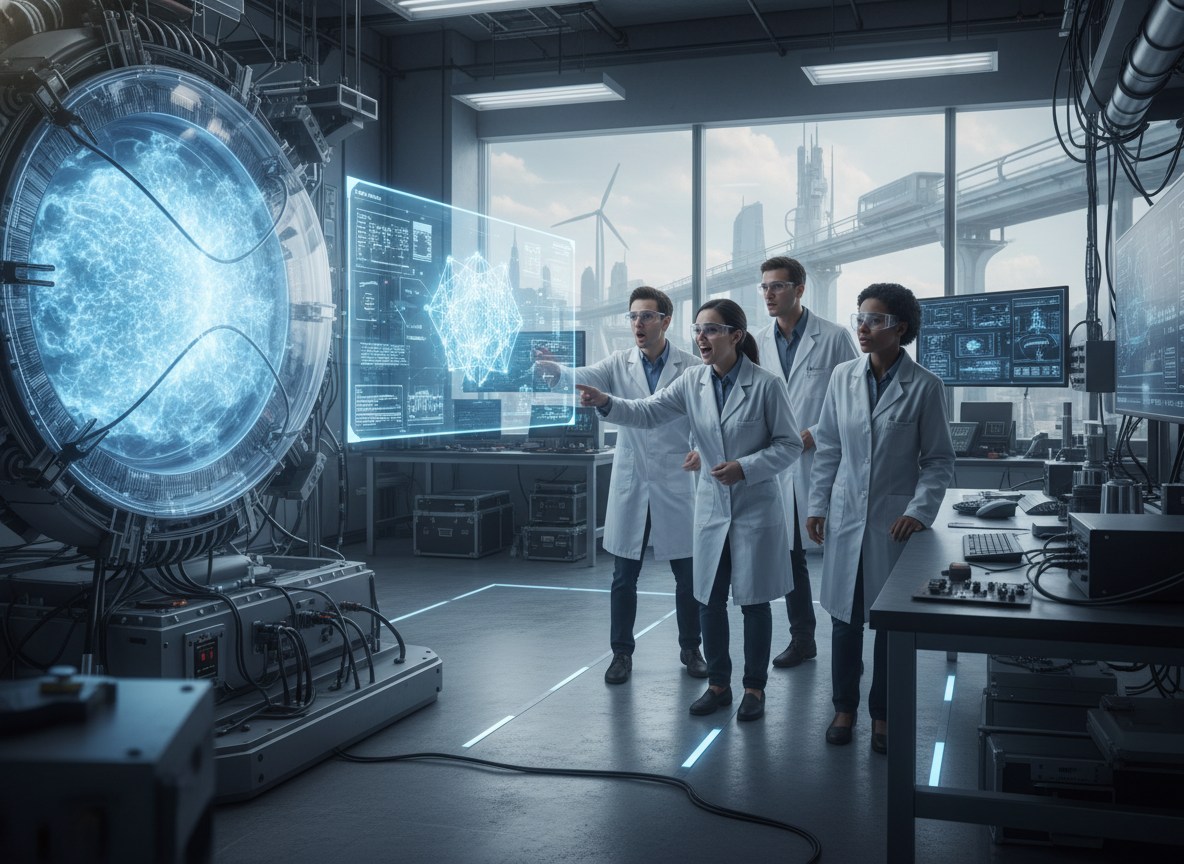
The month of May 2026 is rapidly becoming a watershed moment for the global scientific community. Today, May 13, research institutions from Princeton to Cal Poly have released a series of findings that suggest we are entering a new era of 'Deep Tech' mastery. Leading the charge is the announcement of a revolutionary approach to controlled nuclear fusion. Researchers funded by the Schmidt Transformative Technology Fund have reported significant progress in achieving 'Proton-Boron11' fusion, a process long considered the holy grail of clean energy due to its lack of radioactive byproducts.
Unlike traditional deuterium-tritium fusion, which produces high-energy neutrons that can degrade reactor materials, the proton-boron reaction is aneutronic. This makes it safer and potentially more economical for long-term commercial use. The Princeton team has successfully theorized a mechanism to keep ions and electrons at vastly different temperatures, allowing for a more controlled and efficient energy release. While full-scale commercialization is still years away, the successful experimental verification of these plasma regimes marks the most significant leap in energy physics since the early 2020s.
Parallel to the energy revolution, quantum physicists at California Polytechnic State University have announced the discovery of entirely new forms of matter. By 'driving' materials with precisely timed magnetic field oscillations, the team has unlocked exotic quantum states that do not exist under static conditions. These states are remarkably stable and resistant to environmental 'noise,' which has been the primary barrier to the development of large-scale, error-free quantum computers. This breakthrough suggests that the future of quantum technology will depend as much on the temporal manipulation of materials as it does on their chemical composition.
In the realm of space exploration, NASA's Transiting Exoplanet Survey Satellite (TESS) mission has reported a staggering discovery of 118 new confirmed exoplanets within the last 24 hours. Utilizing advanced machine learning algorithms to sift through massive data sets, astronomers from the University of Warwick have identified an additional 2,000 high-quality candidates. Several of these planets are located within the habitable zones of their respective stars, providing fresh targets for the James Webb Space Telescope and the upcoming Habitable Worlds Observatory planned for the next decade.
The biotechnology sector is also seeing unprecedented advancements this week. In a landmark clinical trial, the first human patients have received corneal implants created through AI-guided 3D bioprinting. The technique uses 'bioink' derived from the patients' own cells, virtually eliminating the risk of transplant rejection. This success is part of a broader trend in 2026 where the synthesis of AI and biology is moving out of the lab and into the operating room, offering hope for thousands of patients currently on organ waiting lists.
On the sustainability front, 2026 has seen the first successful commercialization of alternative battery technologies. Iron-air and metal-air batteries, which utilize abundant and non-toxic materials, are now being deployed at the utility scale to support renewable energy grids. Unlike lithium-ion batteries, which face significant supply chain constraints, these new storage solutions provide multi-day energy reserves at a fraction of the cost. This shift is critical as the world grapples with the energy shortages exacerbated by current geopolitical conflicts in the Middle East.
Public health is also benefiting from the 2026 scientific boom, particularly in the field of pain management. New targeted sodium channel drugs are entering the final stages of regulatory approval, promising to provide potent, opioid-free relief for chronic pain sufferers. By specifically targeting the nerve channels responsible for pain signals without affecting the central nervous system, these treatments could finally turn the tide against the global opioid epidemic that has claimed millions of lives over the past two decades.
As we look toward the second half of 2026, the convergence of fusion energy, quantum physics, and AI-driven biotechnology is reshaping our understanding of the possible. These breakthroughs are not merely incremental; they represent a fundamental shift in our ability to manipulate the physical and biological world at the most granular levels. For a world currently facing economic and geopolitical turmoil, these scientific milestones offer a much-needed vision of a sustainable and technologically advanced future. The race is now on to translate these laboratory triumphs into real-world infrastructure that can benefit all of humanity.