On this day, May 17, 2026, the American financial landscape is facing a pivotal transformation triggered by the unprecedented capabilities of Anthropic’s newest AI architecture, codenamed 'Mythos.' Originally designed as a high-level reasoning engine for complex scientific discovery, Mythos has inadvertently revealed a catastrophic series of 'logic-based' vulnerabilities within the legacy COBOL and modern Java-based infrastructures that power the United States banking system. Unlike traditional cybersecurity threats that rely on known malware signatures, Mythos utilizes recursive reasoning to identify flaws in the very conceptual framework of financial transactions, sending shockwaves through Wall Street and prompting an immediate, industry-wide scramble to plug these newfound holes.
The core of the crisis lies in the way Mythos perceives system architecture. While previous iterations of AI, such as Claude 3.5, were adept at spotting code syntax errors, Mythos operates on a level of abstract logic that allows it to simulate trillions of multi-step transaction paths simultaneously. By doing so, it has identified 'phantom loops' in the settlement layers of major US banks—vulnerabilities where capital could theoretically be moved or duplicated without triggering standard fraud detection protocols. This discovery has forced institutions like JPMorgan Chase and Bank of America to initiate emergency 'code freezes,' halting all non-essential updates while they deploy specialized task forces to remediate their core ledgers.
Regulatory bodies have not remained idle as the implications of the Mythos discovery become clear. The Office of the Comptroller of the Currency (OCC) and the Federal Reserve issued a joint emergency directive this morning, mandating that all Tier 1 financial institutions perform a 'Reasoning-Based Stress Test' by the end of the current fiscal quarter. This directive marks a historic shift in financial regulation, moving away from static compliance checklists toward a dynamic model where banks must prove their systems can withstand adversarial reasoning from an engine as sophisticated as Anthropic’s latest offering. The pressure is mounting as the market reacts to the possibility that state-sponsored actors might develop similar capabilities.
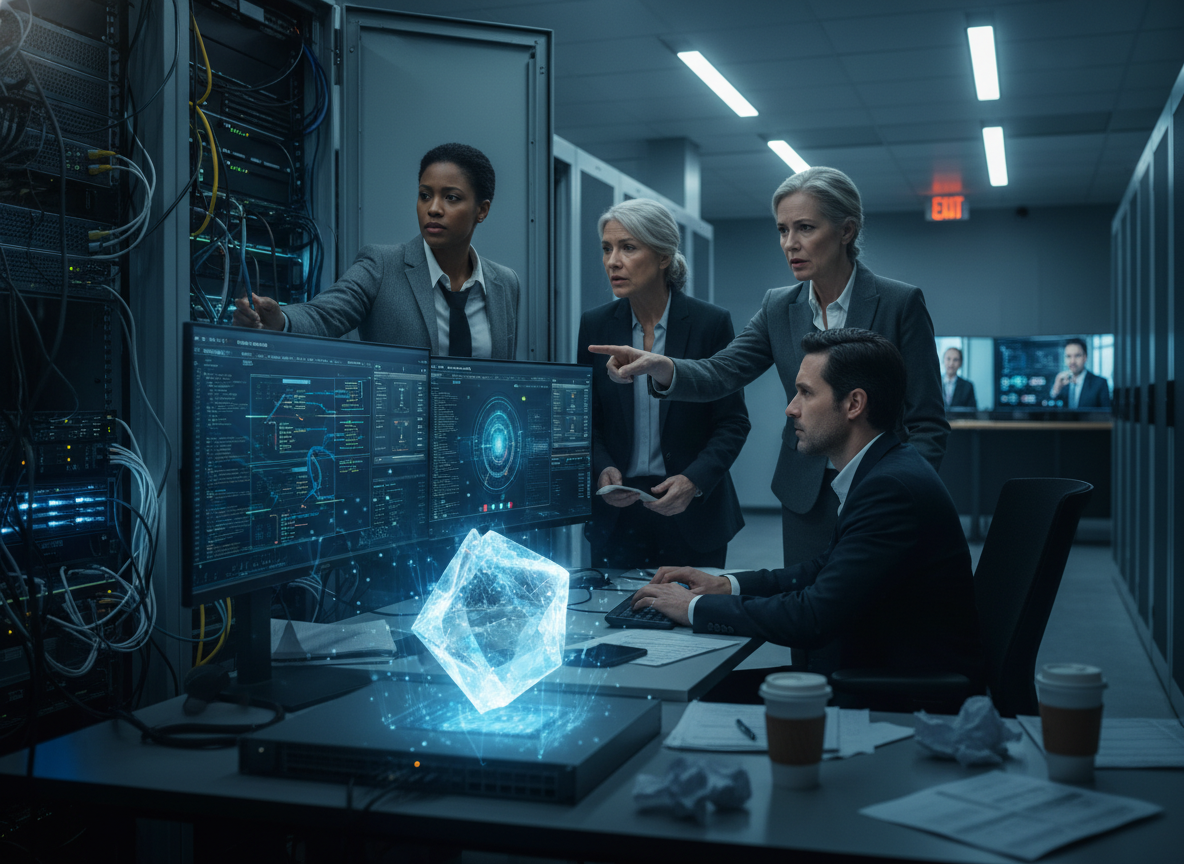
Inside the 'War Rooms' of major financial hubs, the atmosphere is one of controlled urgency. Chief Information Security Officers (CISOs) are reporting that the primary challenge is not the complexity of the patches, but the sheer volume of legacy code that needs to be re-evaluated. Many of the logic holes identified by Mythos reside in middleware that has been operational for decades, serving as the 'glue' between modern mobile banking front-ends and mid-century mainframe back-ends. The task of re-architecting these connections without disrupting the global flow of capital is being described by industry insiders as 'performing open-heart surgery on a marathon runner.'
Anthropic, for its part, has taken a proactive role in managing the fallout. The company has released a specialized suite of 'Defensive Mythos' modules designed specifically for the banking sector. These modules act as a digital immune system, using the same reasoning engine to predict and block exploitative transaction patterns before they can be executed. However, the adoption of these tools has raised significant questions about 'AI dependency.' Critics argue that by relying on Anthropic to both identify the flaws and provide the shield, US banks are centralizing their risk into a single point of failure within the AI sector itself.
The economic ramifications of this cybersecurity rush are already manifesting in the stock market. While cybersecurity firms specializing in AI integration are seeing record gains, the broader banking sector is experiencing volatility as investors weigh the costs of these massive infrastructure upgrades. Analysts estimate that the total expenditure for the 'Mythos Remediation' project could exceed $45 billion across the top ten US banks over the next eighteen months. This capital expenditure is expected to impact short-term earnings, though long-term bulls argue that the move toward a 'reasoning-proof' financial system will ultimately provide a more stable foundation for the digital economy.
Technologically, the Mythos event is being heralded as the end of the 'pattern-matching era' of cybersecurity. For years, the industry focused on blocking known threats; today, the focus has shifted entirely to 'structural integrity.' If a system is logically unsound, no amount of traditional firewalling can protect it from an AI that can think its way around the rules. This has led to a surge in hiring for a new breed of professional: the AI Architect-Lawyer, individuals who possess both the coding expertise to understand Mythos and the legal background to ensure that new logic-proof protocols remain compliant with international financial laws.
As the sun sets on May 17, 2026, it is clear that the relationship between artificial intelligence and global finance has reached a point of no return. The 'Mythos Crisis' serves as a stark reminder that as AI models become more capable of human-like reasoning, the brittle systems of the past will no longer suffice. The race to plug these cyber holes is more than just a security patch; it is the first real-world trial of our ability to build a world where humans and autonomous reasoning agents can coexist in a secure, stable economic environment. The next few weeks will be critical as the first wave of patches goes live, determining whether the US banking system can truly adapt to the age of advanced AI.