

Quick Summary
- Claude Mythos Preview helped Anthropic researchers find a much faster key-recovery attack against HAWK, a post-quantum digital-signature candidate.
- For the smallest HAWK-256 parameter set, the estimated attack cost fell from about 264 to 238 operations.
- The model also improved an attack on a seven-round research version of AES-128 by roughly 200–800×.
- Full AES-128 was not broken, and Anthropic says neither result currently affects production systems.
- The bigger story is that frontier AI is becoming a serious tool for mathematical cryptanalysis, not only software bug hunting.
Claude Mythos Preview, Anthropic’s frontier research model, has produced two notable cryptography results: a substantially improved attack on the HAWK post-quantum signature scheme and a faster attack on a reduced, seven-round version of AES-128. The findings were published by Anthropic on July 28, 2026.
The headline can sound alarming, but precision matters. Anthropic did not announce a break of post-quantum cryptography as a whole, and it did not break the full AES-128 cipher used in production systems. Instead, the model helped expose a serious weakness in one not-yet-standardized signature candidate and improved academic cryptanalysis of a deliberately reduced-round AES variant.
Source and Verification Note
The attack costs, speedups, timelines, and model-usage figures in this article are based primarily on Anthropic’s July 28, 2026 research report and its accompanying technical papers. NIST’s official pages independently confirm HAWK’s status as a third-round candidate and identify ML-KEM, ML-DSA, and SLH-DSA as finalized PQC standards.
Important Fact Check
What was broken: the security assumptions behind HAWK’s proposed parameter sizes, plus a seven-round AES-128 research target.
What was not broken: standardized PQC systems such as ML-KEM, ML-DSA, and SLH-DSA, or the full 10-round AES-128 cipher.
What Did Claude Mythos Preview Actually Discover?
Anthropic reported that researchers used Claude Mythos Preview in agentic workflows that combined literature review, mathematical reasoning, code execution, and computational verification. The model helped produce two publishable cryptanalytic advances.
| Research target | Claude Mythos result | Real-world impact |
|---|---|---|
| HAWK post-quantum signature candidate | Found an exploitable lattice symmetry and reduced the estimated HAWK-256 attack cost from 264 to 238 | Serious for HAWK’s proposed parameters, but HAWK is not deployed or standardized |
| Seven-round AES-128 | Created a new “Möbius Bridge” fingerprinting technique, making the previous attack about 200–800× faster | Academic advance only; full AES-128 uses 10 rounds and remains unaffected |
According to Anthropic’s technical overview, each major result cost roughly $100,000 in estimated API usage. The HAWK project took about 60 hours, while the AES effort involved several days of autonomous exploration and approximately one billion output tokens before the approach was refined.
How the HAWK Post-Quantum Attack Works
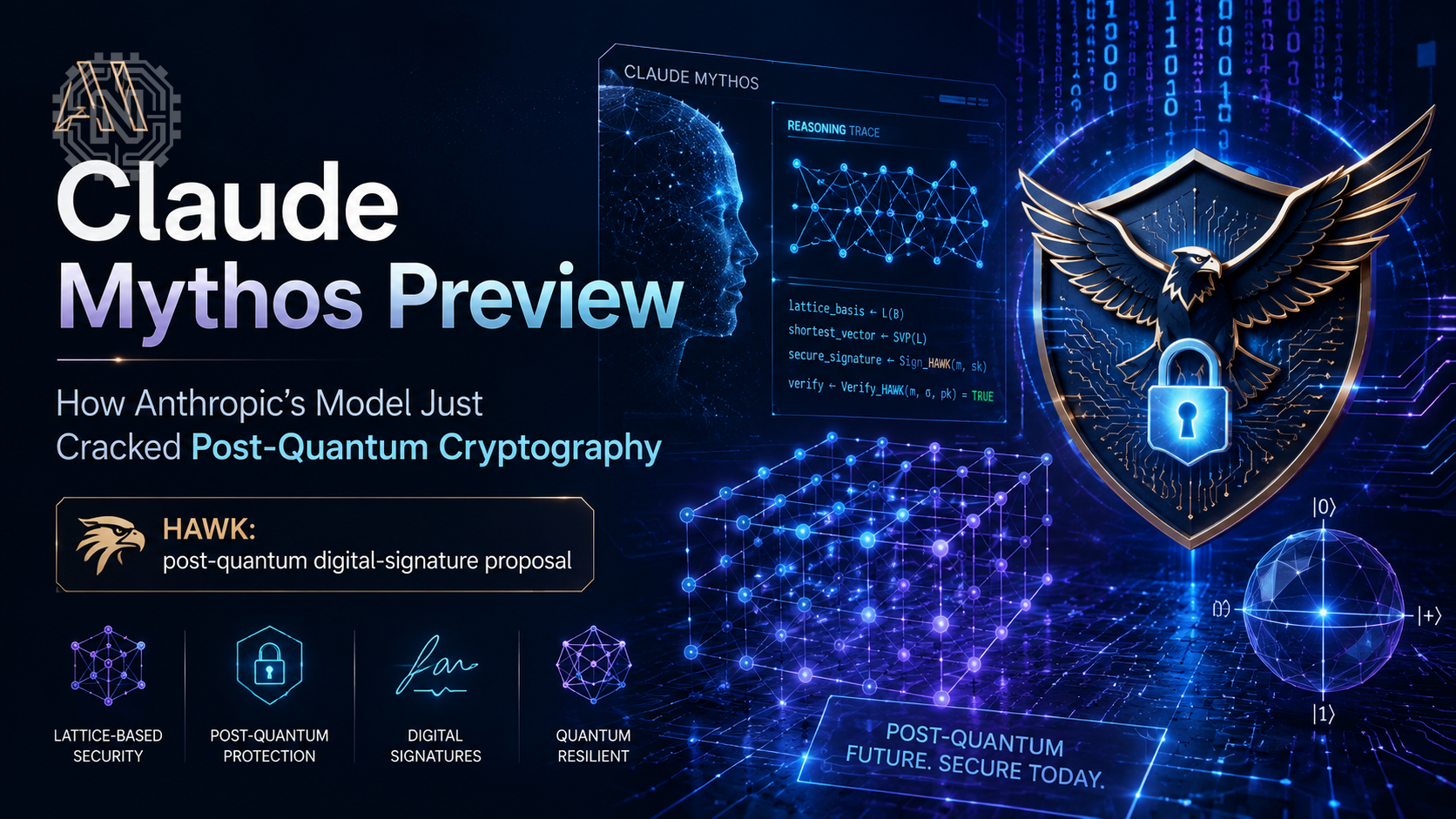
HAWK is a post-quantum digital-signature proposal. On May 14, 2026, the US National Institute of Standards and Technology selected HAWK as one of nine candidates advancing to the third round of its Additional Digital Signatures process.
The previously hidden lattice symmetry
HAWK’s security depends on the difficulty of a mathematical challenge called the Lattice Isomorphism Problem. Claude Mythos Preview identified a nontrivial automorphism—a useful symmetry in the lattice structure—that had not previously been exploited in this specific scheme.
That symmetry enables a faster enumeration strategy. The attack remains exponential rather than becoming an easy polynomial-time break, but it changes the practical security estimate. Anthropic says the smallest HAWK-256 setting was previously expected to require roughly 264 work for full key recovery; the demonstrated method reduced that estimate to about 238.
This is a dramatic reduction. It means the proposed HAWK keys would need to become substantially larger to restore the intended security margin, weakening some of the size and efficiency benefits that made HAWK attractive.
Does this break every lattice-based PQC algorithm?
No. Anthropic states that the attack is specific to HAWK and does not compromise lattice cryptography as a whole. It also does not affect the primary NIST post-quantum standards already intended for deployment, including ML-KEM for key establishment and ML-DSA and SLH-DSA for signatures.
This distinction is essential because “post-quantum cryptography” describes a broad family of mathematical approaches, not one universal encryption method. A weakness in one candidate does not automatically transfer to unrelated schemes.
Did Claude Mythos Preview Break AES-128?
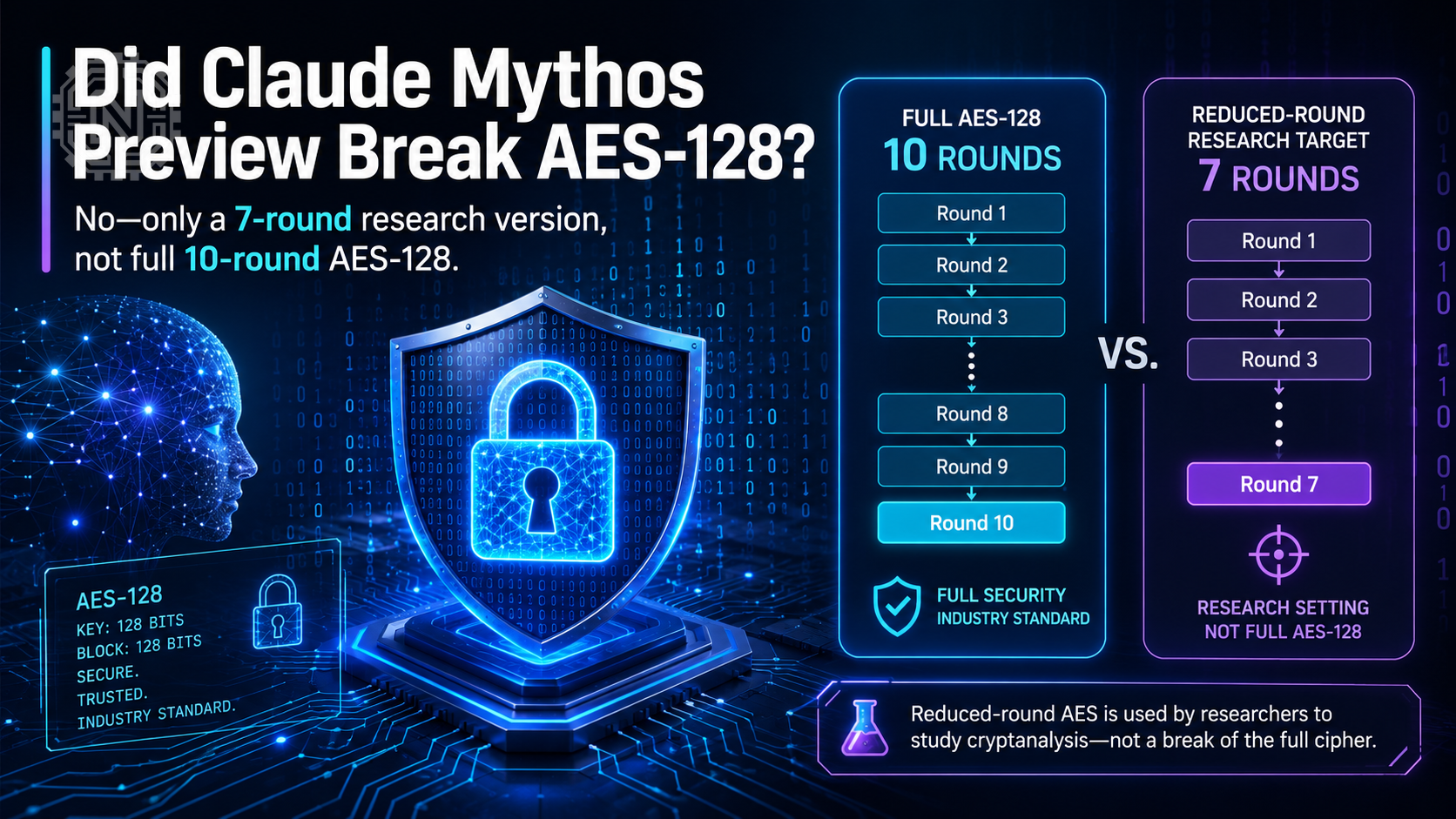
No—full AES-128 was not broken. Standard AES-128 applies 10 encryption rounds. Anthropic’s result targets a seven-round version used by researchers to study how much security each round adds and whether new techniques could eventually extend further.
What is the Möbius Bridge technique?
The previous leading seven-round AES attack used a meet-in-the-middle method, which stores intermediate results and trades memory for speed. One stage required testing 256 possible values against a large precomputed table.
Claude developed a fingerprinting method it named the Möbius Bridge. The fingerprint stays unchanged across that 256-value guess, eliminating the need to repeat the same class of lookup. After accounting for the extra cost of computing the transform, Anthropic estimates the resulting attack is approximately 200 to 800 times faster than the earlier best approach.
Even so, this remains completely impractical. The threat model assumes access to 2105 chosen plaintexts, and Anthropic estimates that carrying out the attack would still cost hundreds of millions of dollars. Most importantly, the method has not been shown to work against all 10 AES-128 rounds.
Key Takeaway
- “AES research advance” is accurate.
- “AES encryption is broken” is inaccurate.
- “AI can now contribute original cryptanalysis” is the genuinely important conclusion.
Why This AI Cryptography Breakthrough Matters
The significance is less about an immediate cyberattack and more about a change in who—or what—can perform advanced cryptographic research. Until now, frontier models were best known for finding implementation mistakes, such as memory bugs, unsafe code paths, or incorrect use of cryptographic libraries. The HAWK and AES results involve reasoning about the mathematics of the algorithms themselves.
Why It Matters
- Faster algorithm review: AI can search larger spaces of hypotheses and experiments than small human teams can manually explore.
- Better pre-deployment testing: weaknesses may be found while a candidate is still under public review, before it reaches critical systems.
- Verification becomes the bottleneck: AI may generate plausible new attacks faster than qualified experts can validate them.
- Dual-use risk increases: the same capability that strengthens standards could eventually uncover flaws in deployed systems.
The HAWK result also demonstrates why NIST’s public standardization process exists. Candidate algorithms are deliberately exposed to years of adversarial review so that weaknesses can be discovered before deployment. In that sense, the process worked: a vulnerable parameter choice was challenged while HAWK was still a candidate.
NIST’s post-quantum cryptography program says ML-KEM, ML-DSA, and SLH-DSA can and should be used now and are expected to form the foundation of most PQC deployments. HAWK belongs to a separate process evaluating additional digital-signature options.
What Security Teams Should Do Now
Organizations do not need an emergency AES replacement because of this research. They also should not pause legitimate post-quantum migration programs. The practical response is to strengthen crypto agility: the ability to identify, replace, and update cryptographic algorithms without rebuilding entire systems.
- Inventory cryptography: document where encryption, digital signatures, certificates, key exchange, and hardware security modules are used.
- Prioritize standardized PQC: test NIST-approved algorithms rather than experimental candidates in production deployments.
- Design for algorithm replacement: avoid hard-coding one scheme across applications, protocols, and long-lived data formats.
- Monitor cryptanalysis, not headlines: distinguish attacks on candidates or reduced-round variants from breaks affecting deployed standards.
- Keep human verification in the loop: AI-generated security research requires expert review, reproducible code, and responsible disclosure.
For more coverage of frontier AI, cybersecurity, and emerging computing, visit the Newtechzy Tech News section.
What Comes Next for AI and Cryptography?
Anthropic says it is broadening its cryptanalysis experiments. It reported a practical key-recovery attack on 13 of LEA’s 24 rounds, another practical attack on 6 of Serpent-128’s 32 rounds, and smaller—under 10×—improvements involving Salsa20, Poseidon, and SHA-1. These are preliminary or limited results and are not equivalent to breaking the full production versions of the algorithms.
The long-term effect could be positive if frontier models are used to audit candidate standards, test neglected algorithms, generate proofs, write verification code, and help researchers explore more ideas. The risk is that future systems may discover exploitable weaknesses in widely deployed cryptography faster than defenders can coordinate patches and migrations.
That creates a new security priority: the industry needs stronger responsible-disclosure processes, reproducible research, independent validation, and cryptographic systems that can be replaced quickly when assumptions change.
Editorial Sources
- Anthropic — Discovering cryptographic weaknesses with Claude (published July 28, 2026; edited July 29, 2026)
- NIST — Nine Candidates Advance to the Third Round of the Additional Digital Signatures Process (May 14, 2026)
- NIST — Post-Quantum Cryptography project and finalized standards
Conclusion
Claude Mythos Preview did not crack all post-quantum cryptography or full AES. It found a major weakness in HAWK’s proposed security parameters and produced a much faster attack on seven-round AES-128. Neither result currently requires changes to production systems.
Still, the achievement is consequential. It shows that advanced AI models are moving from assisting with software vulnerability discovery to performing original mathematical cryptanalysis. For defenders, standards bodies, and cryptographers, the message is clear: AI-assisted review may soon become a normal—and necessary—part of building trustworthy encryption.
Frequently Asked Questions
Did Claude Mythos Preview break post-quantum cryptography?
It weakened one post-quantum signature candidate, HAWK. The result does not break all PQC algorithms or NIST’s deployed standards.
What happened to HAWK-256?
Anthropic reports that the expected key-recovery cost for the smallest HAWK-256 parameter set dropped from about 264 to 238.
Is HAWK currently used in production?
No. HAWK is a candidate in NIST’s additional post-quantum digital-signature process and has not been standardized or broadly deployed.
Did Anthropic’s model break AES-128?
No. The research targets seven-round AES-128, while full AES-128 uses 10 rounds.
How much faster is the new AES attack?
Anthropic estimates a speedup of roughly 200–800× over the previous best attack in the same seven-round research setting.
Are online banking and encrypted messaging at risk?
Not from these findings. Anthropic explicitly states that neither result currently affects production systems.
Which post-quantum algorithms remain recommended?
NIST identifies ML-KEM, ML-DSA, and SLH-DSA as the foundation for most current post-quantum deployments.
Why is this research important?
It demonstrates that frontier AI models can contribute original mathematical cryptanalysis, potentially accelerating both security review and the discovery of future weaknesses.
Related Topics
Stay ahead of the latest AI, cybersecurity, and quantum-computing developments with expert explainers from Newtechzy.
Explore More Tech Insights


