

Quick Summary
- The Delhi High Court declined to grant ANI an interim injunction against OpenAI on July 24, 2026.
- Justice Amit Bansal treated the use of ANI material for large-language-model training as covered by the fair-dealing provision in Section 52(1)(a) at this stage.
- The court also found that the tested ChatGPT responses produced through retrieval-augmented generation were not sufficiently similar to ANI’s original reports.
- The order is a major early win for OpenAI, but it is not a final dismissal of the entire lawsuit.
- The ruling could influence future debates over AI training data, news licensing and copyright law in India.
In one of India’s most closely watched technology lawsuits, the Delhi High Court ruled in OpenAI’s favor at the interim stage of a copyright dispute filed by news agency Asian News International, better known as ANI. The court refused to stop OpenAI from using ANI’s published material in connection with ChatGPT while the wider case continues.
The July 24, 2026 order is important because the OpenAI ANI copyright case is India’s first major courtroom test of whether a generative-AI company can lawfully use publicly available news content to train a large language model. The decision gives OpenAI a significant legal advantage, but its scope should not be overstated: the court was deciding ANI’s request for temporary relief, not finally resolving every copyright, licensing, jurisdiction and attribution question in the suit.
⚠️ Important Legal Context
This article reports an interim ruling. A court’s findings at the injunction stage can be revisited during a final trial or on appeal. The order should not be read as blanket permission for every AI company to copy every kind of protected content.
What Did the Delhi High Court Decide?
Justice Amit Bansal declined ANI’s application for an interim injunction against OpenAI. According to reports on the order, the court concluded that storing and using ANI’s news material to train a large language model did not amount to copyright infringement at this stage because the activity fell within the fair-dealing protection under Section 52(1)(a) of the Copyright Act, 1957.
The court also rejected ANI’s request to restrain ChatGPT from using its content. It reasoned that granting such a broad injunction could cause harm to the public interest. This part of the decision matters because interim injunctions require courts to weigh not only the claimant’s rights, but also the balance of convenience and the risk of irreparable harm.
| Issue | Court’s Interim View |
|---|---|
| Use of ANI news for model training | Treated as fair dealing under Section 52(1)(a) at the interim stage. |
| Copyright infringement under Section 51 | The reported training use did not amount to infringement for purposes of the injunction request. |
| ChatGPT responses generated with RAG | The tested outputs were not sufficiently similar to ANI’s original reports. |
| ANI’s requested injunction | Declined. |
| Status of the overall lawsuit | Still broader than the interim application; the order is not a final disposal of every claim. |
The practical headline is that OpenAI won the injunction battle, not necessarily every remaining legal question in the lawsuit.
Newtechzy Analysis
How Did the ANI–OpenAI Case Begin?
ANI filed the lawsuit in 2024, alleging that OpenAI used its copyrighted news reports without permission to train and operate ChatGPT. The agency argued that public availability does not eliminate copyright protection and that a commercial AI developer cannot automatically reproduce or process protected expression without a licence.
ANI also raised concerns about false attribution and fabricated outputs, claiming that ChatGPT had produced material that appeared to attribute non-existent reports or interviews to the news agency. That allegation goes beyond the narrow question of training data and touches on reputation, accuracy and potential user confusion.
OpenAI denied infringement and argued that copyright protects original expression rather than facts themselves. It also maintained that its models do not function as searchable databases storing complete articles for routine reproduction. During the early proceedings, OpenAI told the court that ANI’s domain had been blocklisted from future training in October 2024.
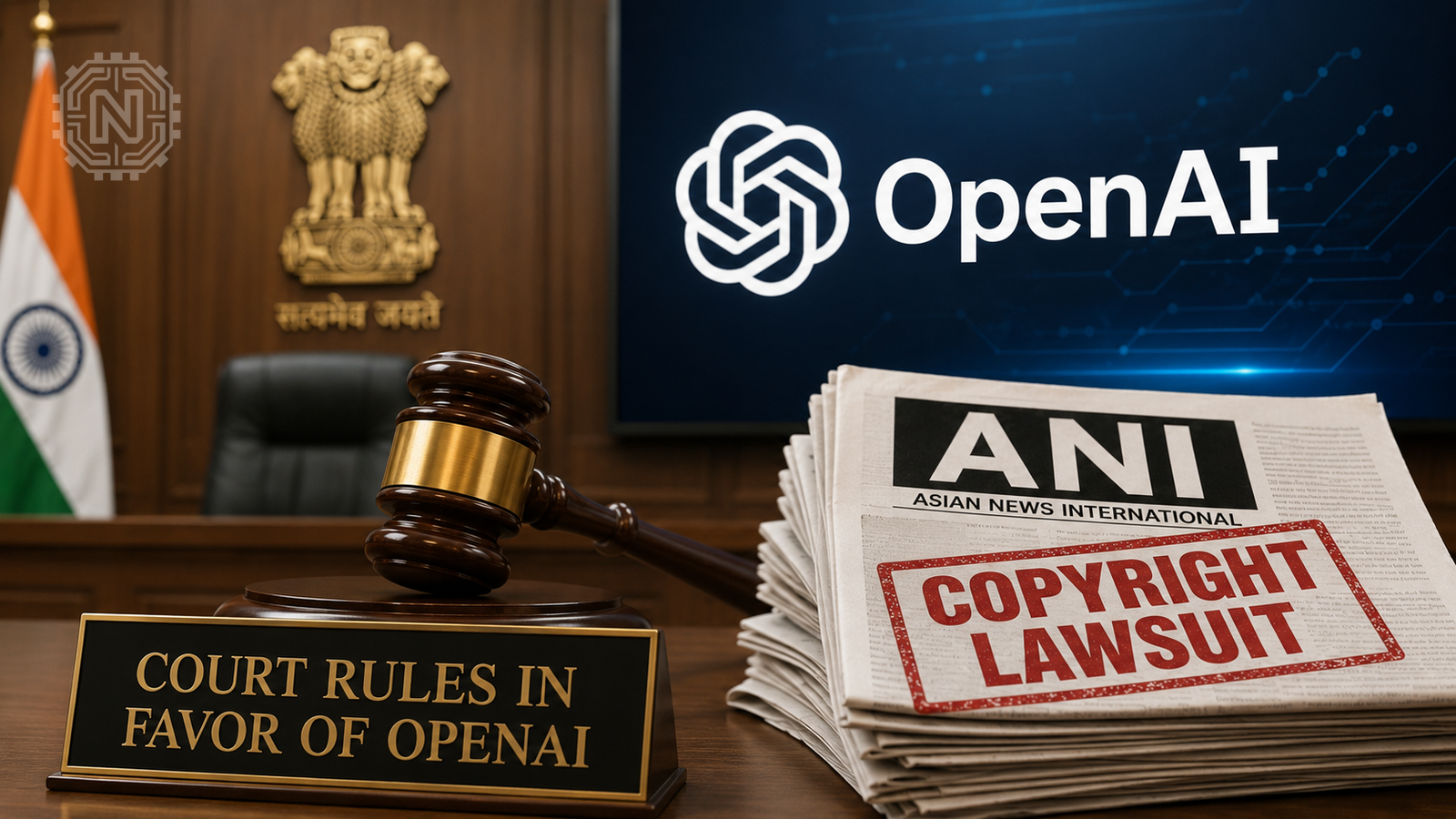
AI-generated illustration representing the conflict between AI training, news publishing and Indian copyright law.
Because the dispute raised novel legal and technical questions, the Delhi High Court appointed two amici curiae—an intellectual-property lawyer and an academic—to assist it. The case later attracted intervention from publishing and media groups concerned about the effect of generative AI on journalism, licensing revenue and control over digital archives.
Why Section 52 Fair Dealing Mattered
The centre of the ruling is Section 52 of India’s Copyright Act, which lists acts that do not constitute copyright infringement. India’s framework is generally described as “fair dealing,” a more specifically framed set of exceptions than the broad, open-ended fair-use analysis associated with United States law.
For the injunction request, the court reportedly accepted that using news content in the training process could fall within Section 52(1)(a). That is a major development because India does not have a simple, AI-specific statutory rule saying that text-and-data mining for commercial model training is always lawful or always infringing.
💡 Why It Matters
- It is an early Indian judicial view directly connecting LLM training with the fair-dealing framework.
- It may strengthen arguments from AI developers that training is analytical or transformative rather than a substitute for the original work.
- Publishers can still distinguish future cases involving paywalled content, contract restrictions, verbatim reproduction or outputs that compete directly with the source.
The decision does not necessarily mean that every act of web scraping is lawful. Copyright disputes often turn on specific evidence: what was copied, how much was used, whether the protected expression can be reconstructed, whether the output substitutes for the original and what safeguards the developer applied.
What the Court Said About RAG Outputs
The order also addressed responses generated using retrieval-augmented generation, or RAG. RAG systems retrieve relevant information from an external source and use it to help produce a response. This differs from a model relying only on patterns learned during its original training.
The court reportedly found that the ChatGPT responses tested in the case were not similar enough to ANI’s original reports to establish copyright infringement at the interim stage. That distinction is important: retrieving facts from an article is not automatically the same as reproducing the article’s protected wording, structure or expressive choices.
For publishers, however, the output question remains highly fact-sensitive. A short factual summary may present a different legal risk from a response that reproduces several paragraphs, preserves a distinctive sequence of expression or gives users a substitute for reading the source.
📌 Key Distinction
Facts are generally not protected in the same way as original expression. A news organisation may own copyright in the wording, arrangement, photographs or other creative elements of a report, while the underlying event or fact remains available for others to describe independently.
ANI and OpenAI’s Main Arguments
What ANI Argued
- OpenAI used ANI’s protected news content without a licence or payment.
- Making an article publicly accessible does not waive copyright.
- Model training can require copying and storage that falls within the copyright owner’s exclusive rights.
- ChatGPT’s alleged false attribution of fabricated material could damage ANI’s reputation and credibility.
- OpenAI’s commercial partnerships with some publishers show that news content can have licensable value.
What OpenAI Argued
- Copyright does not give a news publisher a monopoly over facts.
- Training does not necessarily mean the model stores articles in a form that users can retrieve verbatim.
- The use of publicly available information is protected by fair-dealing or related legal principles.
- Outputs must be compared with the original work before infringement can be established.
- Publishers that do not want future crawling can use technical controls or request blocklisting.
The court’s interim decision largely favoured OpenAI’s position on training and the tested RAG outputs. It does not erase ANI’s broader concerns, particularly where future evidence might show substantial reproduction, memorisation, misleading attribution or use of protected subscription material.
Why This Ruling Matters for AI and Publishers
The Delhi High Court AI copyright ruling could become highly influential even though it arises from an interim application. Indian courts, technology companies, publishers and policymakers now have a concrete judicial analysis to debate when deciding how copyright law applies to generative AI.
AI-generated editorial illustration of the wider impact of the ANI–OpenAI dispute on technology companies and news publishers.
Impact on AI Companies
AI developers may view the decision as support for the argument that model training can be legally distinct from publishing or selling copies of the source material. It could reduce immediate injunction risk in similar Indian disputes, especially where outputs are demonstrably different from the original content.
However, responsible AI companies still have reasons to maintain opt-out tools, copyright complaint systems, output safeguards, source attribution and licensing partnerships. A favourable interim decision is not a substitute for compliance planning.
Impact on News Publishers
Publishers may accelerate efforts to control crawler access, update website terms, document ownership chains and negotiate licensing agreements. They may also focus future litigation on evidence of verbatim output, market substitution, paywall circumvention or false attribution rather than relying only on the fact that content entered a training pipeline.
Impact on Indian AI Policy
The ruling arrives while India continues to debate whether AI developers should compensate copyright owners for training use. Courts apply the law to individual disputes, while lawmakers and policymakers can create broader licensing or remuneration systems. The ANI case may therefore influence both litigation strategy and future regulation.
✅ Practical Takeaways
- AI companies: Keep records of data sources, filtering, opt-outs and output testing.
- Publishers: Use technical access controls and preserve evidence of copying or substitutive outputs.
- Businesses using RAG: Test whether answers reproduce protected wording and provide appropriate citations.
- Readers: Treat generated summaries as secondary tools, not guaranteed substitutes for original reporting.
Why This Is Not the Final End of the Case
Some headlines may describe the decision as an OpenAI victory, which is accurate in relation to ANI’s request for immediate injunctive relief. But the legal status is more precise: the court issued an interim order in I.A. 45300/2024 within CS(COMM) 1028/2024.
That means the court assessed whether ANI had shown enough at this stage to justify temporary restrictions before final adjudication. The parties may still contest evidence, legal interpretation and remaining claims. The decision may also be challenged before a higher bench.
For that reason, businesses should not treat the order as a universal rule that all AI training on copyrighted material is permitted in India. Its strongest immediate value is as a carefully watched precedent on how one judge approached fair dealing, model training, RAG outputs and public interest at the injunction stage.
What Happens Next?
The wider ANI–OpenAI litigation can continue through further case management, evidence and legal argument unless the parties settle or an appellate decision changes the course of the dispute. ANI may examine appeal options, while other publishers and industry groups will study the detailed reasoning for use in their own policies and cases.
The most important next development will be how courts apply this reasoning to different facts. Future disputes may involve books, music, photographs, paywalled databases, code or highly reproducible outputs. Each category raises separate questions about originality, licensing markets, substantial similarity, technical copying and available exceptions.
For India’s technology sector, the ruling provides short-term clarity but not the final word. The balance between AI innovation and creator compensation will continue to be shaped by courts, contracts, platform design and public policy.
Conclusion
The Delhi High Court’s July 24, 2026 order is a significant win for OpenAI in the ANI copyright lawsuit. By declining an interim injunction and treating the challenged training use as fair dealing at this stage, the court gave India its clearest early judicial signal on generative AI and copyrighted news content.
At the same time, the decision is narrower than a final declaration that all AI training is lawful. The continuing importance of output similarity, attribution, access controls, licensing and the specific type of content means the legal landscape remains open. For publishers and AI developers alike, the case is a turning point—but not the last chapter.
Frequently Asked Questions
Did OpenAI completely win the ANI copyright lawsuit?
OpenAI won the interim-injunction stage reported on July 24, 2026. The court declined ANI’s request for immediate restrictions, but the order should not be described as a final resolution of every claim in the wider suit.
What did the Delhi High Court say about ChatGPT training?
The court reportedly treated OpenAI’s use of ANI news material for large-language-model training as falling within Section 52(1)(a)’s fair-dealing protection at the interim stage.
What is Section 52 of the Copyright Act?
Section 52 of India’s Copyright Act, 1957 lists specified acts that do not constitute copyright infringement, including certain fair-dealing uses.
What is RAG in artificial intelligence?
Retrieval-augmented generation is a method in which an AI system retrieves information from external sources and uses it to produce a response.
Did the court say all web scraping is legal?
No. The reported order concerns specific facts and an interim application. Other cases may differ based on the content, access method, amount copied, contractual restrictions and similarity of outputs.
Why did ANI sue OpenAI?
ANI alleged that OpenAI used its copyrighted news content without permission for ChatGPT training and operation, and it also raised concerns about fabricated material being falsely attributed to the agency.
Why is the ANI–OpenAI case important?
It is India’s first major court dispute directly addressing generative-AI training, copyrighted news content, fair dealing and AI-generated outputs.
Where can readers find more Tech News?
Explore more updates in the Newtechzy Tech News section. You can also review our Privacy Policy, Cookie Policy and About page.
Sources and Further Reading
Related Topics
Follow the Latest AI and Tech Law Updates
Stay informed about artificial intelligence, copyright, digital policy and major technology cases shaping the future.
Get in Touch


