


Quick Summary
- Boris Cherny, creator and head of Anthropic’s Claude Code, says users often limit modern AI models by prescribing every implementation step.
- The better approach is to define the desired outcome, set firm guardrails, provide relevant context and let the agent choose much of the execution path.
- Anthropic’s guidance still supports prompt engineering, but places success criteria and empirical evaluation before prompt optimization.
- For coding agents, reliable verification—tests, builds, screenshots, logs and security checks—matters more than clever prompt wording alone.
- Developers remain responsible for product decisions, architecture, risk, review and deciding when an AI-generated change is safe to ship.
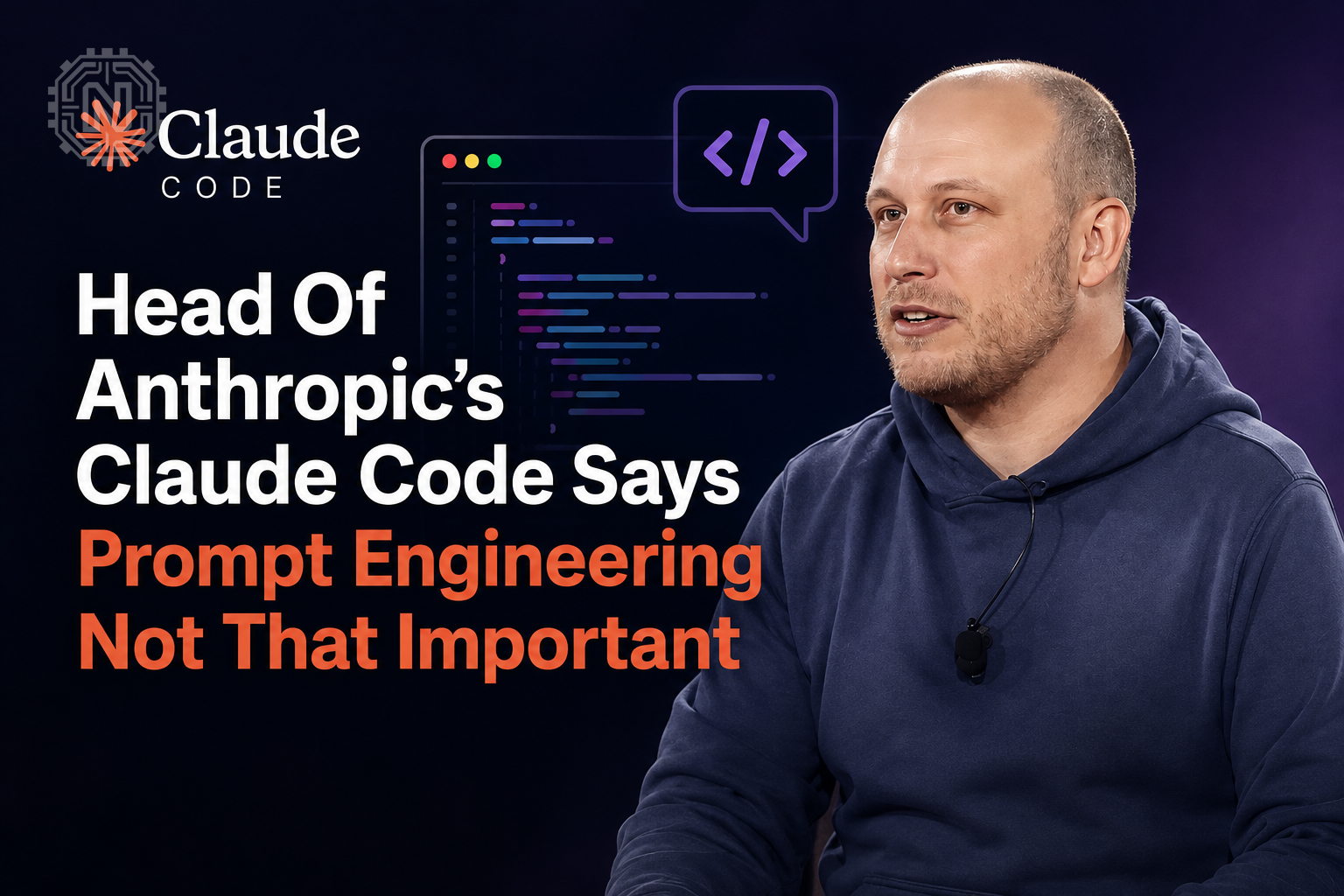
Claude Code prompt engineering may be entering a new phase. Boris Cherny, the creator and head of Anthropic’s Claude Code, recently argued that users often get worse results by telling advanced AI models exactly how to complete every step. His advice is not to abandon instructions, but to stop treating a modern coding agent like a fragile autocomplete system.
During a recent Y Combinator Startup School conversation, Cherny said many people still use prompting habits developed for older models: long numbered procedures, tightly controlled implementation paths and repeated reminders about how to reason. With stronger models, that approach can prevent the agent from choosing a faster or more reliable solution.
The more useful strategy is outcome-first delegation. Explain what should be built, identify the boundaries that cannot be crossed, provide the codebase and business context that affect the decision, and define how the result will be checked. Then allow the model to handle more of the execution.
Why This Matters
AI coding is moving from one-answer chat toward longer agentic workflows. As the agent takes more actions, the quality of the environment, tests and approval controls becomes more important than finding a “perfect” sentence.
What Boris Cherny Said About Prompt Engineering
Cherny’s core point is that users should be specific about the result without unnecessarily dictating the route. Reporting from the Y Combinator discussion says he recommended describing the task, setting guardrails and defining what successful completion looks like before letting the model work more independently.
“For modern models, that’s actually really not the way to do it.”
Boris Cherny, discussing rigid step-by-step prompting
This is an important distinction. “Use fewer instructions” does not mean “be vague.” A weak request such as “improve this app” leaves too many product and technical decisions undefined. A strong outcome-focused request explains the user problem, expected behavior, constraints and proof of completion—without forcing an implementation sequence that may be wrong.
Why Micromanaging an AI Coding Agent Can Backfire
Overly prescriptive prompts can lock an agent into assumptions that have not been tested against the actual repository. The user may specify a library that conflicts with the current stack, demand a database change when the problem belongs in application logic, or force a file-by-file sequence that ignores an existing abstraction.
Micromanagement also increases prompt length without guaranteeing correctness. More words can introduce contradictory requirements, bury the real goal or cause the model to optimize for following the procedure instead of solving the problem.
A modern coding agent is most useful when it can inspect the relevant files, form a plan, run tools, observe failures and revise its work. The human should retain control over product intent and risk, while the agent gets enough freedom to select implementation details within clear boundaries.
| Micromanaged Prompt | Outcome-Focused Prompt |
|---|---|
| Lists every file and coding step before the repository is inspected. | Defines the feature, affected user flow and non-negotiable constraints. |
| Forces one technical approach even if the project uses another pattern. | Asks the agent to follow existing architecture and explain major choices. |
| Measures quality by whether the response sounds confident. | Measures quality using tests, builds, screenshots, logs and review. |
| Adds more instructions after every failure. | Improves context, tooling, acceptance criteria and feedback loops. |
| Treats the model as a line-by-line code generator. | Treats the model as an agent operating inside controlled boundaries. |
Why Verification Matters More Than Prompt Tricks
A prompt can influence behavior, but it cannot prove that the result works. Verification connects the agent’s output to observable evidence. Anthropic’s current Claude Code best-practice documentation explicitly recommends giving Claude a way to verify its work and asking it to show evidence rather than merely claiming success.
Useful verification methods include:
- Unit, integration and end-to-end tests.
- Type checking, linting, formatting and production builds.
- Browser automation and screenshot comparison for user interfaces.
- API response checks, database reconciliation and expected totals.
- Performance benchmarks and regression thresholds.
- Dependency audits, secret scanning and security tests.
- A human review of the plan, code diff, migrations and deployment impact.
This creates a repeatable loop: attempt the task, run the check, inspect the failure, revise the implementation and run the check again. A better initial prompt may reduce the number of attempts, but a reliable feedback loop helps every attempt move toward the target.
Key Takeaway
Spend less time searching for secret prompt phrases and more time making success measurable. The agent should be able to demonstrate what changed and why the result meets the acceptance criteria.
Is Prompt Engineering Dead?
No. The more accurate conclusion is that prompt engineering is becoming part of a larger system. Anthropic’s prompt-engineering overview begins with three prerequisites: clear success criteria, a method for empirical testing and a draft prompt to improve. That order matters because prompt optimization cannot rescue an unclear goal or an environment with no reliable evaluation.
Prompting remains valuable when it communicates information the model cannot infer, including:
- Outcome: what should be true when the work is complete.
- Context: relevant files, users, business rules and existing patterns.
- Constraints: security rules, supported platforms, budgets and prohibited changes.
- Verification: commands, tests, screenshots or checks that prove completion.
- Deliverables: code, documentation, migration notes, tests and a concise summary.
What is fading is the belief that longer prompts are automatically better. Clear communication still matters; unnecessary control does not.
A Better Claude Code Workflow
1. Define the user-visible outcome
Start with the problem and the expected behavior. Explain who benefits, which flow changes and what must remain unchanged. This prevents the agent from optimizing a technical detail while missing the actual product goal.
2. Let Claude explore before coding
For multi-file or unfamiliar tasks, ask Claude Code to inspect the relevant area and summarize the current architecture before making edits. Anthropic’s documentation recommends an explore-plan-implement sequence when the scope or approach is uncertain.
3. Provide high-value context
Reference the issue, design, API contract, related component and repository conventions. Avoid adding unrelated documents. Good context is not the largest possible context window; it is the smallest set of information that changes the correct decision.
4. State guardrails and permissions
Identify files that must not change, dependencies that cannot be added, data that must remain private, compatibility requirements and actions that require approval. Agent autonomy should operate inside explicit limits.
5. Make completion testable
Provide the exact checks the agent should run. Ask it to fix failures where safe and report unresolved problems instead of hiding them. For visual work, include a reference screenshot or browser test. For financial or data work, include reconciliation rules and expected outputs.
6. Review evidence, not confidence
Inspect the diff, test output, screenshots, dependency changes and migration plan. A persuasive explanation is useful, but it is not a substitute for evidence.
Claude Code Prompt Example: An Outcome-First Template
A useful Claude Code prompt does not need dozens of clever phrases. It needs a clear destination, the context that changes technical decisions, firm boundaries and objective evidence that the work is complete. The following example shows how those elements can fit into one concise repository task.
Outcome-first Claude Code prompt
Task
Add passwordless email sign-in to the existing Next.js application.

Outcome
A returning user can request a secure sign-in link, open it and reach the current dashboard without breaking the existing session flow.

Context
- Reuse the current user model, email service and authentication utilities.
- Follow the repository's existing naming, validation and error-handling patterns.
- Inspect the relevant files before selecting an implementation.

Guardrails
- Do not change public API response shapes.
- Do not add a new authentication provider or database.
- Never log authentication tokens or personal data.
- Require approval before changing environment variables or running a migration.

Verification
- Add or update unit and integration tests.
- Run type checking, linting, tests and the production build.
- Confirm that expired, reused and invalid links are rejected.
- Summarize changed files, commands run, results and remaining risks.
This structure gives the agent room to inspect the codebase and choose implementation details, while the outcome, guardrails and checks remain controlled by the developer. It is more reliable than either an underspecified one-line request or a long procedure built on assumptions the repository may not support.
What Anthropic’s Usage Research Found
In a typical Claude Code session, people made about 70% of planning decisions, while Claude made about 80% of execution decisions. The pattern supports a division of labor in which humans decide what should be built and the agent handles much of how it is built.
What This Means for Developers and AI Teams
More capable agents do not eliminate engineering expertise. They move expertise toward problem definition, system understanding, architecture, evaluation and risk management. Anthropic’s research found that users displaying greater task-specific expertise gave more precise direction, requested better verification and recovered from failures more successfully.
For individual developers, the highest-value skills increasingly include reading unfamiliar systems, identifying hidden constraints, writing meaningful tests, reviewing generated code and deciding when automation should stop.
For engineering leaders, the lesson is to invest in the environment around the model:
- Reliable test suites and reproducible development environments.
- Clear product specifications and acceptance criteria.
- Current repository instructions and architecture documentation.
- Least-privilege tool access and approval checkpoints.
- Evaluation datasets for repeated AI-assisted workflows.
- Monitoring for cost, quality, security and regression risk.
This broader discipline is often described as context engineering, harness engineering or loop engineering. The names differ, but the principle is the same: model performance depends on the complete system surrounding the prompt.
NewTechzy readers following Anthropic can also review our report on the Claude security-test incidents involving three companies. It shows why agent capability must be paired with containment, permissions and monitoring. For broader coverage, explore the Artificial Intelligence and Tech News sections.
Risks, Limits and When Detailed Instructions Still Help
Cherny’s advice works best when a capable model has access to relevant context and safe verification tools. It should not be interpreted as permission to grant unrestricted production access or remove human review.
Detailed instructions remain important when:
- The task involves legal, privacy, safety or compliance requirements.
- The output must follow a strict schema, protocol or brand standard.
- The model does not have access to essential business context.
- A mistake could cause financial loss, data exposure or downtime.
- The task is subjective and cannot be evaluated automatically.
- External actions, credentials or production changes require approval.
Open-ended agent loops can also increase token use, tool calls and infrastructure cost. Teams should define budgets, stopping conditions, retry limits and escalation rules. The goal is deliberate delegation—not unlimited autonomy.
Balanced View
Less implementation micromanagement can unlock better reasoning, but less governance can create serious quality and security problems. Give the agent freedom over reversible execution details while keeping humans accountable for intent and risk.
Conclusion
Boris Cherny’s comments capture a broader shift in AI-assisted software development. As coding agents become more capable, the advantage is moving away from elaborate prompt rituals and toward clear outcomes, relevant context, strong guardrails, automated verification and informed human review.
Prompt engineering is not disappearing. It is becoming one layer in a more mature workflow. The key question for Claude Code users is no longer only “How should I phrase this?” It is also “What evidence will prove that the agent completed the right task safely?”
Frequently Asked Questions
Who is Boris Cherny?
Boris Cherny is the creator and head of Claude Code at Anthropic. Claude Code is Anthropic’s agentic coding tool for working with repositories, running commands and completing software tasks.
Did Boris Cherny say prompts do not matter?
Not exactly. His argument is that rigid, step-by-step micromanagement can limit modern models. Clear outcomes, guardrails, context and success criteria still matter.
Is prompt engineering dead in 2026?
No. Prompt engineering remains useful, but it increasingly works alongside context engineering, tools, evaluations, automated feedback loops and human review.
What is the best way to prompt Claude Code?
Define the desired result, point to relevant context, state non-negotiable constraints and specify the tests or evidence that prove the work is complete.
What does verification mean in Claude Code?
Verification means checking the output with evidence such as passing tests, a successful build, expected API responses, screenshots, benchmark results or a reviewed code diff.
Should Claude Code work without human review?
High-impact changes should not ship without human review. Teams should control permissions, review code and migrations, verify security and define approval points for production actions.
What is context engineering?
Context engineering is the practice of giving an AI agent the right files, tools, rules, memory and feedback signals so it can complete a task reliably.
Editorial Sources
Related Topics
Follow the Next Shift in AI Development
Read verified NewTechzy coverage of Claude, AI coding agents, developer tools and the technologies changing how software is built.
Explore More AI News


