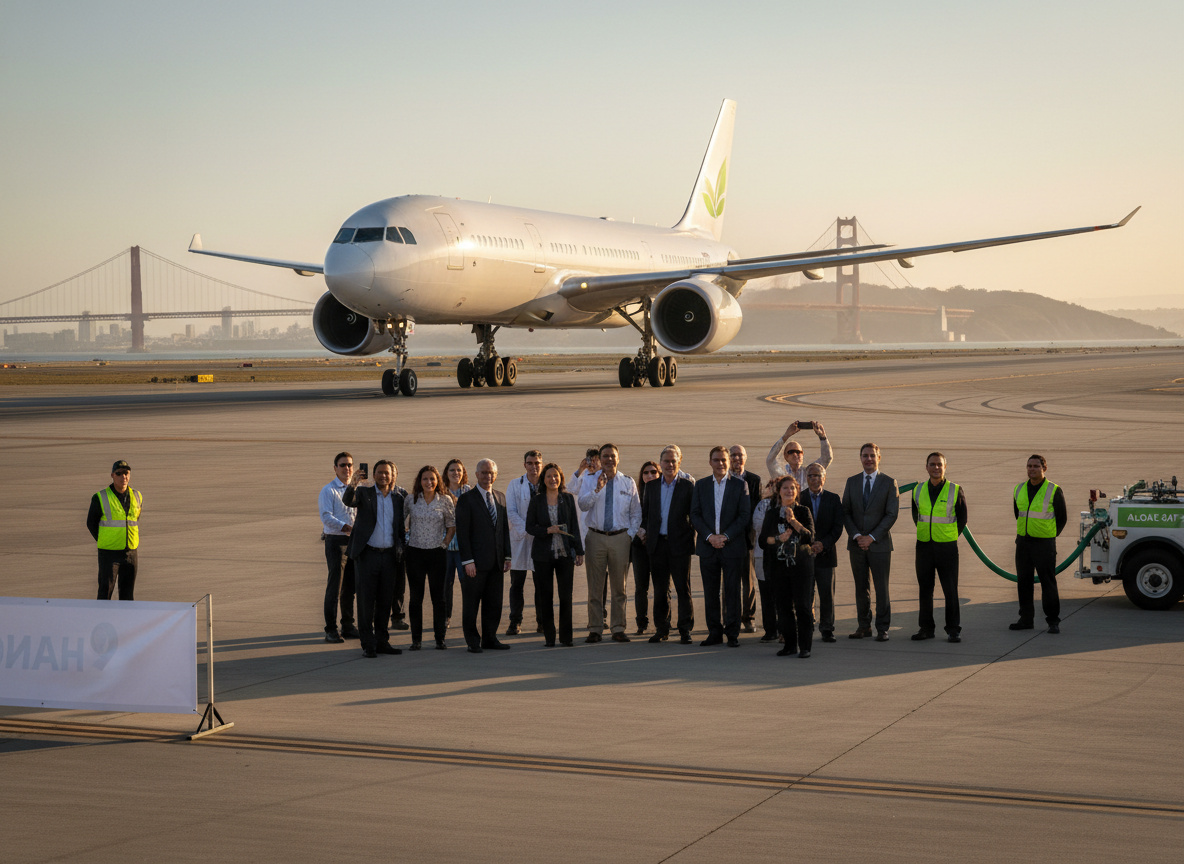
The aviation world is celebrating a monumental achievement today, April 11, 2026, as Global Green Airways Flight 72 landed at San Francisco International Airport after a ten-hour journey from Tokyo. What makes this flight historic is its fuel source: 100 percent carbon-neutral, algae-derived Sustainable Aviation Fuel (SAF). This marks the first time a commercial wide-body aircraft has completed a trans-oceanic crossing without a single drop of traditional petroleum-based kerosene, proving that the 'net-zero by 2050' goal is not just a dream but a rapidly approaching reality.
The fuel, developed by a consortium of biotech firms and aerospace engineers, utilizes third-generation biofuel technology. Unlike first-generation biofuels that relied on food crops like corn or soy, this algae-based propellant is grown in saltwater tanks on non-arable land. This ensures that the production of jet fuel does not compete with global food supplies or contribute to deforestation. The environmental footprint of this flight is estimated to be 85 percent lower than traditional flights, considering the carbon captured by the algae during its growth phase.
Technological hurdles that previously plagued SAF, such as the 'aromatic' requirements for engine seal integrity, have been solved through advanced synthetic chemistry. The engines used in today's flight were standard-issue models with zero modifications, demonstrating that the industry is ready for a 'drop-in' transition. This scalability is crucial for airlines that cannot afford to replace entire fleets but are under immense pressure from both regulators and eco-conscious travelers to reduce their carbon emissions immediately.
Passenger sentiment is also shifting rapidly in 2026. Data from the flight showed that travelers are increasingly willing to pay a 'Green Premium' for carbon-neutral journeys. This morning's flight was sold out months in advance, with passengers receiving a digital certificate and a blockchain-verified carbon offset report as part of their ticket. The transparency provided by these digital tools is building a new level of trust between airlines and the public, moving past the 'greenwashing' accusations that characterized the early 2020s.
Governmental support has played a pivotal role in reaching this milestone. New subsidies for algae cultivation facilities in coastal regions have driven the cost of SAF down to near-parity with conventional fuels for the first time this quarter. The European Union and the United States have also synchronized their 'Green Skies' mandates, requiring all departing international flights to utilize at least 20 percent SAF blend starting next year, with today's flight serving as the ultimate proof of concept for the feasibility of 100 percent usage.
The logistical infrastructure for SAF is also seeing a massive overhaul. Major airports are now installing dedicated 'Green Hydrants' that feed directly into the aircraft refueling systems. This infrastructure project, which reached its 50th airport milestone today, ensures that the supply chain for sustainable fuels is as robust as the old oil pipelines. The success of the Tokyo-San Francisco route is expected to trigger a wave of similar announcements from other major carriers looking to secure their share of the algae-fuel market.
Furthermore, the byproduct of this algae fuel production is being repurposed into high-protein animal feed and organic fertilizers, creating a circular economy that benefits the agricultural sector. This holistic approach to sustainability is a key feature of the 2026 economic landscape, where industries no longer operate in silos but as part of an integrated ecological system. The flight today wasn't just about moving people across an ocean; it was about demonstrating a new way of interacting with our planet's resources.
As the sun sets over the San Francisco Bay today, the aviation industry looks toward a bright, clean future. The success of Flight 72 is a beacon of hope for travelers who love to explore the world but are deeply concerned about their environmental impact. We are witnessing the birth of a new era in flight, where the sky is no longer a limit to our sustainability goals, but the stage upon which we prove our commitment to the Earth.