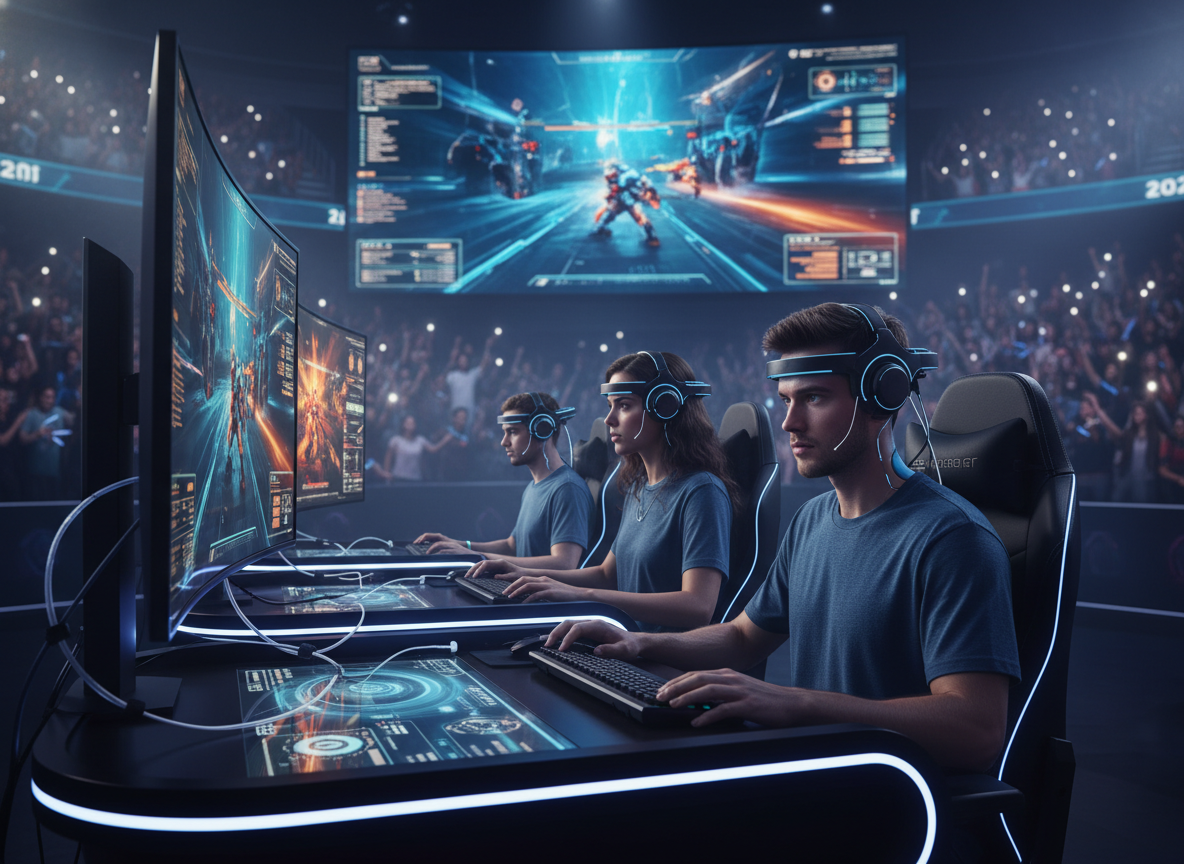
Today, April 10, 2026, marks the opening ceremony of the Global eSports Federation (GEF) World Finals, but the focus isn't just on the players—it's on the hardware. For the first time in competitive history, the 'Link-S1' Brain-Computer Interface (BCI) headset has been sanctioned for professional use. This device allows players to execute commands via neural impulses rather than physical button presses, effectively reducing input latency to near-zero. This technological leap is being hailed as the most significant evolution in competitive gaming since the transition from dial-up to fiber optics.
The 'Link-S1' works by using high-density EEG sensors to detect motor cortex activity. When a player thinks about moving their character or firing a weapon, the headset translates those electrical signals into game commands in less than 2 milliseconds. In a world where professional matches are won or lost in frames, this advantage is insurmountable. Pro-gamers who have spent the last six months training with BCI technology are reporting a 'flow state' that is far deeper and more intuitive than anything achievable with a traditional mouse and keyboard.
However, the introduction of BCI has not been without controversy. Regulatory bodies are currently debating the ethics of 'neural-tuning'—the practice of using low-level electrical stimulation to enhance a player's focus or reaction time. The GEF has strictly banned any form of active brain stimulation, implementing rigorous pre-match 'neural-scans' to ensure a level playing field. Critics argue that this creates a new digital divide, where those who can afford the latest BCI hardware and specialized cognitive coaching have an unfair advantage over those who cannot.
From a spectator's perspective, BCI technology is revolutionizing the viewing experience. Broadcasts now include 'Biometric Overlays,' showing the real-time heart rate, adrenaline levels, and even the cognitive load of the players. Seeing a player's mental stress spike during a 1v5 clutch situation adds a layer of psychological drama that was previously invisible. It allows fans to understand the sheer mental fortitude required to compete at the highest level, transforming eSports into a true test of both mind and machine.
The physical benefits of BCI are also a major talking point. Long-term gaming often leads to repetitive strain injuries (RSI) and carpal tunnel syndrome, which have cut many professional careers short. By removing the need for rapid physical movements, BCI allows players to compete without the physical toll on their hands and wrists. This could potentially extend the career lifespan of eSports athletes by decades, allowing the 'old guard' to remain competitive well into their 40s as long as their cognitive faculties remain sharp.
Game developers are already reacting to this trend by designing 'Neuro-Native' titles. These games feature mechanics that are impossible to execute with physical controllers, such as multitasking three different units simultaneously with separate neural channels. We are seeing the birth of a new genre of 'Cognitive Strategy' games where the complexity of the input is limited only by the player's ability to partition their focus. This is forcing a complete rewrite of game design theory, moving away from dexterity and toward pure mental processing speed.
Safety and long-term health remain the primary concerns for the general public. While the 'Link-S1' is non-invasive and uses passive sensors, the psychological impact of prolonged neural immersion is still being studied. Experts like Dr. Sarah Jenkins have warned about 'Input-Lag Dysphoria,' a condition where players feel a disconnect from their physical bodies after hours of zero-latency neural gaming. Manufacturers are responding by building in mandatory 'reality-checks' and cooldown periods to ensure user safety and mental well-being.
As we look at the results from the first day of the GEF World Finals, it's clear that there is no going back. The precision and speed displayed by BCI-equipped players are unlike anything we've seen in the history of the medium. The year 2026 will be remembered as the moment the controller became obsolete for the elite tier of gaming. Whether this technology will eventually trickle down to the casual market remains to be seen, but for now, the neural revolution is officially here, and it's changing everything we know about competition.