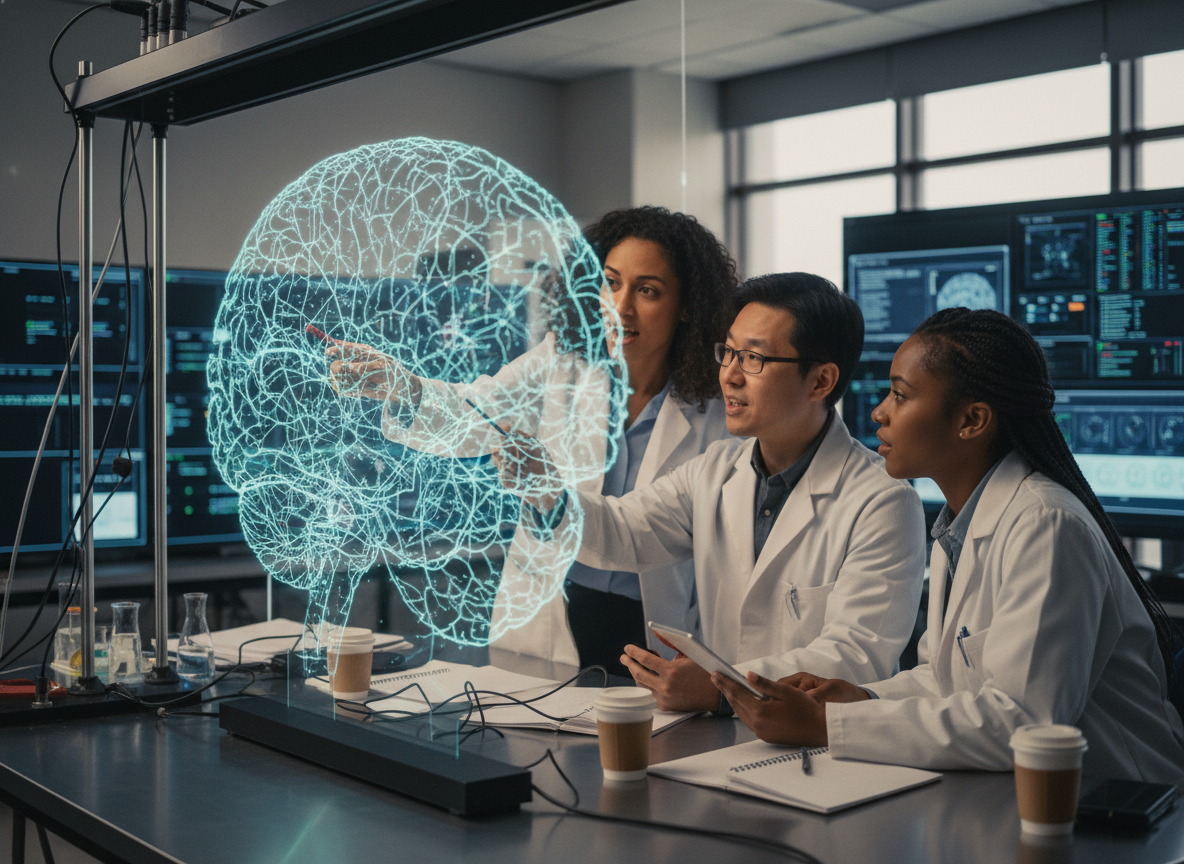
In a landmark achievement for human knowledge, an international consortium of scientists announced today, April 10, 2026, the completion of the first high-resolution synaptic map of an adult brain. This massive undertaking, known as the 'Global Connectome Project,' has successfully charted over 50 million connections between more than 139,000 neurons, providing an unprecedented look at the complex architecture of thought. The achievement is being hailed as the 'Human Genome Project' of the 21st century, promising to revolutionize our understanding of every aspect of the human experience.
The technical breakthrough that made this possible was the development of a revolutionary RNA barcoding technique that allows researchers to sequence neural connections as if they were lines of code. Previous mapping efforts were limited by the sheer physical complexity of tracing individual synapses through dense brain tissue, a process that would have taken decades using traditional microscopy. By labeling each neuron with a unique genetic sequence, the team was able to use automated sequencing technology to map thousands of connections simultaneously with single-synapse precision.
The implications for the treatment of neurological diseases are profound, as researchers can now pinpoint exactly where and how connections are disrupted in conditions like Alzheimer's, Parkinson's, and schizophrenia. Early data from the map has already revealed surprising new connections between the regions of the brain responsible for memory and those that regulate emotional response. These findings suggest that many neurodegenerative diseases may actually begin as subtle connectivity failures long before physical symptoms appear, opening the door to earlier and more effective interventions.
Beyond medical applications, the complete brain map is providing critical insights for the development of next-generation artificial intelligence. By studying the biological efficiency of the brain's neural networks, engineers are designing AI architectures that require significantly less power while maintaining higher processing capabilities. This biomimetic approach to computing is expected to lead to the first truly 'neuromorphic' processors, which mimic the brain's ability to learn and adapt in real-time without the need for massive data sets.
The project also touches on the deep philosophical questions of human consciousness and identity, as we can now visualize the physical structures that underpin our personalities and memories. Some ethicists are already raising concerns about the potential for this data to be misused, such as in the development of intrusive neural monitoring or the commercialization of cognitive profiles. There is an active global debate regarding the ownership of 'neuro-data' and the need for strict international regulations to protect the privacy of the human mind.
Funding for this breakthrough came from a unique partnership between government research agencies, private technology firms, and philanthropic organizations. This multi-sector approach ensured that the project had access to both the cutting-edge computing power of the tech world and the rigorous peer-review standards of academia. The open-source nature of much of the data means that scientists around the world can now begin their own specialized studies using this map as a foundational resource.
As the scientific community celebrates this milestone, the next phase of the project is already beginning: mapping the 'dynamic' connectome, or how these connections change over time through learning and experience. This will require even more advanced technology capable of monitoring neural activity in living subjects with microscopic detail. While the current map is a static snapshot, it provides the essential framework for understanding the brain as a living, evolving system that is constantly rewriting its own blueprint.
The discovery announced on this Friday in April 2026 will likely be remembered as the moment we finally gained the tools to understand ourselves from the inside out. For the millions of people living with neurological disorders, it represents a new beacon of hope for a future without cognitive decline. For the rest of humanity, it is a humbling reminder of the infinite complexity contained within each of us, and a testament to what we can achieve through global cooperation and scientific curiosity.