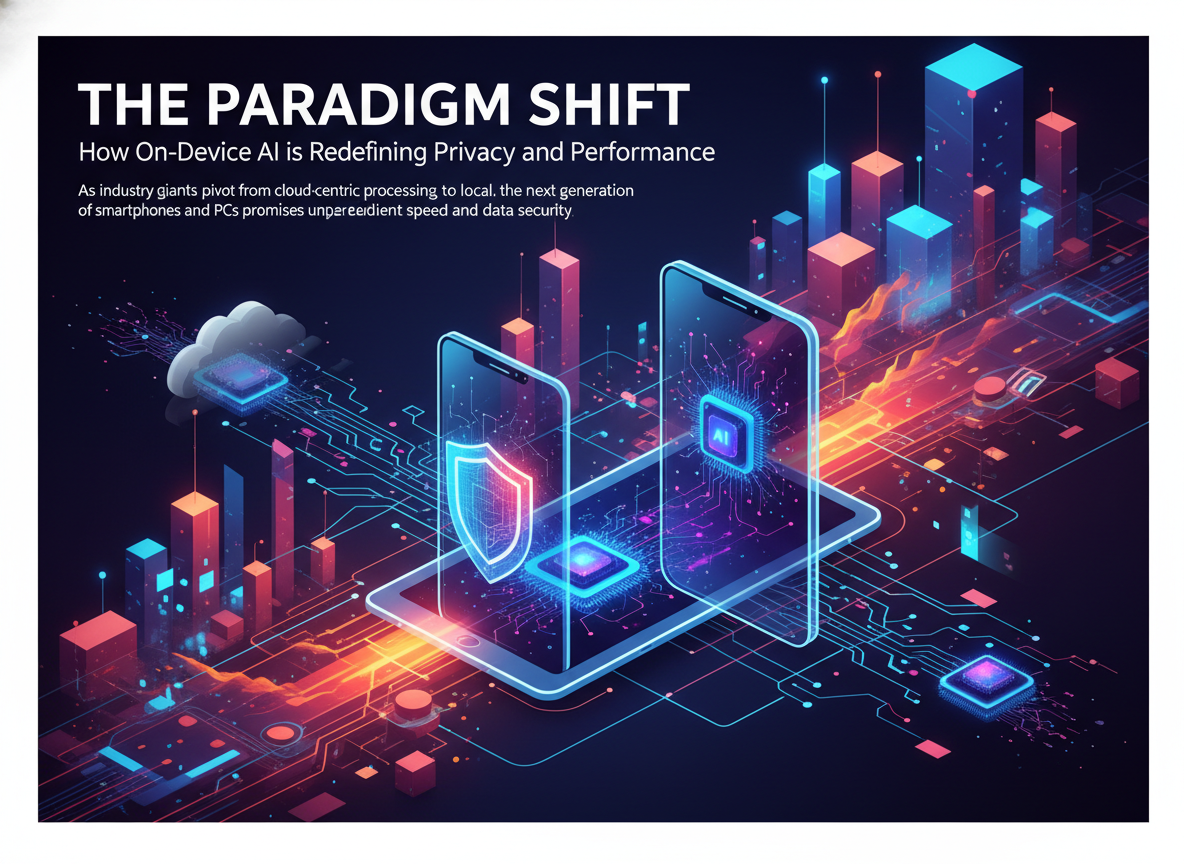
The dawn of May 10, 2026, marks a pivotal shift in the AI landscape with the widespread adoption of Vellum Personal Intelligence Agents. Unlike the centralized models of the early 2020s, Vellum represents a paradigm shift toward local sovereignty. These agents are not merely chatbots; they are deeply integrated cognitive partners residing entirely on the user's hardware. The recent release of the Vellum V4 Core has set a new benchmark for what is possible when high-performance neural processing units (NPUs) meet sophisticated localized algorithms. By prioritizing data residency and low-latency response times, Vellum is effectively ending the era of cloud-dependency for personal productivity.
At the heart of today’s announcement is the 'Vellum-Sovereign' architecture, which allows for complex reasoning tasks to be performed locally on devices with as little as 16GB of unified memory. This is achieved through advanced quantization techniques and a novel 'Sparse-Context Recovery' system that efficiently manages massive personal datasets without taxing the system's thermal limits. Users are now reporting that their Vellum agents can index and cross-reference a lifetime of personal documents, emails, and encrypted communications in real-time, providing context-aware assistance that was previously impossible without exposing sensitive data to external servers.
Privacy has moved from a feature to the foundational requirement of the Vellum ecosystem. In an age where data breaches are ubiquitous, the Vellum Personal Intelligence Agent operates within a 'Zero-Knowledge Sandbox.' This ensures that not even Vellum’s developers have access to the telemetry or intelligence gathered by the agent. On May 10, 2026, the company introduced the 'Vaulted Logic' protocol, which encrypts the agent's thought process itself, ensuring that personal insights remain strictly between the user and their local hardware. This move has resonated deeply with corporate executives and legal professionals who require the power of AI without compromising attorney-client privilege or trade secrets.
The integration of Vellum agents into the broader Internet of Things (IoT) landscape has also seen a significant leap today. Vellum’s new 'Ambient Awareness' update allows agents to interface directly with local smart home protocols via Matter 3.0, without routing through third-party cloud bridges. This means your Vellum agent can manage home security, energy consumption, and personalized lighting by learning your habits locally. The agent identifies patterns in your daily life, such as your preferred focus hours or sleep cycles, and adjusts your environment autonomously, all while maintaining a secure, localized footprint.
What distinguishes Vellum from previous iterations of AI assistants is its hyper-personalized learning trajectory. As of this latest May 2026 update, the agents utilize 'Continual Local Fine-Tuning' (CLFT). This process allows the agent to evolve its tone, vocabulary, and decision-making framework based on direct interactions with the user. Instead of a generic model, the Vellum agent becomes a digital twin of sorts, reflecting the user's specific professional expertise and personal preferences. This level of customization ensures that the AI's suggestions are not just accurate but are tailored to the specific nuances of the user’s unique workflow.
The market response to Vellum's New Era has been overwhelming, with local AI hardware sales surging by 40% in the first quarter of 2026. Tech analysts are pointing to 'The Vellum Effect' as the primary driver behind the revitalization of the high-end PC and mobile workstation markets. Consumers are no longer looking for just CPU or GPU power; they are demanding NPU-optimized machines specifically designed to host Vellum-class agents. This shift is forcing silicon giants to accelerate their roadmaps, ensuring that personal intelligence is accessible even in mid-range consumer devices by the end of the year.
In terms of productivity, the Vellum V4 update has introduced 'Proactive Task Synthesis.' This feature allows the agent to anticipate the user's needs before they are explicitly voiced. For instance, if a Vellum agent detects an upcoming board meeting in a locally stored calendar, it will automatically synthesize a briefing document based on previous meeting notes, current project files, and relevant industry news cached during background local web-scraping. This proactive stance transforms the AI from a reactive tool into a strategic partner, significantly reducing the cognitive load on human operators.
As we look toward the remainder of 2026, the trajectory of Vellum Personal Intelligence Agents suggests a future where the 'cloud' is reserved for public information, while the 'local' is the sanctuary of personal intelligence. The breakthroughs announced today confirm that the era of sacrificing privacy for performance is officially over. Vellum has demonstrated that the most powerful AI is the one that stays with you, on your device, and under your control. This revolution in local AI assistants is not just a technological milestone; it is a fundamental reclaiming of digital agency in an increasingly complex world.