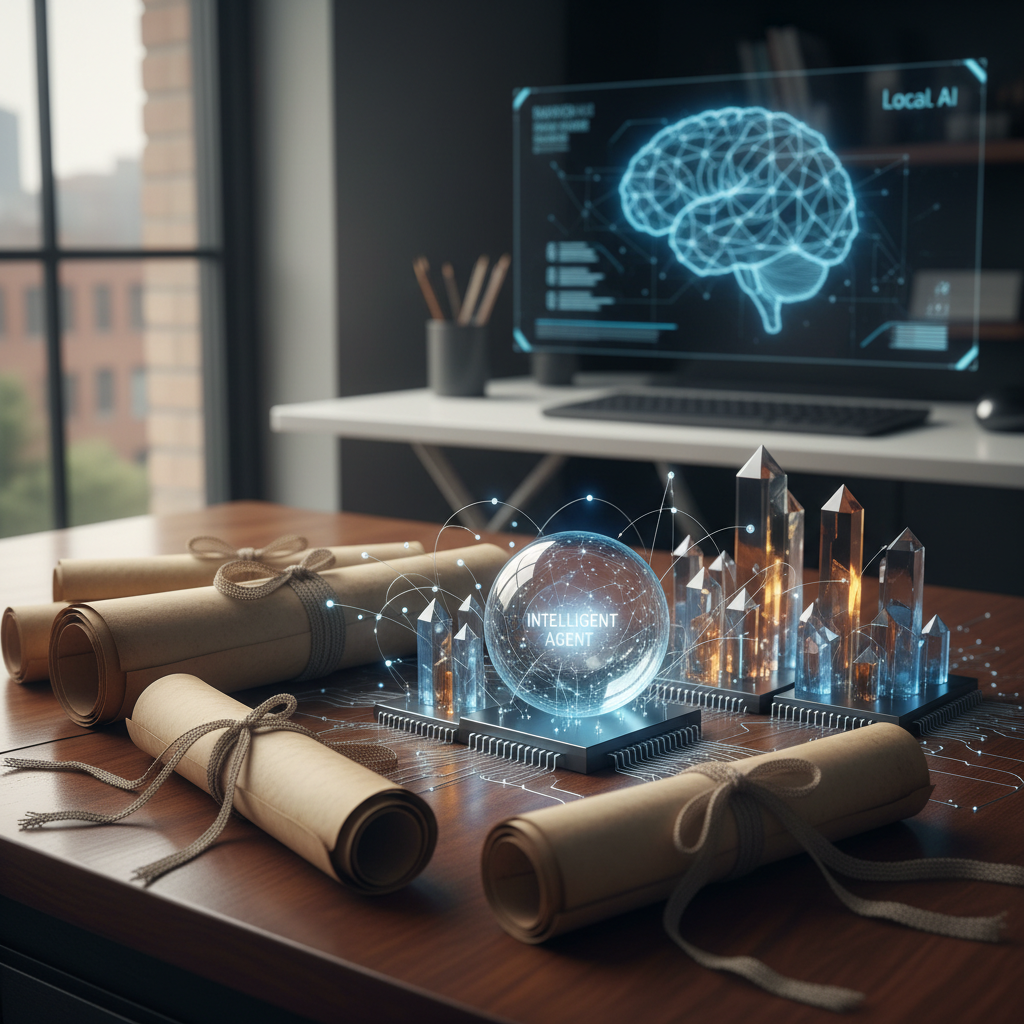
Today, April 5, 2026, marks a pivotal moment in the evolution of artificial intelligence as we move beyond the era of simple conversational interfaces and into the age of fully autonomous agent swarms. The digital landscape has shifted dramatically over the past year, transitioning from Large Language Models (LLMs) that merely respond to prompts to 'Agentic Ecosystems' that proactively manage complex workflows without human intervention. This transformation is driven by the maturation of reasoning-heavy architectures that prioritize logical consistency and multi-step planning over simple predictive text, fundamentally changing how humans interact with silicon.
The headline news this week is the widespread rollout of the 'Nexus-6' protocol, a cross-platform standard that allows AI agents from different developers—such as OpenAI, Anthropic, and Google—to negotiate and collaborate in real-time. We are seeing a shift where a user's personal agent can interact with a corporate logistics agent to resolve a shipping delay, re-route a flight, and update a calendar, all while the user is asleep. This interoperability represents the 'Internet of Agents' that experts predicted years ago, now a tangible reality influencing global commerce and personal productivity.
On the hardware front, the 2026 Spring Tech Expo in San Jose showcased the first generation of 'True Neural' silicon. These chips, now standard in flagship mobile devices, boast dedicated matrix-processing units capable of running 200-billion parameter models locally with minimal battery drain. This move toward edge computing addresses long-standing privacy concerns, as sensitive data no longer needs to leave the device for the AI to perform complex reasoning tasks. The era of the 'Cloud-First' AI is rapidly being replaced by 'Privacy-First' local intelligence that functions even in offline environments.
In the professional sector, the concept of a 'workforce' has been redefined by the integration of synthetic talent. As of today, over 60% of Fortune 500 companies have implemented 'Synthetic Departments,' where AI agents handle routine administrative, coding, and data analysis tasks autonomously. These are not just automated scripts; they are dynamic entities capable of self-correction and iterative learning. The role of the human employee has evolved into that of an 'Agent Orchestrator,' focusing on high-level strategy and ethical oversight rather than the minutiae of execution, leading to unprecedented levels of operational efficiency.
Technological breakthroughs in the first quarter of 2026 have also solved the 'Memory Horizon' problem that plagued earlier generative models. New architectures utilizing 'Infinite Context Windows' via advanced vector-database integration allow AI agents to maintain a perfect, persistent memory of every interaction and data point they have ever encountered. This creates a deeply personalized experience where the AI understands the user’s long-term goals, past preferences, and evolving professional needs with a level of nuance that was previously impossible, making the AI a true digital twin rather than just a tool.
However, this rapid advancement has not been without its challenges, necessitating new legal frameworks. The International AI Regulatory Body (IARB) recently issued a new set of guidelines regarding 'Agent Accountability,' addressing the legal complexities that arise when an autonomous agent makes a financial or contractual error. As we see on April 5, 2026, the focus of global legislation has shifted from preventing 'hallucinations' to defining 'agency,' as governments struggle to keep pace with the speed of autonomous digital transactions that are now reaching trillions of dollars in value annually.
The field of AI-driven biotechnology has also seen a massive leap forward today, proving the utility of specialized agent swarms. Researchers at the Zurich AI Institute announced a breakthrough in protein folding that was achieved using an agentic swarm specifically designed for molecular simulation. By allowing thousands of specialized agents to work in parallel, each optimizing a different variable of a chemical compound, the time required to develop new drug candidates has been reduced from years to weeks. This 'Parallelized Discovery' model is being hailed as the most significant contribution of AI to human health in this decade.
As we look toward the remainder of 2026, the convergence of robotics and agentic AI suggests that the next frontier will be the physical world. With AI brains now capable of complex reasoning and environmental awareness, the focus is shifting to 'Embodied Intelligence,' where these digital minds are integrated into humanoid robots capable of navigating unpredictable human environments. Today's developments in software and edge computing are the foundational blocks for a world where AI is no longer confined to screens, but is an active, physical participant in our daily lives, signaling the true arrival of the second industrial revolution.