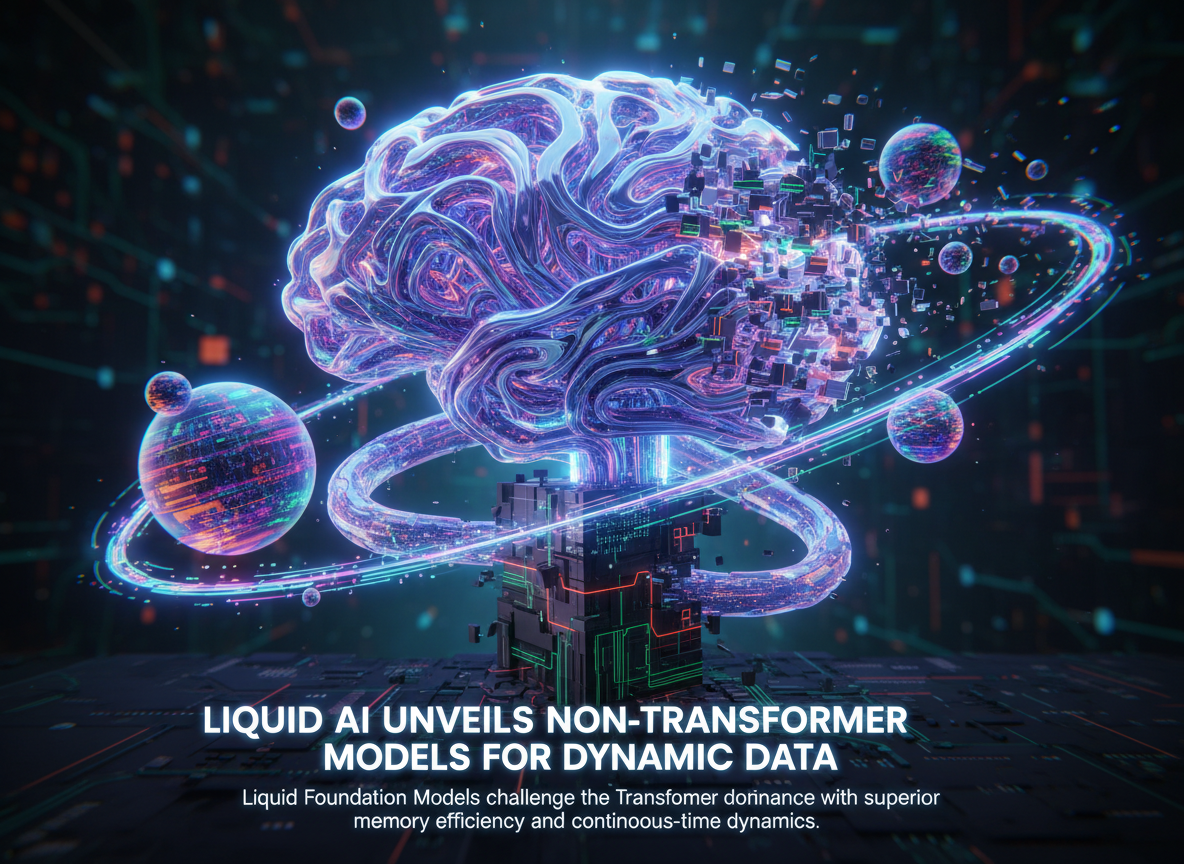
While the Transformer architecture has dominated AI research since 2017, a new challenger has emerged from the MIT ecosystem. Liquid AI recently announced the release of its Liquid Foundation Models (LFMs), which utilize a different mathematical framework for processing sequential data. LFMs are based on continuous-time neural networks that adapt their parameters based on the input they receive, much like biological brains.
The primary advantage of LFMs lies in their efficiency. Because they do not rely on the massive attention matrices used by Transformers, they require significantly less memory, especially when processing long sequences of data. This makes them ideal candidates for edge computing applications, such as autonomous vehicles and drones, where onboard memory and power are strictly limited.
Early benchmarks show that LFMs can outperform or match the performance of Transformer-based models like Llama and Mistral across several modalities, including text and audio. By providing a scalable alternative to the current AI status quo, Liquid AI is opening up new possibilities for real-time, resource-constrained AI applications that were previously thought impossible.