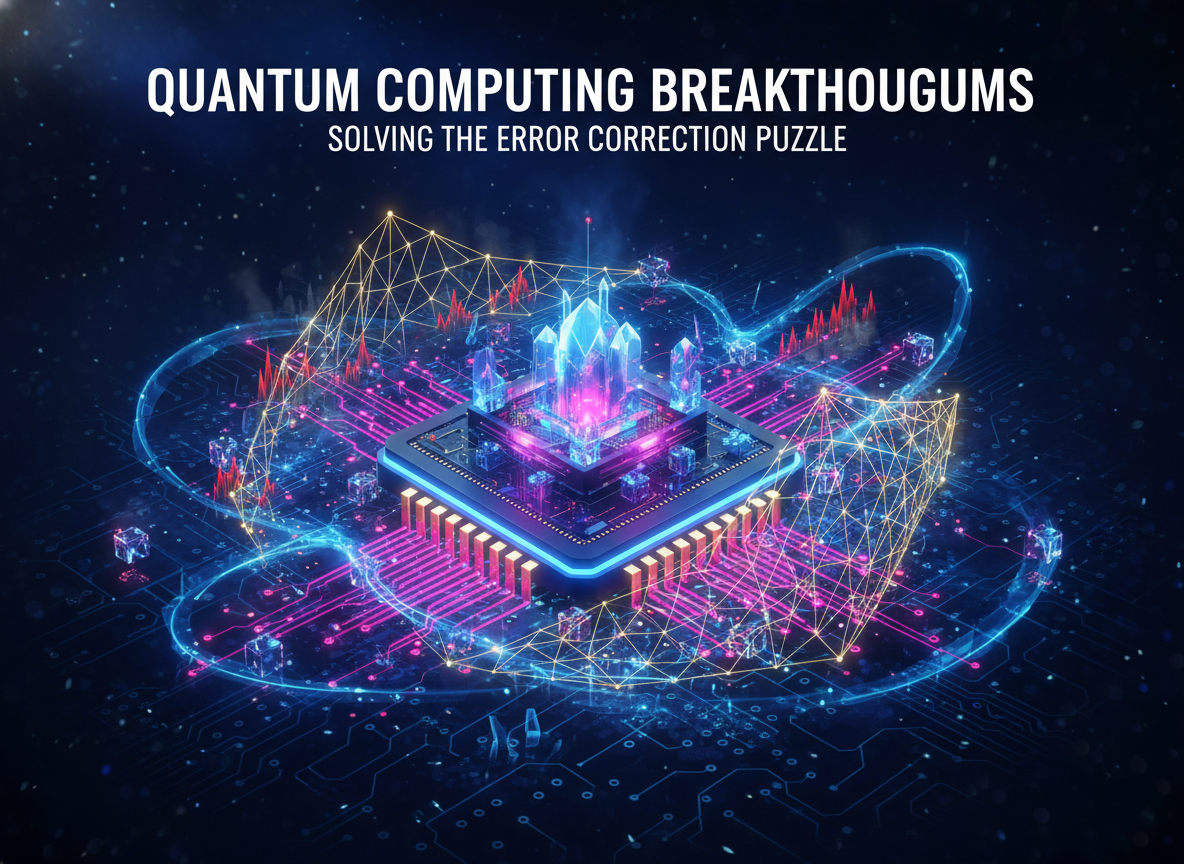
Quantum computing has long been the 'holy grail' of the technology world, promising to solve calculations that would take classical supercomputers thousands of years to complete. However, the biggest obstacle to this vision has been the extreme fragility of qubits, which are prone to errors caused by environmental noise and decoherence. Recent breakthroughs in quantum error correction (QEC) have finally provided a roadmap to stable, fault-tolerant quantum systems. By using sophisticated codes to spread information across multiple physical qubits, researchers can now detect and correct errors without destroying the underlying quantum state. This achievement marks a transition from experimental prototypes to functional machines capable of performing reliable computations in complex environments.
The concept of 'logical qubits' is central to this new era of quantum progress, representing a group of physical qubits that work together to remain stable. In recent experiments, major players like IBM and Google have demonstrated that increasing the number of physical qubits can actually decrease the overall error rate, a feat that was once thought to be technically impossible. This 'breakeven point' is a critical milestone, as it proves that quantum systems can be scaled without becoming uncontrollably noisy. The development of surface codes and honeycomb codes has allowed for more efficient error detection with fewer overhead resources. As these codes become more refined, the hardware requirements for building a useful quantum computer are becoming more realistic for commercial deployment.
The implications for industries like cryptography, materials science, and pharmaceuticals are staggering, as quantum computers can simulate molecular interactions at an atomic level. Traditional computers struggle with the complexity of quantum mechanics, making it difficult to design new drugs or highly efficient battery materials. A fault-tolerant quantum computer could unlock the secrets of nitrogen fixation or find room-temperature superconductors, potentially solving some of the world's most pressing energy and food security issues. In the realm of finance, quantum algorithms could optimize portfolios and manage risks with a degree of precision that is currently unattainable. The race is now on to build the first 100-logical-qubit machine that can perform these life-changing simulations.
Cybersecurity is perhaps the most immediate concern as quantum capabilities grow, since quantum algorithms like Shor's could theoretically break current encryption standards. This has led to the rise of Post-Quantum Cryptography (PQC), a new field dedicated to developing encryption methods that are resistant to quantum attacks. Governments and large corporations are already beginning to migrate their data to these quantum-resistant protocols to prevent future breaches. While a 'Q-Day'—the day a quantum computer can break modern encryption—is still years away, the preparation must begin now due to the 'store now, decrypt later' threat. The intersection of quantum physics and cybersecurity is becoming one of the most critical battlegrounds in national security and data protection.
Scaling quantum hardware requires a complete rethink of classical computer architecture, involving ultra-cold dilution refrigerators and specialized microwave electronics. The qubits must be kept at temperatures near absolute zero to minimize thermal noise, creating a massive engineering challenge for large-scale integration. Companies are now exploring different qubit modalities, from superconducting loops and trapped ions to topological qubits and silicon spins. Each approach has its own set of advantages and challenges in terms of gate speed, coherence time, and scalability. The diversification of hardware strategies ensures that the industry is not putting all its eggs in one basket, increasing the likelihood of a major commercial breakthrough soon.
Software development for quantum systems is also evolving rapidly, with new programming languages and compilers designed to abstract away the complexity of the underlying physics. Platforms like Qiskit and Cirq allow developers to write quantum circuits and run them on real hardware via the cloud. This 'Quantum-as-a-Service' model is democratizing access to quantum resources, allowing researchers and startups to experiment without owning a multi-million dollar machine. As the software stack matures, we are seeing the emergence of hybrid classical-quantum algorithms that leverage the strengths of both systems. These hybrid approaches are likely to provide the first practical applications of quantum computing in optimization and machine learning.
The global competition for quantum supremacy has become a point of geopolitical tension, with billions of dollars in subsidies flowing into quantum research. Major powers recognize that the first nation to master quantum technology will have an overwhelming advantage in intelligence gathering, scientific discovery, and economic productivity. This has led to a surge in private venture capital and public grants aimed at fostering a robust quantum ecosystem. Universities are also launching specialized quantum engineering programs to train the next generation of researchers and technicians. The collaborative nature of scientific research is being tested by the strategic importance of quantum breakthroughs, leading to a complex web of international partnerships and export controls.
Looking ahead, the next decade will be defined by the transition from the NISQ (Noisy Intermediate-Scale Quantum) era to the era of true fault-tolerance. While there is still significant work to be done in perfecting the hardware and refining the error correction codes, the path forward is clearer than ever. We are moving away from the question of 'if' quantum computing will work to the question of 'when' and 'how' it will be integrated into the broader computing landscape. The convergence of quantum technology with AI and high-performance classical computing will likely spark a technological renaissance that rivals the industrial revolution. For those watching the space, the current breakthroughs in error correction are the clearest signal yet that the quantum age has finally arrived.