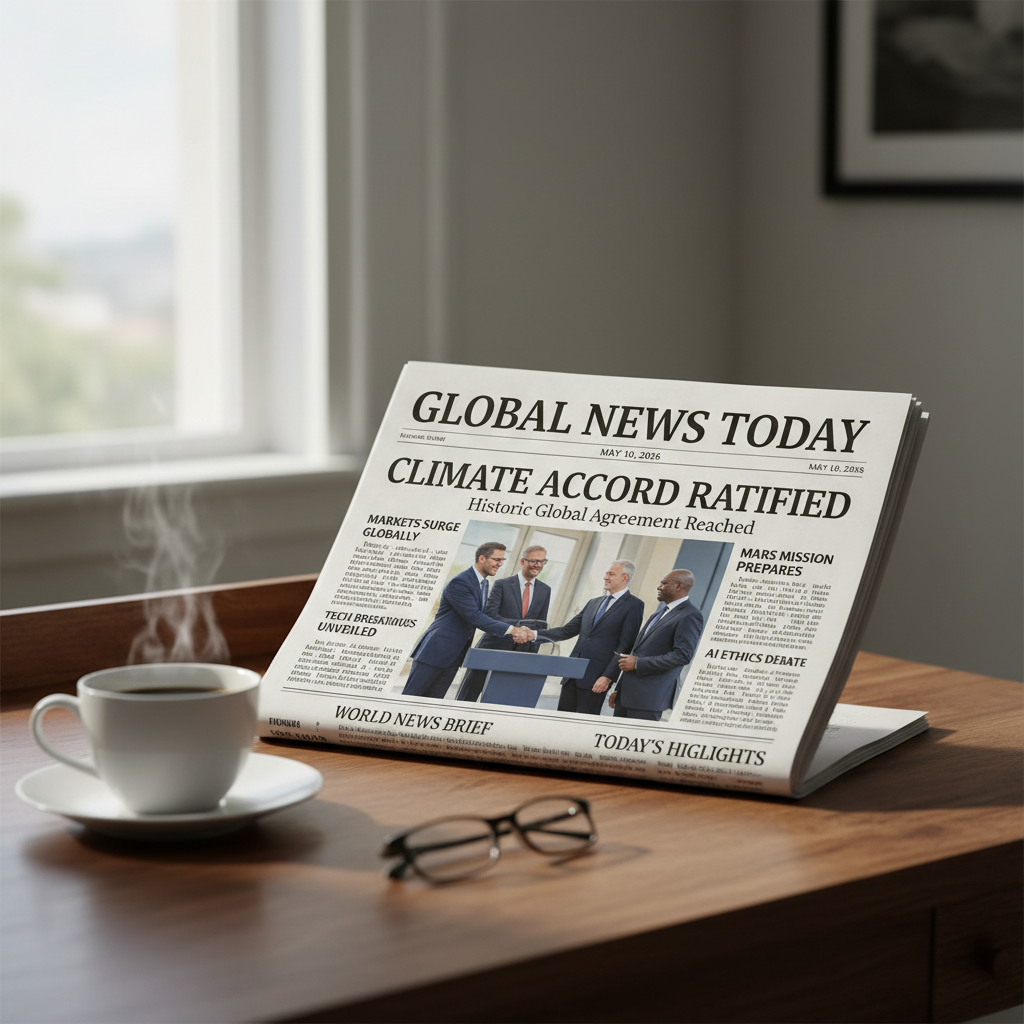
The global landscape on this Sunday, May 10, 2026, is defined by a high-stakes intersection of maritime brinkmanship, rapid technological evolution, and urgent environmental alerts. As the world navigates the complexities of mid-decade geopolitics, today's headlines highlight a precarious balance between industrial progress and the persistent threat of regional conflict. From the corridors of power in Washington and Tehran to the cutting-edge laboratories of quantum researchers, the events of the last 24 hours underscore a transformative period in human history where traditional security concerns are increasingly amplified by emerging technologies and shifting ecological patterns.
At the forefront of today's news is the escalating tension in the Middle East, as President Donald Trump has intensified rhetoric against Iran following a series of tanker attacks in the Strait of Hormuz. The administration has issued a direct threat of 'tanker strikes' if maritime passage continues to be disrupted, a move that has sent shockwaves through global energy markets. Meanwhile, China has stepped into a rare mediator role, publicly pressing Tehran to ensure the reopening and safety of the Hormuz route. Diplomats in Cairo are frantically reviewing a proposed peace deal, though core demands regarding nuclear monitoring and regional influence remain significant sticking points that threaten to derail a potential resolution.
In a major win for international non-proliferation efforts, the U.S. National Nuclear Security Administration (NNSA) successfully completed the removal of all highly enriched uranium from Venezuela today. This high-risk operation, conducted under tight security, significantly reduces the threat of nuclear material falling into the hands of non-state actors in South America. The Department of Energy hailed the move as a triumph of 'American Energy Dominance' and a key pillar of the 'Trump Peace Pipelines Framework,' which seeks to stabilize energy exports while neutralizing potential regional threats through strategic material recovery.
The scientific community has issued a chilling 'Super El Ni!o' warning, with new data suggesting that 2026 could see one of the most powerful climatic events on record. Meteorologists are tracking a 3 C rise in central equatorial Pacific temperatures, which is expected to trigger extreme weather patterns globally, including devastating floods in Brazil and severe droughts across the Horn of Africa and Australia. This warning coincides with a poll of the world's leading climate scientists, who now predict that global heating is on an irreversible path to blast past the 1.5 C target, potentially reaching 2.5 C by the end of the century if current emission trajectories are not immediately curtailed.
Technological progress continues at a staggering pace, with IonQ reporting a record-breaking 755% year-on-year growth in its first-quarter financial results for 2026. The surge is being fueled by a massive expansion in quantum computing platform utilization across the commercial sector. As industries from pharmaceuticals to logistics begin to leverage 'Tempo' demand for complex problem-solving, the realization of a quantum-integrated economy seems closer than ever. This leap in computing power is also raising urgent questions about cybersecurity and the future of encrypted communications, leading to new calls for a global regulatory framework for quantum-safe protocols.
Security concerns are also mounting in the Kremlin, as reports emerge that President Vladimir Putin has significantly tightened his personal security detail amid renewed fears of internal dissent and assassination plots. The Russian capital has seen a notable increase in surveillance and restricted zones as the administration attempts to project stability in the face of ongoing economic pressure. International analysts suggest that these measures reflect a deepening anxiety within the Russian leadership as the long-term impacts of the current geopolitical stalemate continue to weigh on the nation's social and political fabric.
Humanitarian organizations are sounding the alarm over a deepening crisis in the Democratic Republic of Congo, where conflict-driven hunger has reached unprecedented levels. Millions are displaced as local militias and regional forces clash over mineral-rich territories, leaving aid agencies struggling to provide basic necessities. The United Nations has called for an immediate surge in funding and a renewed diplomatic push to address the root causes of the instability, which is increasingly being exacerbated by the global race for 'green' minerals essential for the energy transition in the West.
In a rare public intervention, Pope Leo has rejected the escalating nuclear rhetoric emanating from world capitals, specifically taking issue with claims that suggest nuclear weapons could serve as a viable tool of diplomacy. Speaking from the Vatican, the first American-born pontiff emphasized that the mission of the Church remains focused on 'preaching the gospel of peace.' His comments come ahead of a scheduled meeting with Secretary of State Marco Rubio, where the Vatican is expected to lobby for a de-escalation of the Iran war and a return to multi-lateral arms control agreements that have been sidelined in recent years.
The entertainment and tech industries are abuzz following Sony's latest disclosures regarding the PlayStation 6. The company confirmed today that the next-generation console will feature deep integration of Generative AI to create dynamic, ever-evolving gaming environments that respond to player behavior in real-time. This move marks a significant shift in how digital content is produced and consumed, signaling the end of static game design. While enthusiasts are excited about the potential for 'limitless' worlds, industry ethics groups are already raising concerns about the psychological impact of AI-driven immersion and the potential for digital addiction.
As May 10, 2026, unfolds, the world remains in a state of flux, caught between the dangers of 20th-century geopolitical rivalries and the promise of 21st-century innovation. Whether it is the fight for maritime security, the race for quantum supremacy, or the struggle to mitigate a warming planet, the decisions made today will echo through the remainder of the decade. The interconnectedness of these events—where a tanker strike in the Middle East can influence climate policy in South America or tech stocks in Tokyo—serves as a stark reminder that in the modern era, no event occurs in isolation.