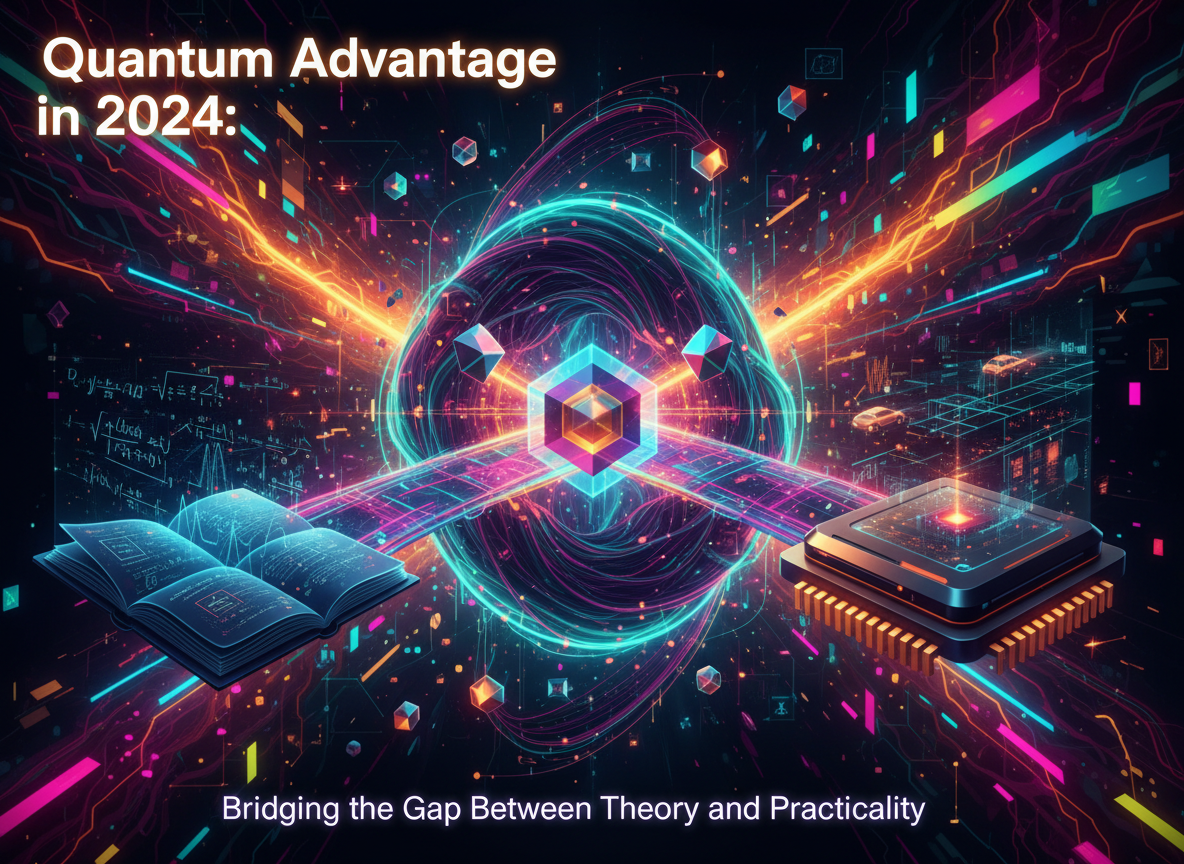
Quantum computing has long been viewed as a 'tomorrow' technology, always a decade away from meaningful application. However, 2024 has seen a series of breakthroughs that suggest the timeline is accelerating. The industry is moving past the era of Noisy Intermediate-Scale Quantum (NISQ) devices and toward the development of fault-tolerant quantum computers. The primary challenge has always been decoherence—the tendency of qubits to lose their quantum state due to environmental noise—but new techniques are finally taming this instability.
The most significant milestone recently has been in the field of quantum error correction (QEC). Earlier this year, a collaboration between Microsoft and Quantinuum demonstrated a way to create 'logical qubits' that are far more stable than the underlying physical qubits. By grouping physical qubits and using sophisticated algorithms to correct errors in real-time, they achieved an error rate that is 800 times lower than previous benchmarks. This is a critical step because, without error correction, quantum computers cannot perform the long, complex calculations required for real-world tasks.
IBM has also been aggressive in its hardware roadmap, shifting its focus from simply increasing qubit counts to improving the quality and connectivity of those qubits. Their Heron processor represents a new modular architecture that allows multiple quantum units to be linked together. This 'quantum system-of-systems' approach is designed to scale horizontally, much like classical data centers, providing a pathway to the thousands of logical qubits needed for pharmaceutical and material science simulations.
The race for quantum advantage is not just a corporate battle but a geopolitical one. Nations are investing billions into quantum research, recognizing that the first country to achieve a stable, large-scale quantum computer will have a massive advantage in cryptography, materials science, and national security. The potential to break current encryption standards—a scenario often referred to as 'Q-Day'—has prompted a global shift toward post-quantum cryptography (PQC), with the NIST recently finalizing its first set of quantum-resistant standards.
One of the most promising near-term applications of quantum computing lies in chemistry and materials science. Classical computers struggle to simulate the behavior of subatomic particles because the complexity grows exponentially with each added atom. Quantum computers, which operate on the same principles as these particles, are naturally suited for the task. This could lead to the discovery of new catalysts for carbon capture, more efficient battery chemistries, and even life-saving drugs discovered in a fraction of the time currently required.
Financial services are also exploring quantum algorithms for portfolio optimization and risk management. In a market where milliseconds and marginal gains matter, the ability to process vast amounts of multi-dimensional data could provide a significant edge. Major banks are already partnering with quantum startups to develop algorithms that can navigate the complexities of global markets more effectively than the best classical models currently available.
Despite the excitement, significant engineering hurdles remain. Most quantum processors still require extreme environments, such as temperatures near absolute zero, to function. Scaling these systems while maintaining their delicate quantum states requires breakthroughs in cryogenics, microwave engineering, and interconnects. The move toward 'quantum-centric supercomputing,' where quantum and classical resources work in tandem, is seen as the most pragmatic way forward over the next five years.
In conclusion, 2024 marks a turning point where quantum computing is transitioning from a laboratory curiosity to a viable engineering roadmap. While we are not yet at the point where quantum machines are outperforming supercomputers on everyday tasks, the foundation for fault-tolerant computing has been laid. The coming years will be defined by the refinement of these error-correction techniques and the emergence of the first practical applications that will change the world as we know it.