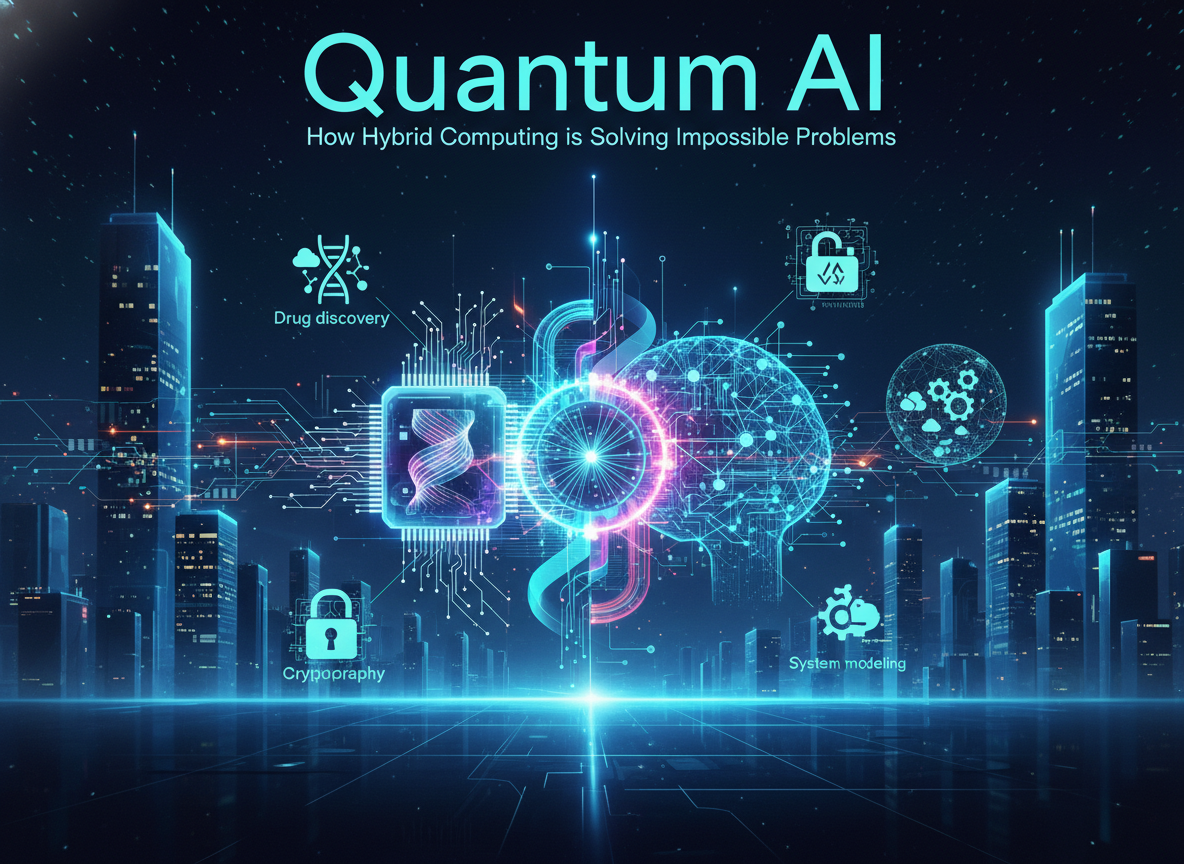
Quantum computing and artificial intelligence are two of the most transformative technologies of our time, and their convergence is creating a powerful synergy known as Quantum AI. By leveraging the principles of quantum mechanics—such as superposition and entanglement—quantum computers can process vast amounts of data in ways that classical silicon-based systems cannot. When integrated with neural networks, quantum processors can accelerate the training of AI models and solve optimization problems that are currently intractable for even the world's fastest supercomputers. This hybrid approach is opening doors to scientific breakthroughs that were once thought impossible.
The core advantage of Quantum AI lies in its ability to navigate high-dimensional search spaces with incredible efficiency. In fields like drug discovery, this means simulating the behavior of complex molecules at an atomic level, a task that requires astronomical computational power. Quantum algorithms can analyze molecular structures and predict their interactions with biological targets, significantly shortening the timeline for bringing life-saving medications to market. This capability is not just an incremental improvement; it is a fundamental shift in how we approach chemical and biological research.
Another critical application of Quantum AI is in the realm of financial modeling and risk assessment. The global financial system is a web of interconnected variables that are notoriously difficult to predict using classical algorithms. Quantum-enhanced AI can process these variables simultaneously to identify patterns and anomalies that indicate market shifts or fraudulent activity. By providing more accurate simulations of economic scenarios, Quantum AI helps institutions optimize their portfolios and mitigate risks in real-time, leading to a more stable and resilient global economy.
In the field of cryptography, the rise of quantum computing presents both a challenge and an opportunity. While quantum computers have the potential to break current encryption standards like RSA, they also enable the creation of unbreakable quantum-safe cryptographic protocols. AI plays a vital role here by helping to design and test new encryption methods that can withstand quantum attacks. The integration of AI with quantum key distribution ensures that our digital infrastructure remains secure in a post-quantum world, protecting sensitive data across government, healthcare, and finance sectors.
The technical hurdles to achieving practical Quantum AI remain significant, particularly in the area of error correction and qubit stability. Quantum systems are extremely sensitive to environmental interference, which can cause 'decoherence' and lead to errors in calculation. However, recent advancements in 'logical qubits' and hybrid quantum-classical algorithms are showing great promise. These hybrid models offload specific, highly complex tasks to a quantum processor while using classical computers to handle the rest of the workflow, maximizing the strengths of both systems while minimizing the impact of quantum noise.
Major tech players like IBM, Google, and Rigetti are in a fierce race to achieve 'quantum utility,' where quantum systems provide a measurable advantage over classical ones for real-world problems. IBM’s recent roadmap highlights the development of modular quantum processors that can be interconnected to scale up computational power. At the same time, software frameworks like Qiskit and PennyLane are making it easier for AI researchers to experiment with quantum algorithms without needing a deep background in physics. This accessibility is crucial for fostering a vibrant ecosystem of Quantum AI developers.
Looking ahead, the long-term impact of Quantum AI on materials science and climate modeling could be revolutionary. We may see the development of room-temperature superconductors or highly efficient carbon capture materials that were designed and optimized by Quantum AI systems. Furthermore, the technology could help us better understand complex systems like global weather patterns or the intricacies of the human brain. The ability to model these systems with high fidelity would provide us with the tools needed to address some of the most pressing challenges facing humanity today.
As we move closer to the era of practical Quantum AI, the focus will shift from theoretical proofs to scalable, commercial applications. The journey is complex and requires unprecedented collaboration between physicists, computer scientists, and industry experts. However, the potential rewards are so significant that the investment is accelerating globally. Quantum AI is not just a faster way of computing; it is a new lens through which we can understand and manipulate the fabric of reality, ushering in a new age of discovery and innovation.