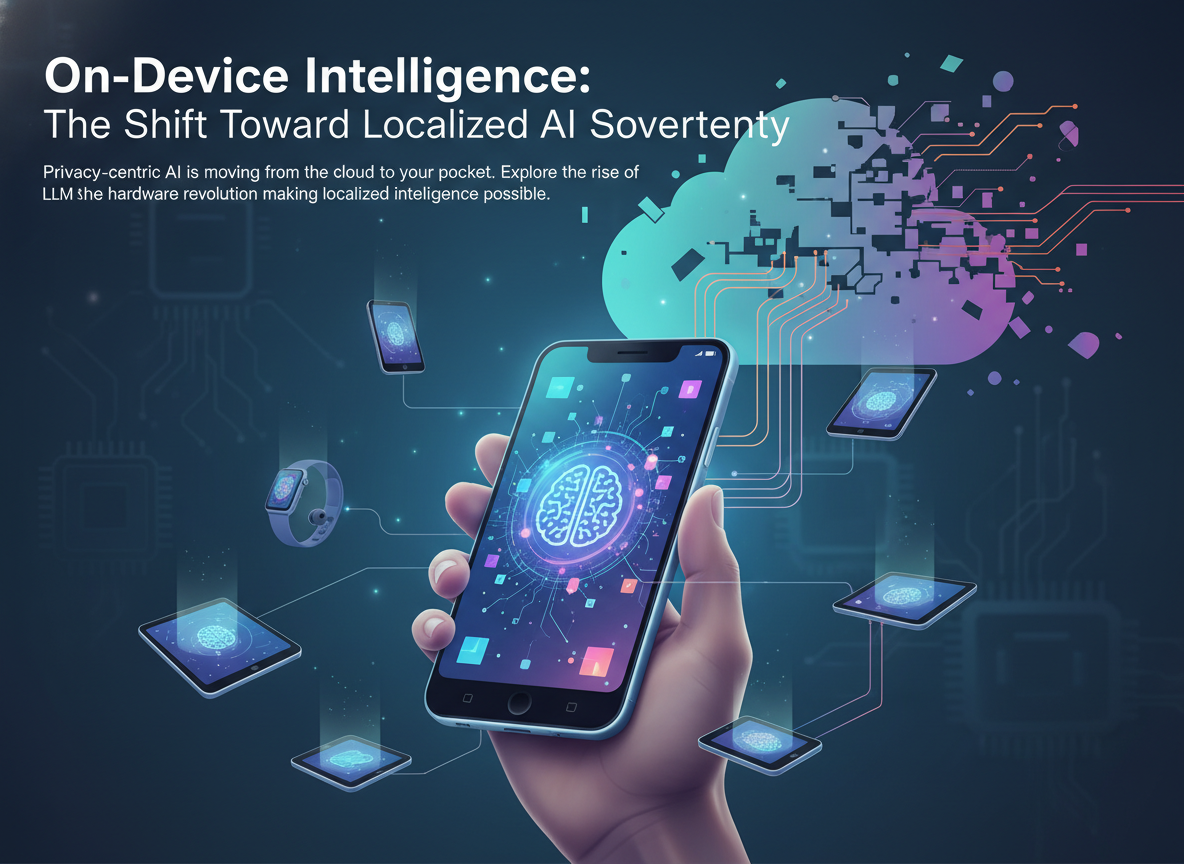
For years, the power of generative AI has been confined to massive data centers, requiring an active internet connection and the offloading of personal data to the cloud. However, a new paradigm is emerging: On-Device Intelligence. This shift is driven by a desire for greater privacy, lower latency, and the ability to use AI tools in offline environments. By running Large Language Models (LLMs) locally on smartphones, laptops, and IoT devices, manufacturers are promising a future where your personal assistant knows everything about you but tells no one. This localized approach is redefining the relationship between users and their digital data.
Hardware manufacturers are responding to this demand by integrating dedicated Neural Processing Units (NPUs) into their latest chipsets. Apple’s M4 and A18 chips, Qualcomm’s Snapdragon X Elite, and Intel’s Core Ultra processors are all designed with a specific focus on AI performance per watt. These NPUs are optimized to handle the matrix multiplications required for deep learning, allowing devices to run complex models without draining the battery or overheating. The result is a hardware revolution that brings the power of a data center to the palm of your hand, enabling real-time features like live translation and image generation.
One of the most significant proponents of this movement is Apple, with its 'Apple Intelligence' framework. By emphasizing that data remains on the device and is never stored or accessible by the company, Apple is positioning privacy as a premium feature. For tasks that require more power, they use 'Private Cloud Compute,' which utilizes dedicated servers running Apple silicon to ensure the same level of privacy as on-device processing. This hybrid model sets a new standard for how AI can be integrated into a consumer ecosystem without compromising user trust.
The move to localized AI also addresses the growing concern over the environmental impact and cost of cloud-based AI. Running a query on a cloud server consumes significant energy and incurs infrastructure costs for the provider. In contrast, on-device processing utilizes the hardware the user already owns, reducing the load on global data centers. Furthermore, it eliminates the latency associated with sending data back and forth to a server, making AI interactions feel instantaneous. For applications like augmented reality and autonomous driving, this low latency is not just a convenience but a safety requirement.
Software developers are also adapting by creating 'smaller' but highly efficient models, often referred to as SLMs (Small Language Models). Models like Microsoft’s Phi-3 or Google’s Gemini Nano are specifically distilled and quantized to run on mobile hardware without a significant loss in reasoning capability. These models are trained on high-quality, curated datasets, allowing them to punch above their weight class in terms of performance. The availability of these models means that even mid-range devices will soon be able to offer sophisticated AI experiences previously reserved for flagship hardware.
The shift toward on-device AI also empowers users in regions with limited connectivity, democratizing access to advanced technology. In developing markets where high-speed internet is not always available, localized AI can provide educational tools, medical diagnostics, and language translation services that work reliably offline. This 'AI sovereignty' ensures that the benefits of the AI revolution are not restricted to those in well-connected urban centers, but can be leveraged by anyone with a modern device, regardless of their location.
However, the challenges of on-device AI include the physical limitations of mobile memory and storage. LLMs require significant amounts of RAM to run efficiently, which has led to a push for higher memory specifications in consumer electronics. We are seeing a trend where 16GB or even 24GB of RAM is becoming the new baseline for AI-capable laptops and phones. Additionally, keeping models updated without massive downloads is a technical hurdle that developers are currently working to solve through incremental update systems and modular architectures.
Ultimately, the rise of on-device intelligence marks a return to the ethos of personal computing, where the user has full control over their tools and their data. As NPU technology continues to advance and models become even more efficient, the distinction between cloud AI and local AI will continue to blur. We are heading toward a future where every device we interact with is inherently 'smart,' providing personalized, private, and powerful assistance that adapts to our unique needs while keeping our digital lives secure. This localized revolution is the key to making AI truly personal.