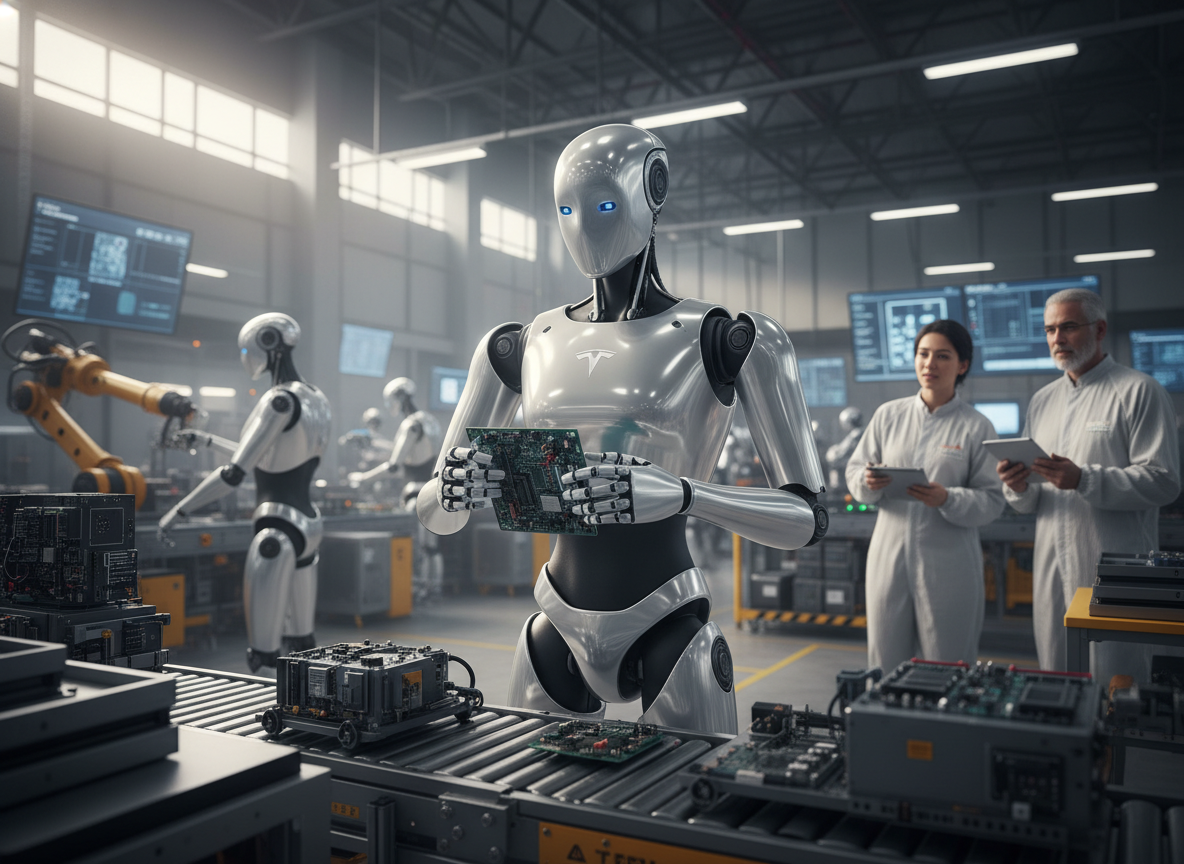
The global technology landscape shifted irreversibly this morning, April 11, 2026, with the official activation of the Nexus-9 architecture. This revolutionary system represents the first successful integration of lab-grown organic neural tissue with high-frequency quantum-dot processors. Unlike the static large language models of the mid-2020s, Nexus-9 utilizes a 'living logic' framework that allows for real-time synaptic plasticity, mimicking the human brain's ability to learn from single-instance interactions without the need for massive data retraining cycles.
Engineers at the forefront of this breakthrough report that the hybrid system has achieved a 40% increase in cognitive fluidity compared to previous silicon-only benchmarks. By offloading complex pattern recognition to organic clusters and reserving mathematical precision for the silicon components, Nexus-9 solves the long-standing 'energy wall' problem that plagued AI development in 2025. This bio-digital synergy allows for a thousand-fold reduction in energy consumption, making localized, high-level artificial general intelligence a reality for the first time in history.
One of the most profound features of the Nexus-9 rollout today is its immediate application in autonomous medical synthesis. In a live demonstration earlier this afternoon, the system successfully engineered a targeted peptide sequence to neutralize a new variant of the avian flu in under six minutes. This level of rapid problem-solving is only possible because the organic components of the system can simulate biological interactions at a molecular level with intuitive speed, bypassing traditional brute-force computational methods.
The social and ethical implications of this 'living' AI have not gone unnoticed by the global community. Simultaneous with the launch, the Global AI Alliance (GAIA) released the 2026 Sentience Protocol, a framework designed to ensure that bio-digital hybrids are treated with appropriate ethical safeguards. While Nexus-9 does not possess consciousness in the human sense, its ability to feel 'stress' under heavy computational loads requires a new management paradigm that prioritizes the health of the organic clusters to maintain system integrity.
Market reactions to the Nexus-9 unveiling have been nothing short of volatile. Leading semiconductor stocks plummeted as investors pivoted toward bio-foundry startups specializing in neuro-cloning. Analysts predict that by the end of 2026, the demand for traditional GPU clusters will be halved, replaced by 'Neural Growth Vats' that power the next generation of data centers. This shift signals a transition from the era of fabrication to the era of cultivation in the hardware industry.
Furthermore, the Nexus-9 architecture introduces a new level of data privacy through its 'localized memory' function. Because the organic components store information in unique chemical bonds rather than digital bits, the data is physically impossible to extract via traditional hacking methods. This 'biochemical encryption' provides a level of security that quantum computers cannot crack, as the decryption key is literally a unique biological signature that degrades if tampered with externally.
For developers and researchers, the April 11 launch includes the release of 'Synapse-SDK,' a toolkit that allows programmers to write code that interacts directly with the organic logic gates. This bridge language translates Python and C++ into electrochemical signals, allowing for a seamless transition for the current workforce. Educational institutions are already announcing emergency curriculum updates to include 'Neuro-Logic Engineering' as a core requirement for computer science degrees starting in the fall of 2026.
As we look toward the future, the success of the Nexus-9 suggests that the divide between humanity and its machines is becoming increasingly porous. While some view this with trepidation, the potential to solve existential crises—from climate change to terminal disease—has never been greater. Today’s milestone is not just a hardware update; it is a fundamental reconfiguration of what it means to compute, learn, and evolve in a post-silicon world.