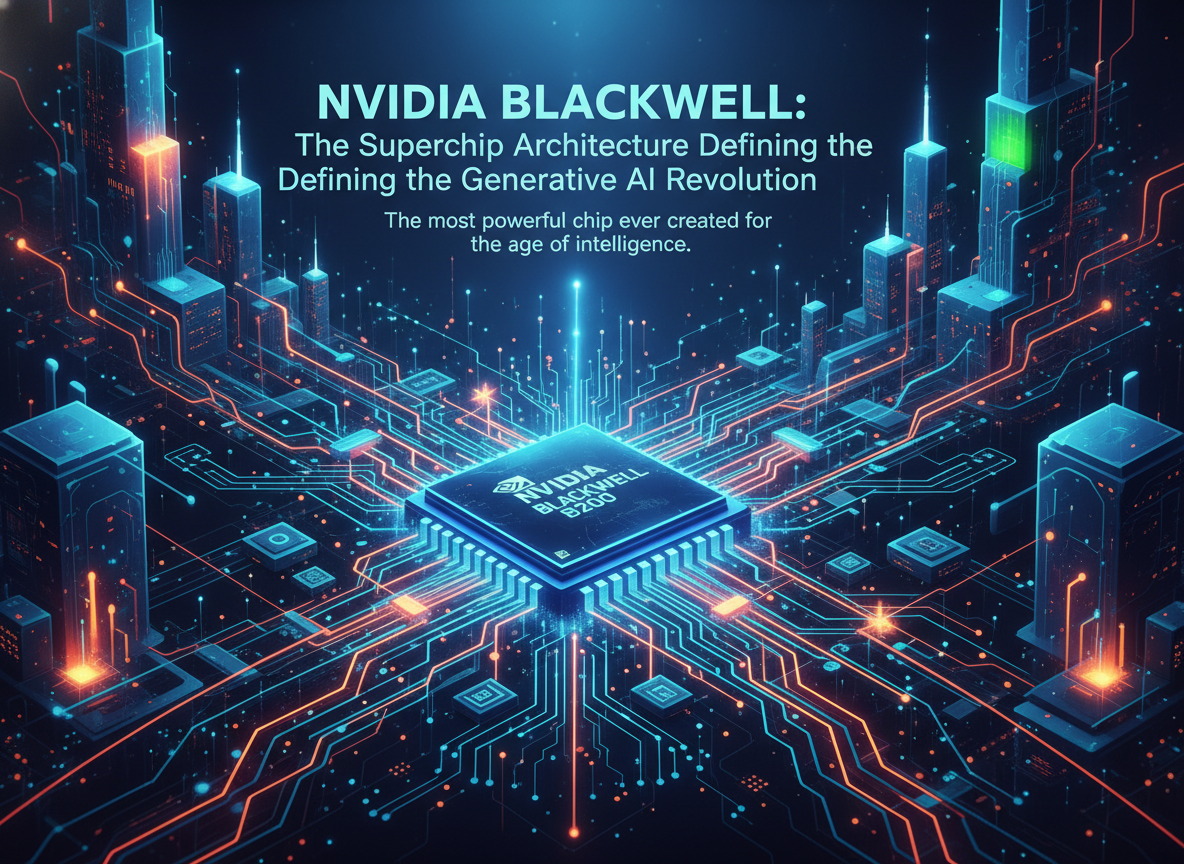
The generative AI boom has created an insatiable demand for computational power, and NVIDIA has answered the call with the introduction of its Blackwell architecture. Unveiled at the GTC 2024 conference, Blackwell represents a massive leap forward in GPU design, specifically engineered to handle the trillion-parameter models that define modern AI. The flagship B200 GPU is not just a faster chip; it is a complex system of 208 billion transistors that utilizes a unique multi-die design to push the boundaries of what is physically possible in semiconductor manufacturing. This architecture is the engine that will drive the next wave of AI breakthroughs across every sector of the global economy.
What makes Blackwell truly revolutionary is its performance in both training and inference tasks. According to NVIDIA, the B200 can deliver up to 20 petaflops of FP4 power, making it significantly more efficient at running large language models than the previous H100 Hopper generation. This increase in performance is coupled with a new second-generation Transformer Engine that dynamically adjusts the precision of calculations to maximize throughput without sacrificing accuracy. For companies like Google, Meta, and Microsoft, this means they can train more complex models in a fraction of the time and at a significantly lower cost.
Energy efficiency is a central theme of the Blackwell design, addressing one of the most persistent criticisms of the AI industry: its massive carbon footprint. NVIDIA has implemented a range of power-saving technologies, including a dedicated high-speed link called NVLink 5.0, which allows up to 576 GPUs to talk to each other with incredibly high bandwidth and low latency. By streamlining the communication between chips, Blackwell reduces the energy wasted during data transfer. This enables data centers to scale their AI capabilities without requiring a linear increase in power consumption, a critical factor for the sustainable growth of digital infrastructure.
The Blackwell architecture also introduces the GB200 Grace Blackwell Superchip, which combines two B200 GPUs with a single Grace CPU. This tightly integrated package is designed for the most demanding generative AI workloads, offering a 30x performance increase for LLM inference compared to the H100. This level of power is what will enable the transition from simple chatbots to sophisticated autonomous agents that can reason through complex problems in real-time. By providing the 'brains' for the next generation of data centers, NVIDIA is cementing its position as the indispensable backbone of the entire AI ecosystem.
Supply chain dominance remains a key part of the NVIDIA story, as the company has secured the vast majority of the high-end GPU market. While competitors like AMD and Intel are releasing their own AI-focused chips, such as the Instinct MI300X and Gaudi 3, NVIDIA's software stack—known as CUDA—remains a powerful moat. Developers have spent over a decade building their AI applications on CUDA, making it difficult for them to switch to alternative hardware. The Blackwell launch further reinforces this lead by offering hardware that is perfectly optimized for the software tools that the industry already uses.
The impact of Blackwell will be felt far beyond the tech giants of Silicon Valley. Industries such as weather forecasting, drug discovery, and materials science are poised to benefit from the massive parallel processing capabilities of these new chips. For example, simulating the molecular interactions required for new life-saving drugs requires immense computational power that Blackwell is uniquely suited to provide. By accelerating these scientific simulations, NVIDIA is helping to shorten the time it takes to move from a laboratory concept to a real-world product, potentially saving countless lives and billions of dollars in R&D.
As sovereign nations begin to recognize AI as a critical component of national security and economic competitiveness, the demand for 'Sovereign AI' infrastructure is rising. Countries are now looking to build their own data centers powered by NVIDIA hardware to ensure they are not left behind in the global AI race. Blackwell is at the center of this geopolitical shift, as governments scramble to secure allocations of the new chips. This high demand has led to a significant backlog, with some analysts suggesting that the Blackwell generation could be sold out well into 2025, further driving up NVIDIA's market valuation.
In conclusion, NVIDIA Blackwell is more than just a piece of silicon; it is the physical foundation of the new industrial revolution. By providing the necessary horsepower for the world's most advanced AI models, it is enabling a future where intelligence is ubiquitous and integrated into every device and service we use. As we move from the era of general-purpose computing to the era of accelerated, AI-driven computing, the Blackwell architecture stands as the most important technological development of our time, shaping the world for years to come.