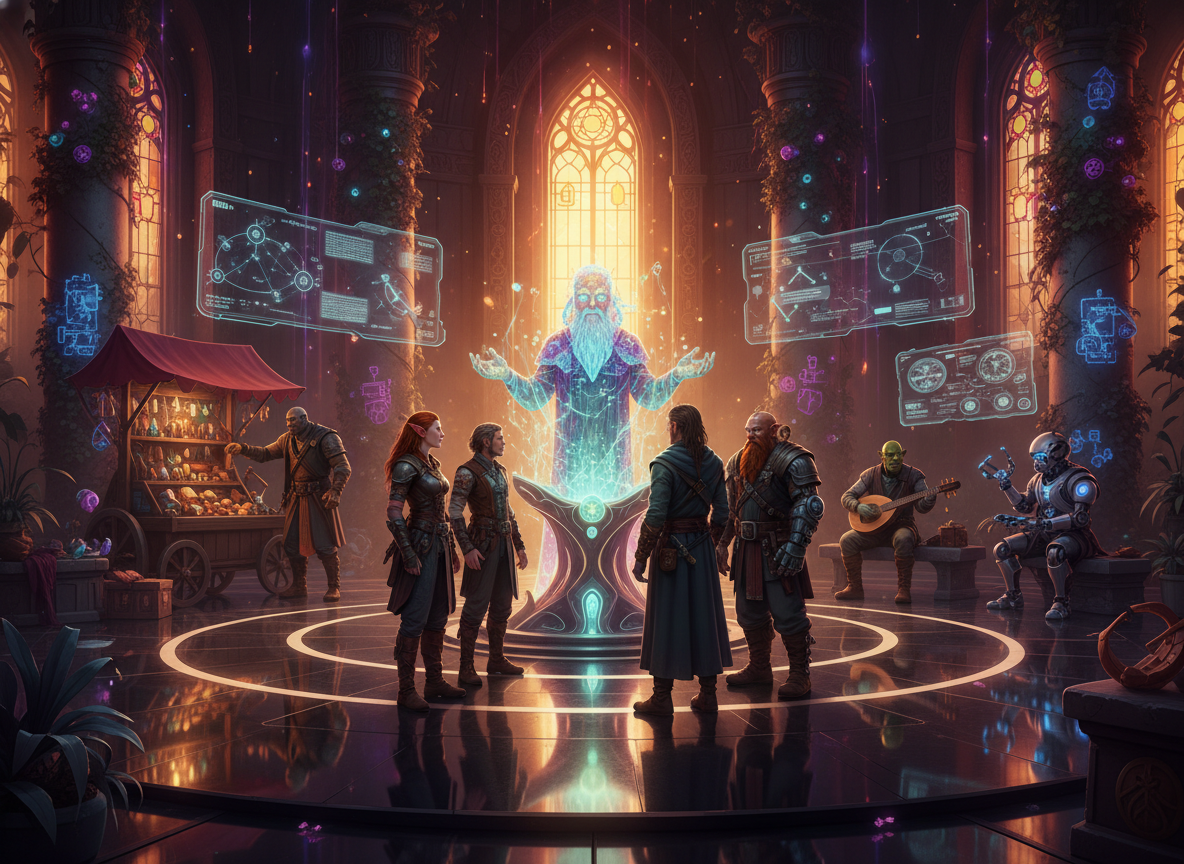
The landscape of Role-Playing Games changed forever on March 31, 2026, with the full release of 'Neural Quest.' Developed by the indie-turned-giant studio Aetheria, the game is the first to completely discard scripted dialogue trees in favor of a real-time Generative AI engine. Every NPC in the game is powered by a localized version of the GPT-6 'Aether' model, allowing for fluid, natural conversations that are unique to every single player's playthrough. The days of hearing the same three lines from a town guard are officially over.
What sets 'Neural Quest' apart is its 'Permanent Memory Architecture.' NPCs do not just respond to what you say; they remember your previous interactions, your reputation in other towns, and even the equipment you are wearing. If you help a blacksmith's daughter in the early hours of the game, that blacksmith will remember your kindness twenty hours later, potentially offering you discounts or unique quests that are generated on-the-fly based on your current needs and gameplay style.
This level of immersion is facilitated by 'Neural Voice Synthesis,' which generates high-quality, emotive voice acting in real-time. The AI can modulate its tone, pitch, and cadence based on the NPC's emotional state—fear, anger, joy, or suspicion. If a player threatens a merchant, the AI doesn't just trigger a 'scared' animation; the merchant's voice will audibly tremble, and they might attempt to negotiate their way out of the situation using logic that matches their established personality traits.
The implications for quest design are staggering. 'Neural Quest' features 'Emergent Objectives,' where the plot is not written by a human designer but is instead a result of the interactions between various AI entities. If two rival factions are at odds, the player can choose to mediate, escalate, or profit from the conflict. The AI leaders of these factions will weigh the player's proposals against their own goals and resources, leading to story outcomes that the developers themselves could never have predicted.
Ethical considerations have naturally followed this technological leap. Aetheria has implemented strict 'Core Directives' for their AI to ensure that NPCs do not generate inappropriate or harmful content. Furthermore, the game includes a 'Reality Check' feature that periodically reminds players they are interacting with synthetic intelligence, a necessary precaution as the lines between digital and human interaction become increasingly blurred by the high-fidelity emotional responses of the characters.
Technically, running such a complex system requires significant local processing power. 'Neural Quest' utilizes the 'NPU' (Neural Processing Unit) found in 2026-era graphics cards and consoles to handle the inference locally, ensuring that dialogue is near-instantaneous and does not require a constant internet connection. This shift toward local AI processing is expected to become the industry standard for all AAA titles by the end of the decade, as cloud-based AI costs remain prohibitive for mass-market gaming.
Critics have hailed 'Neural Quest' as the 'Skyrim moment' of the 2020s. It represents a paradigm shift where the player is no longer just a participant in a story but a co-author. The game's world feels 'alive' in a way that previous titles only simulated through complex scripting. When you walk into a tavern in Neural Quest, the chatter you hear isn't a looped audio file; it is a dozen unique AI agents discussing the events of the game world as they perceive them.
As we move further into 2026, the success of 'Neural Quest' is forcing major studios like Bethesda and BioWare to rethink their upcoming projects. The demand for 'living' worlds is now the primary driver of RPG sales. While human writers are still essential for crafting the overarching world-building and lore, the era of the 'Dialogue Designer' is evolving into the 'AI Personality Architect,' marking a new chapter in the history of interactive entertainment.