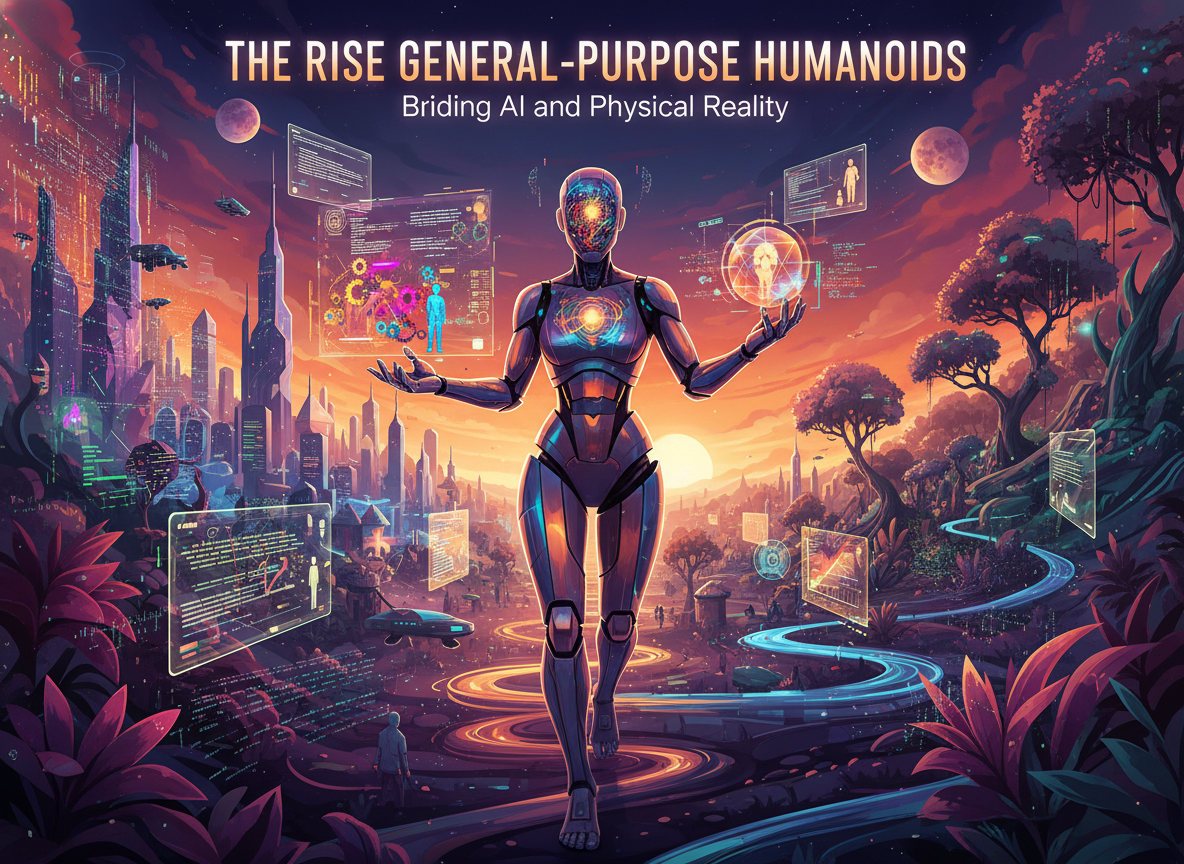
For decades, robotics has been synonymous with specialized machines—robotic arms on assembly lines or vacuum cleaners on carpets. However, the convergence of advanced AI and sophisticated hardware is giving rise to a new category: general-purpose humanoid robots. Unlike their predecessors, these machines are designed to navigate human environments and perform a wide variety of tasks, from moving boxes in a warehouse to performing delicate assembly work. The goal is to create 'embodied AI' that can learn and interact with the physical world just as humans do.
A standout player in this field is Figure AI, which recently demonstrated its Figure 01 robot interacting with humans in real-time. Powered by a custom OpenAI model, the robot can understand spoken commands, reason about its environment, and explain its actions. This integration of a 'brain' (the LLM) with a 'body' (the humanoid hardware) allows the robot to perform tasks it wasn't explicitly programmed for, such as identifying an apple and giving it to a person when they say they are hungry.
Tesla’s Optimus program is another major driver of this trend. Elon Musk has stated that the humanoid robot could eventually become more valuable than the car business. The Optimus Gen 2 features improved actuators, tactile sensors in its fingers, and a more streamlined walk. Tesla’s advantage lies in its ability to leverage the self-driving AI stack and its massive manufacturing capabilities, aiming to produce these robots at a cost that makes them accessible for industrial and eventually domestic use.
The shift in robotics architecture is moving away from rigid, rule-based programming toward 'end-to-end' neural networks. In this approach, the robot learns by observing human actions—either through teleoperation or video data—and then generalizes that behavior to different scenarios. This allows robots to handle the 'messiness' of the real world, such as picking up an object that isn't in a fixed position or reacting to unexpected obstacles in its path.
Boston Dynamics, a pioneer in the field, recently retired its hydraulic Atlas in favor of an all-electric version. The move to electric motors provides better control, efficiency, and a more compact design suitable for commercial scaling. Their new Atlas model showcases range-of-motion capabilities that exceed human limits, such as joints that can rotate 360 degrees, allowing the robot to maneuver in ways a biological human never could. This 'super-humanoid' flexibility is essential for efficient operation in tight industrial spaces.
The labor market implications of humanoid robots are a subject of intense debate. Proponents argue that these machines will fill critical labor shortages in manufacturing, logistics, and elder care, taking over 'dull, dirty, and dangerous' jobs. Critics, however, warn of potential mass displacement of low-skilled workers. The reality will likely be a gradual integration, where robots augment human labor and handle the most repetitive physical tasks, allowing humans to focus on higher-level supervisory and creative roles.
Safety and ethics remain paramount as these machines enter public and private spaces. A 150-pound robot moving around humans poses a physical risk if its software glitches. This necessitates the development of 'soft' robotics, force-sensing skin, and rigorous safety protocols that ensure a robot will stop instantly if it detects a potential collision. Furthermore, the ethical question of how we treat and integrate these human-like entities into society will become more pressing as they become more common.
As we look toward the end of the decade, the presence of humanoid robots in warehouses and factories will likely become a common sight. The transition from specialized machines to general-purpose helpers is one of the most significant technological shifts of our time. By marrying the reasoning capabilities of AI with the physical versatility of the human form, we are creating a tool that can fundamentally reshape the global economy and our daily lives.