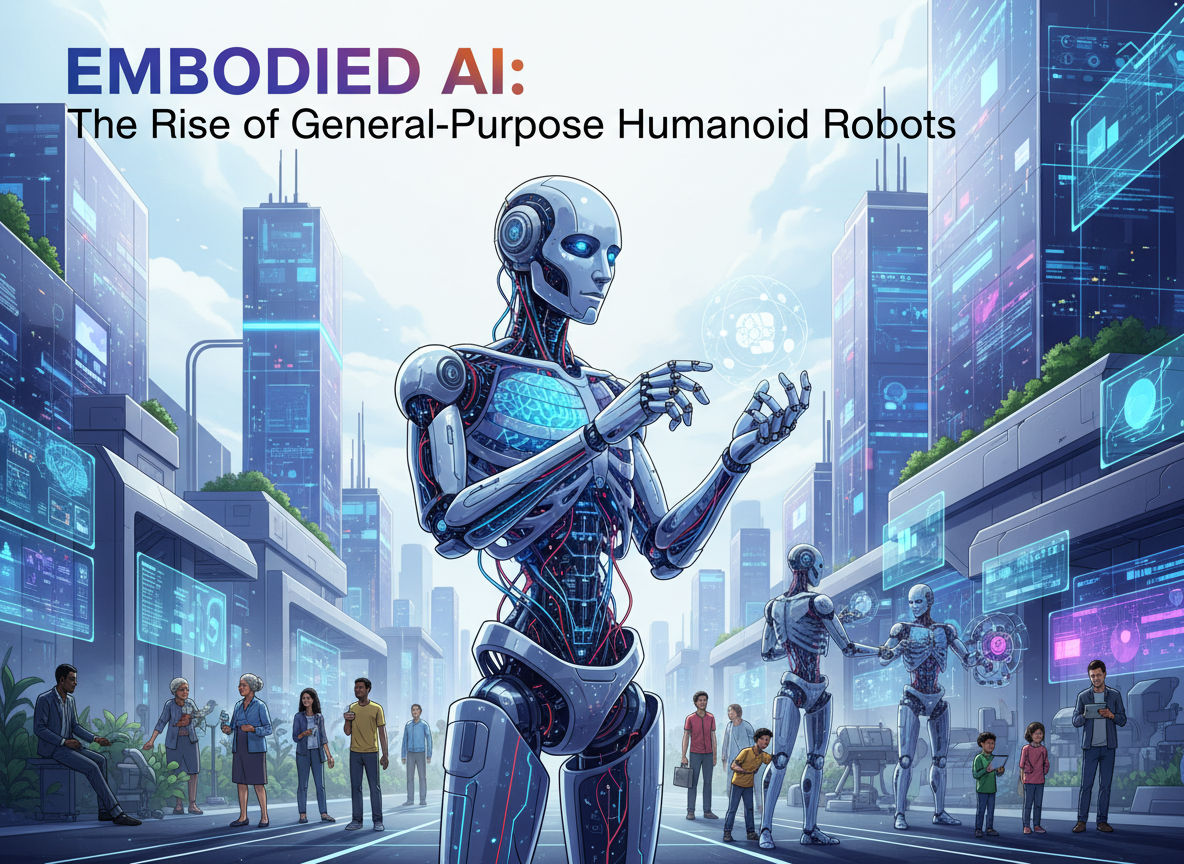
For decades, robotics and artificial intelligence have developed on parallel tracks, with robots excelling at repetitive tasks in structured environments and AI mastering abstract reasoning. Today, those tracks are finally converging in the form of 'Embodied AI,' where neural networks are given physical bodies to interact with the world. The recent demonstrations by companies like Figure AI and Tesla with its Optimus project have shown that humanoid robots can now perform complex, unscripted tasks such as sorting objects or navigating cluttered spaces. This breakthrough is driven by the same transformer architectures that power LLMs, adapted for spatial reasoning and motor control. The result is a machine that can learn by observation and adapt to its surroundings without being explicitly programmed for every move.
The shift toward general-purpose humanoid robots represents a massive departure from the specialized industrial arms found in automotive factories. These new machines are designed to fit into a world built for humans, using the same tools, doorways, and interfaces that we use every day. By utilizing high-torque actuators and advanced sensors, these robots can mimic human dexterity and balance with surprising fluidity. The integration of computer vision allows them to perceive depth, recognize objects, and understand social cues from human coworkers. This versatility makes them ideal candidates for a wide range of applications, from logistics and manufacturing to domestic assistance and elder care, where a human-like form factor is a distinct advantage.
One of the key technical hurdles in embodied AI is the 'sim-to-real' gap, the challenge of training a robot in a virtual simulation and having its skills transfer perfectly to the physical world. Developers use reinforcement learning and high-fidelity physics engines to teach robots how to walk, grab, and manipulate objects in thousands of different scenarios simultaneously. Once a model is sufficiently trained in simulation, it is deployed to the physical robot, where it continues to learn through real-world experience. This iterative process has accelerated the development cycle, allowing robots to acquire skills in weeks that used to take years of manual coding. The use of 'end-to-end' neural networks means the robot's brain can process raw sensor data and output motor commands in a single, unified system.
The economic implications of humanoid robotics are profound, particularly in regions facing labor shortages and aging populations. Industries like warehouse fulfillment and construction are struggling to find workers for physically demanding or repetitive roles, creating a massive market for robotic labor. Unlike specialized automation, a humanoid robot can be repurposed from one task to another by simply loading a new software model. This flexibility lowers the barrier to entry for small and medium-sized enterprises that cannot afford custom-built automation systems. As production scales and the cost of components like sensors and actuators drops, we can expect to see these robots becoming a common sight in both industrial and commercial settings.
Safety and human-robot collaboration are central themes in the design of next-generation humanoids, as these machines must operate alongside people without posing a threat. Modern robots use 'soft' actuators and tactile sensors that allow them to detect contact and stop instantly if they encounter a human. This move toward collaborative robotics (cobots) ensures that machines act as partners rather than replacements, augmenting human capabilities in hazardous or strenuous environments. The goal is to create a seamless interface where humans can communicate with robots using natural language, thanks to the integration of voice-enabled AI models. This level of interaction makes the technology more accessible to non-experts and fosters a more intuitive working relationship.
The hardware challenges of building a humanoid are as significant as the software ones, requiring a balance of power, weight, and battery life. To walk and perform tasks for an entire shift, a robot needs high-density energy storage and efficient power management systems. Engineers are experimenting with lightweight materials like carbon fiber and high-strength alloys to reduce the weight of the limbs while maintaining structural integrity. Cooling is also a major concern, as the high-performance onboard computers and powerful motors generate significant heat. Solving these mechanical engineering puzzles is essential for making humanoid robots practical for real-world deployment beyond the controlled environment of a laboratory.
Ethical considerations regarding the replacement of human labor and the potential for surveillance are also coming to the forefront of the robotics debate. As robots become more autonomous, questions of liability and accountability in the event of an accident become increasingly complex. There are also concerns about the psychological impact of interacting with human-like machines, particularly in sensitive areas like healthcare. Policymakers and ethicists are calling for clear guidelines on how these robots should be deployed and what rights, if any, users should have over their data. Ensuring that the benefits of robotic automation are distributed equitably across society will be a major challenge for governments in the coming decades.
As we look to the future, the rapid evolution of embodied AI suggests that the science fiction vision of personal robot assistants is closer than many realize. The convergence of large-scale AI models with sophisticated mechanical platforms is creating a new category of technology that will fundamentally change how we live and work. We are witnessing the birth of a new industry that could eventually become as ubiquitous as the smartphone or the personal computer. The journey is just beginning, and while many obstacles remain, the potential for humanoid robots to enhance human productivity and quality of life is truly limitless. The robots are no longer just coming; they are learning to walk, and soon they will be running alongside us.