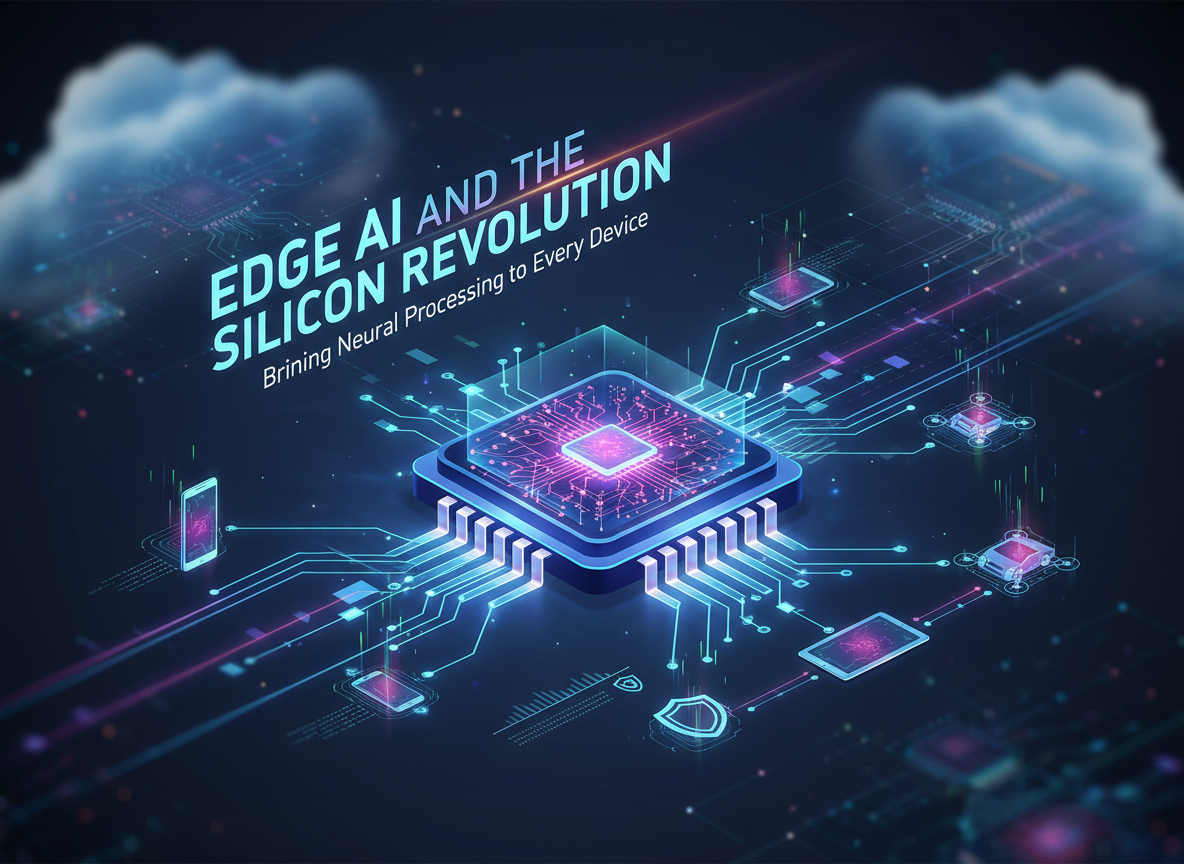
For the past decade, the AI revolution has primarily taken place in massive, energy-hungry data centers, with users accessing powerful models via the cloud. However, a significant shift is underway as 'Edge AI' moves the processing power directly onto local devices like smartphones, laptops, and IoT sensors. This transition is being driven by the need for lower latency, reduced bandwidth costs, and enhanced data privacy. By running neural networks locally, devices can respond to inputs in real-time without needing a constant internet connection. This is particularly critical for applications like autonomous driving and industrial robotics, where even a millisecond of delay can have serious consequences. The 'Silicon Revolution' is providing the specialized hardware needed to make this on-device intelligence possible.
At the heart of the Edge AI movement is the development of Neural Processing Units (NPUs), specialized circuits designed specifically to handle the mathematical operations required for machine learning. Unlike general-purpose CPUs or GPUs, NPUs are optimized for high-efficiency tensor multiplication, allowing them to perform billions of operations per watt of power. Companies like Apple, Qualcomm, and Intel are now integrating dedicated AI silicon into every chip they produce, turning everyday devices into AI powerhouses. This hardware acceleration enables features like real-time language translation, advanced computational photography, and on-device voice recognition to function seamlessly. The competition among semiconductor manufacturers to build the most efficient NPU is the new front line of the global tech race.
Privacy is a major driver for the adoption of Edge AI, as users become increasingly wary of sending their personal data to the cloud for processing. When AI tasks are handled locally, sensitive information like voice recordings, health data, and private photos never leave the device. This 'privacy-by-design' approach is becoming a key selling point for consumer electronics and a requirement for enterprise applications in regulated industries. Furthermore, on-device AI reduces the risk of large-scale data breaches, as there is no central repository of user data for hackers to target. As privacy regulations tighten globally, the ability to offer powerful AI features without compromising user data is a significant competitive advantage.
The emergence of 'Small Language Models' (SLMs) is another critical factor in the rise of Edge AI, as researchers find ways to condense the capabilities of massive models into a fraction of the size. Through techniques like quantization, pruning, and knowledge distillation, these compact models can run on mobile hardware without sacrificing too much performance. This allows for sophisticated generative AI experiences, such as text summarization and image generation, to happen entirely offline. The development of SLMs democratizes access to AI, as it reduces the reliance on expensive cloud infrastructure and makes advanced technology accessible in areas with limited connectivity. We are moving toward a world where every object around us has a degree of 'ambient intelligence.'
In the industrial sector, Edge AI is transforming manufacturing through predictive maintenance and real-time quality control. Sensors on factory floors can now analyze vibrations, sounds, and thermal data locally to detect signs of equipment failure before it happens. This proactive approach minimizes downtime and saves companies millions in repair costs. In agriculture, AI-powered drones and tractors can process visual data on the fly to identify pests and optimize the application of fertilizers and pesticides. The ability to make intelligent decisions at the 'edge' of the network is making our global supply chains and production systems more resilient and efficient. This integration of AI and IoT is often referred to as the Artificial Intelligence of Things (AIoT).
Energy efficiency is perhaps the most significant challenge for Edge AI, as mobile devices have limited battery capacity compared to the virtually unlimited power of a data center. Developers are constantly looking for ways to optimize AI models to run with minimal power consumption, often using 'sparse' neural networks that only activate the necessary neurons for a given task. Advancements in memory architecture, such as 'Compute-in-Memory' (CiM), are also helping to reduce the energy cost of moving data between the processor and storage. As we move toward a trillion-sensor economy, the sustainability of our hardware will be just as important as its performance. Innovation in low-power silicon is the key to making the AI-powered future a sustainable one.
The software ecosystem for Edge AI is also maturing, with frameworks like TensorFlow Lite and PyTorch Mobile providing developers with the tools to deploy models across a wide variety of hardware. These platforms abstract the complexity of different chip architectures, making it easier to build applications that run efficiently on everything from a high-end smartphone to a low-power microcontroller. There is also a growing movement toward 'federated learning,' a technique where AI models are trained across many decentralized edge devices without ever exchanging the raw data itself. This allows for the collective intelligence of the network to improve while maintaining the privacy of individual users. The synergy between optimized software and specialized hardware is the foundation of the Edge AI revolution.
As we look forward, the distinction between 'online' and 'offline' devices will continue to blur as everything becomes inherently intelligent. The silicon revolution is not just about making devices faster; it's about making them smarter and more autonomous. From wearable health monitors that can predict a heart attack to smart glasses that provide an augmented reality overlay of the world, Edge AI will be the invisible force powering the next generation of human-computer interaction. The shift away from centralized cloud AI toward a distributed, local model is a fundamental change in the architecture of the internet. In this new era, the power of artificial intelligence will truly be in the palm of your hand.