Newtechzy
  • Home
  • News
  • Technology and AI
  • Personal Finance and Money
  • Health and Fitness
  • Food and Recipes
  • Travel
  • Fashion and Beauty
  • Online Earning and Side Hustle
  • Gaming
  • Education and Tutorials
  • Product Reviews and Affiliate Marketing

At Newtechzy, every click is an adventure in the digital world. Whether you're a tech enthusiast or a casual user, we're your go-to for the latest technology news, innovations, and trends.

Subscribe to our newsletters. We'll keep you in the loop.

HomeAbout UsContactPrivacy PolicyTerms & ConditionsDisclaimer

© 2026 Newtechzy. All rights reserved. Technology news, reviews and innovations platform.

Home/technology-and-ai/The Convergence of Neural Interfaces and Spatial Computing
The Convergence of Neural Interfaces and Spatial Computing
technology-and-ai

The Convergence of Neural Interfaces and Spatial Computing

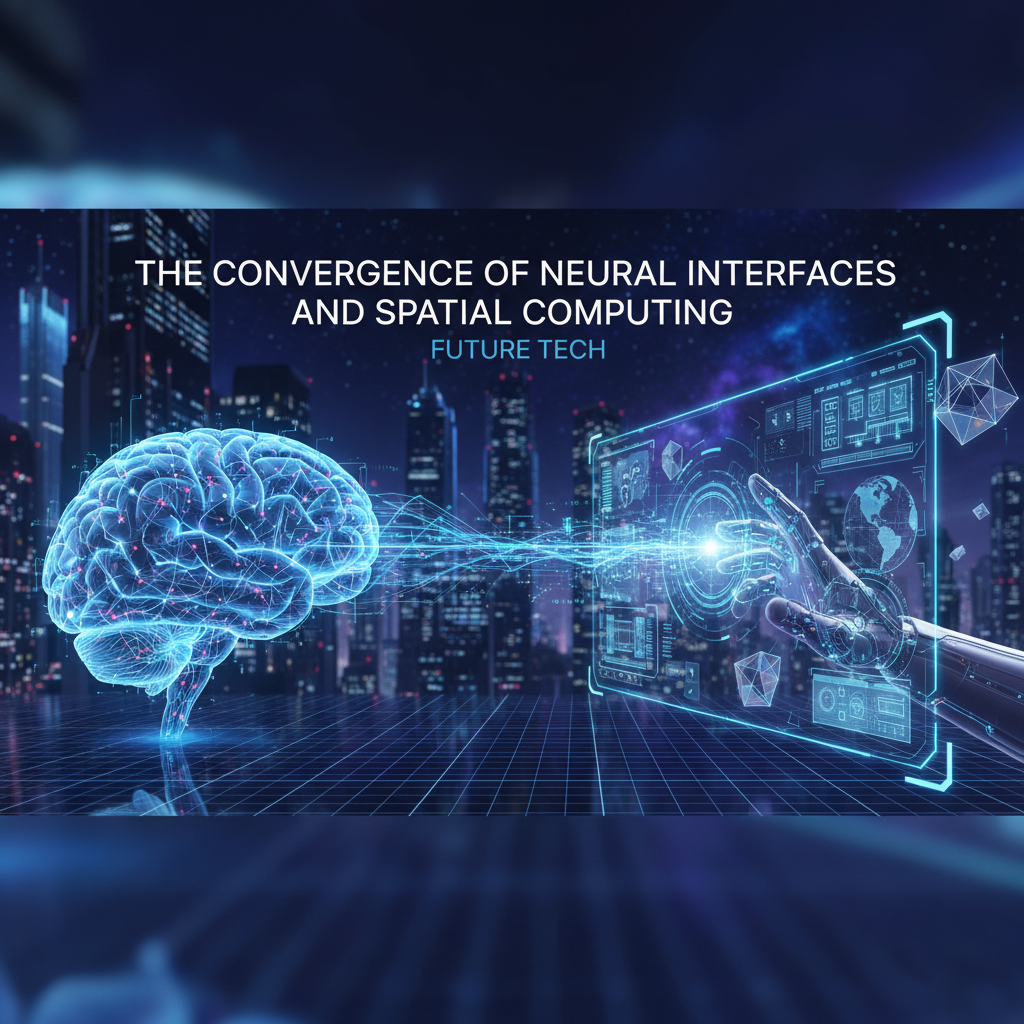
Exploring how direct brain-computer interfaces are merging with augmented reality to redefine human interaction with digital environments in the late 2020s.

March 29, 20268-10 minutes

As we approach the end of the decade, the boundary between our physical reality and the digital layer has become increasingly porous. Spatial computing, once limited to bulky headsets and handheld controllers, is undergoing a radical transformation through the integration of Neural Interfaces. This synergy represents the next great leap in human-computer interaction, moving beyond tactile input into the realm of direct cognitive intent.

The current generation of non-invasive BCI devices utilizes high-density EEG and fNIRS sensors embedded within lightweight glasses. These sensors can interpret pre-motor cortex signals, allowing users to select objects or scroll through menus before they even physically move their hands. This 'zero-latency' interaction makes digital elements feel like natural extensions of the physical world, creating an unparalleled sense of presence and agency within spatial environments.

Beyond simple navigation, the convergence of these technologies is enabling what researchers call 'Shared Cognitive Spaces.' In these environments, multiple users can collaborate on 3D models or complex datasets where the system adapts in real-time to the collective focus and mental load of the participants. By monitoring cognitive strain, the software can automatically simplify visual information or provide AI-driven assistance, ensuring optimal productivity without overwhelming the user.

However, this level of intimacy with our neural data brings forth significant ethical challenges. The concept of 'Cognitive Privacy' has moved from academic debate to the forefront of legislative agendas. As our devices become capable of interpreting our subconscious reactions to digital stimuli, the need for robust, decentralized encryption of neural data is paramount. Future systems must be designed with 'Neural-Privacy-by-Design' to ensure that our thoughts remain our own.

Looking toward 2030, the maturation of these technologies suggests a world where the hardware becomes invisible. We are moving toward a 'Silent Interface' era, where the digital world responds to our needs intuitively. The fusion of spatial computing and neural interfaces is not just about new gadgets; it is about the evolution of the human experience itself, expanding the horizons of how we learn, create, and connect with one another.


Share This:
XFBLIWA

Recent Posts

The Dawn of Reasoning: How System 2 AI is Transforming Complex Problem Solving
technology-and-ai

The Dawn of Reasoning: How System 2 AI is Transforming Complex Problem Solving

Alex Sterling
The Paradigm Shift: How On-Device AI is Redefining Privacy and Performance
technology-and-ai

The Paradigm Shift: How On-Device AI is Redefining Privacy and Performance

Elena Vance
The Rise of Agentic AI: Why Workflows are the Next Frontier
technology-and-ai

The Rise of Agentic AI: Why Workflows are the Next Frontier

Jordan Vance
The Dawn of Reasoning Models: Moving Beyond Next-Token Prediction
technology-and-ai

The Dawn of Reasoning Models: Moving Beyond Next-Token Prediction

Marcus Sterling
NeuralinkARSpatial ComputingBCICybernetics

Related Posts

Liquid AI Unveils Non-Transformer Models for Dynamic Data
technology-and-ai

Liquid AI Unveils Non-Transformer Models for Dynamic Data

2024-11-07
Quantum Computing Milestone: Achieving Fault-Tolerant Logical Qubits
technology-and-ai

Quantum Computing Milestone: Achieving Fault-Tolerant Logical Qubits

2024-11-09
Logical Qubits: Solving the Error Correction Puzzle in Quantum Computing
technology-and-ai

Logical Qubits: Solving the Error Correction Puzzle in Quantum Computing

2024-05-18
Quantum Computing Breakthroughs: Solving the Error Correction Puzzle
technology-and-ai

Quantum Computing Breakthroughs: Solving the Error Correction Puzzle

2023-11-21