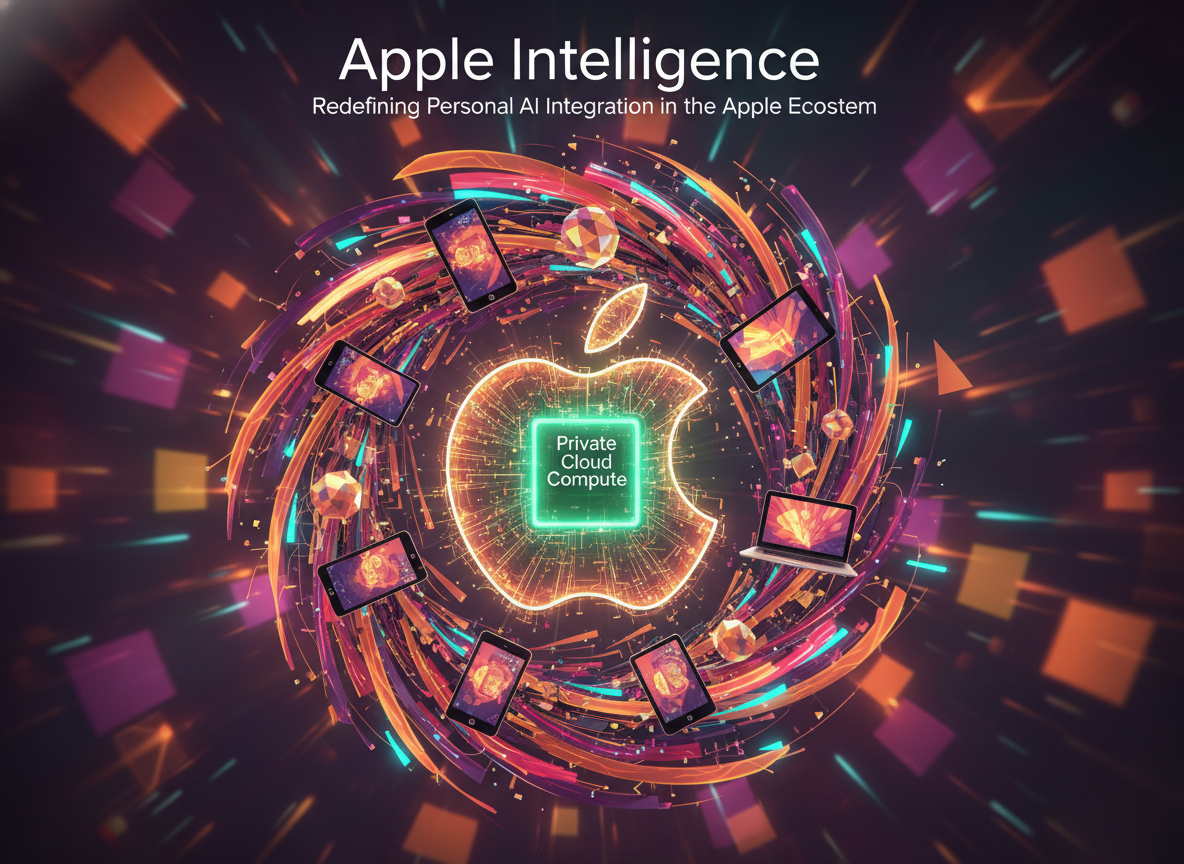
For a long time, the tech world wondered when Apple would make its move in the generative AI race. With the announcement of 'Apple Intelligence' at WWDC 2024, the company finally revealed its strategy. Rather than launching a standalone chatbot, Apple is weaving AI into the very fabric of its operating systems—iOS, iPadOS, and macOS. Their approach is distinctly 'Apple': a focus on personal context, deep system integration, and an uncompromising commitment to user privacy.
At the heart of Apple Intelligence is the concept of personal context. Most AI models operate in a vacuum, knowing nothing about your schedule, your relationships, or your recent emails. Apple’s system, however, can tap into your data across various apps to provide highly relevant assistance. If you ask, 'When is my mom’s flight landing?' the AI can scan your emails for the flight details and cross-reference them with real-time flight tracking, all without the data ever leaving your device.
Privacy is the cornerstone of Apple’s AI architecture. While many companies process AI requests in the cloud where data could be vulnerable, Apple prioritizes on-device processing. For tasks that require more compute power than a phone can provide, Apple introduced 'Private Cloud Compute.' This involves custom Apple silicon servers that process data in a secure, verifiable way, ensuring that the data is never stored or accessible to anyone—even Apple.
The integration with Siri is perhaps the most visible change for users. The virtual assistant, which has often lagged behind competitors, is getting a massive upgrade. Siri will now have 'screen awareness,' allowing it to understand what you are looking at and take actions within apps. For example, if a friend texts you a new address, you can simply tell Siri to 'add this to his contact card,' and it will understand the context and perform the task seamlessly across apps.
Apple has also entered a strategic partnership with OpenAI, allowing users to opt into using ChatGPT for broader world-knowledge queries. This is a pragmatic move that recognizes that while Apple is great at personal context, others have built more powerful general-purpose knowledge engines. The integration is handled with typical Apple polish, asking for user permission before sending any data to OpenAI and masking the user's IP address to protect their identity.
The 'AI iPhone' upgrade cycle is a significant driver for this rollout. Apple Intelligence will only run on the latest hardware—iPhone 15 Pro and newer—due to the heavy demands on the Neural Engine and RAM. This move is expected to trigger a massive refresh of the iPhone user base, as consumers look to take advantage of new features like 'Genmoji' (AI-generated emojis), 'Image Wand,' and advanced writing tools that can rewrite, proofread, and summarize text across the system.
Critics have pointed out that Apple is 'late' to the AI party, but the company’s history shows a preference for being 'best' rather than 'first.' By focusing on the user experience and privacy, Apple is positioning itself to make AI a daily utility for hundreds of millions of people who may not be 'tech-savvy' enough to use standalone AI tools. Their goal is to make AI feel like a natural extension of the device, rather than a separate, complex feature.
As Apple Intelligence begins its rollout, it will set a new standard for how mobile devices interact with their owners. The focus on local, private, and contextual AI is a compelling alternative to the centralized, data-hungry models of its competitors. If successful, Apple will not only have caught up in the AI race but will have redefined the rules of the game for the entire mobile industry.