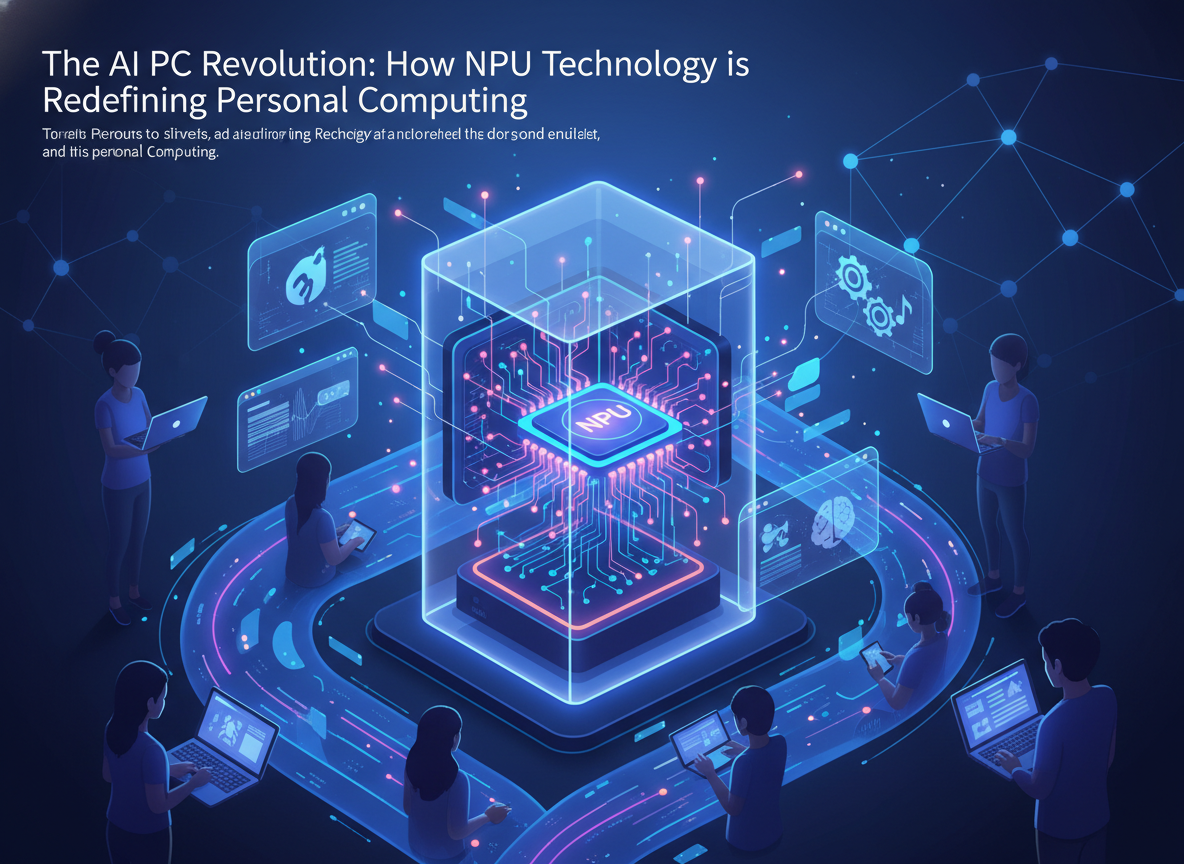
The personal computer is undergoing its most significant architectural shift in decades with the introduction of the 'AI PC.' Unlike traditional laptops that rely solely on the CPU and GPU, these new machines feature a dedicated Neural Processing Unit (NPU) designed specifically to handle machine learning tasks locally. This shift is being championed by industry giants like Microsoft, Intel, and Qualcomm, who argue that the future of computing lies in 'on-device' AI. By moving AI processing from the cloud to the local hardware, users gain advantages in speed, privacy, and battery efficiency, marking the end of the era where AI was synonymous with high latency and data center reliance.
Qualcomm's Snapdragon X Elite has emerged as a formidable challenger in this space, bringing mobile-first efficiency to the Windows ecosystem. With its Hexagon NPU capable of 45 Trillion Operations Per Second (TOPS), it sets a high bar for performance, enabling features like real-time language translation and advanced noise cancellation without draining the battery. This benchmark has forced traditional chipmakers like Intel and AMD to accelerate their roadmap, leading to the release of the Core Ultra and Ryzen AI series. The competition is fierce, as the winner will likely dictate the hardware standards for the next decade of enterprise and consumer computing.
Microsoft's Copilot+ PC initiative serves as the software backbone for this hardware transition. By integrating AI deeply into the Windows 11 kernel, Microsoft is enabling features like 'Recall,' which uses local AI to index everything a user sees on their screen, making it searchable through natural language. While controversial from a privacy standpoint, it demonstrates the sheer power of local AI to enhance productivity. The goal is to create a 'photographic memory' for the computer, allowing it to understand context and assist users in ways that were previously impossible without sending sensitive data to external servers.
Apple has also entered the fray with 'Apple Intelligence,' leveraging its custom silicon to bring generative AI to the Mac and iPad. Apple’s approach emphasizes the synergy between the NPU and their unified memory architecture, allowing for large language models to run smoothly on portable devices. By prioritizing 'Private Cloud Compute' for tasks too heavy for the device, Apple is attempting to set a standard for how AI can be both powerful and privacy-centric. This move ensures that the AI PC trend isn't limited to the Windows ecosystem, making intelligent computing a universal expectation for all high-end hardware.
The primary driver behind the NPU trend is the need for efficiency. Generative AI models are notoriously power-hungry, and running them on a traditional GPU can quickly deplete a laptop's battery. The NPU solves this by using a specialized architecture optimized for the matrix mathematics required by neural networks, consuming a fraction of the power of a general-purpose processor. This allows for 'always-on' AI features, such as eye-contact correction during video calls or background malware detection, to run continuously in the background without impacting the user's primary tasks or thermal performance.
For developers, the rise of the AI PC means a fundamental change in how software is written. Instead of building applications that call cloud APIs, developers are now using frameworks like ONNX and Windows ML to deploy models directly to the NPU. This reduces the cost of running AI features, as there are no server fees involved, and allows for much lower latency in user interactions. We are already seeing this impact in creative software like Adobe Premiere and DaVinci Resolve, where AI-driven features like auto-reframe and rotoscoping are now instantaneous thanks to local hardware acceleration.
Privacy and security are the most significant selling points of the AI PC era. As AI becomes more personal, the data it processes—emails, documents, and private photos—becomes increasingly sensitive. By keeping this data on the device, manufacturers can guarantee that no third party, including the AI provider itself, has access to the user's information. This 'edge computing' model is essential for enterprise adoption, where data sovereignty and regulatory compliance are paramount. The AI PC is not just about speed; it is about creating a secure vault for our digital lives.
As we look to the future, the definition of a 'standard' PC will inevitably include a high-performance NPU. We are currently in the early adoption phase, similar to the introduction of dedicated graphics cards in the 1990s. As software caught up to that hardware, it revolutionized gaming and professional design; similarly, as AI-native applications become the norm, the NPU will become the most important component in our devices. The AI PC revolution is just beginning, and it promises to turn our computers from tools we use into partners that understand us.