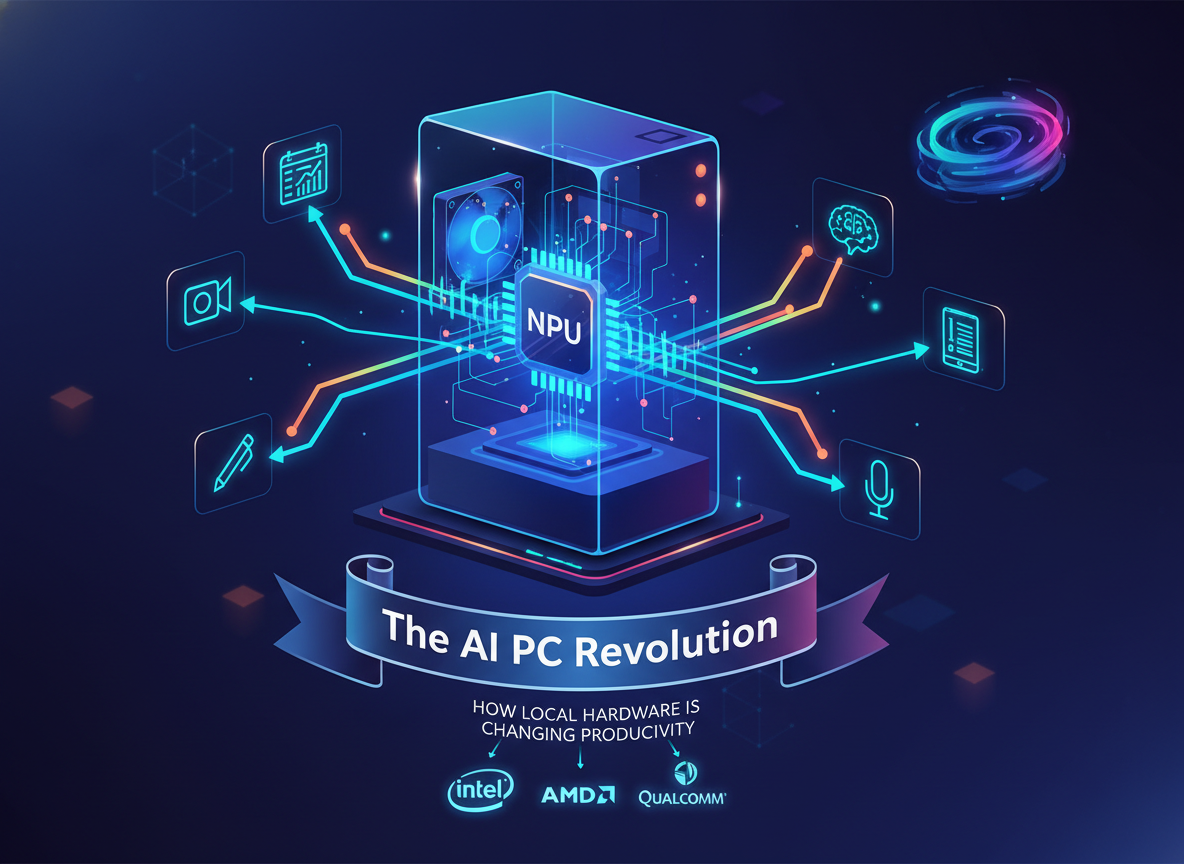
The shift from cloud-based AI to Edge AI is marking a new era in personal computing, frequently referred to by industry leaders as the AI PC revolution. This transition is characterized by moving the heavy lifting of machine learning from remote data centers directly onto the local silicon of consumer laptops and desktop workstations.
Major chipmakers like Intel, AMD, and Qualcomm are now integrating dedicated Neural Processing Units (NPUs) directly into their system-on-a-chip (SoC) designs to handle AI tasks locally. These NPUs are optimized for the mathematical operations required by neural networks, providing a massive efficiency boost compared to traditional CPUs and GPUs.
This localized processing offers significant benefits in terms of privacy, as sensitive user data no longer needs to be transmitted to remote servers for processing and storage. For enterprises dealing with confidential intellectual property, the ability to run large language models locally is a critical requirement for maintaining security standards.
Performance is also a key driver of this hardware shift, as on-device AI significantly reduces latency, allowing for seamless real-time features like instant background blur and noise cancellation. Users can now expect AI-assisted tools to respond instantly, providing a more fluid and intuitive experience across the entire operating system.
Software developers are quickly optimizing their applications to leverage these new hardware capabilities, leading to a surge in AI-powered productivity tools across various sectors. From real-time code suggestions to automated photo editing, the integration of local hardware acceleration is transforming software design principles.
Microsoft's integration of Copilot into Windows is a prime example of how the operating system itself is being reimagined with AI at its core. By utilizing local NPU power, Windows can provide proactive assistance and intelligent search capabilities without consuming excessive battery life or requiring an active internet connection.
The battery life of laptops is seeing remarkable improvements, as NPUs are far more energy-efficient at specific AI tasks than traditional high-power processors. This efficiency allows for thin-and-light devices to perform complex computational tasks that were previously reserved for bulky workstations or high-end gaming laptops.
As the market matures, the distinction between a traditional computer and an AI PC will disappear, making local intelligence a standard feature for all users. We are witnessing the birth of a new computing paradigm where the hardware is as smart as the software it runs, forever changing how we interact with our digital tools.