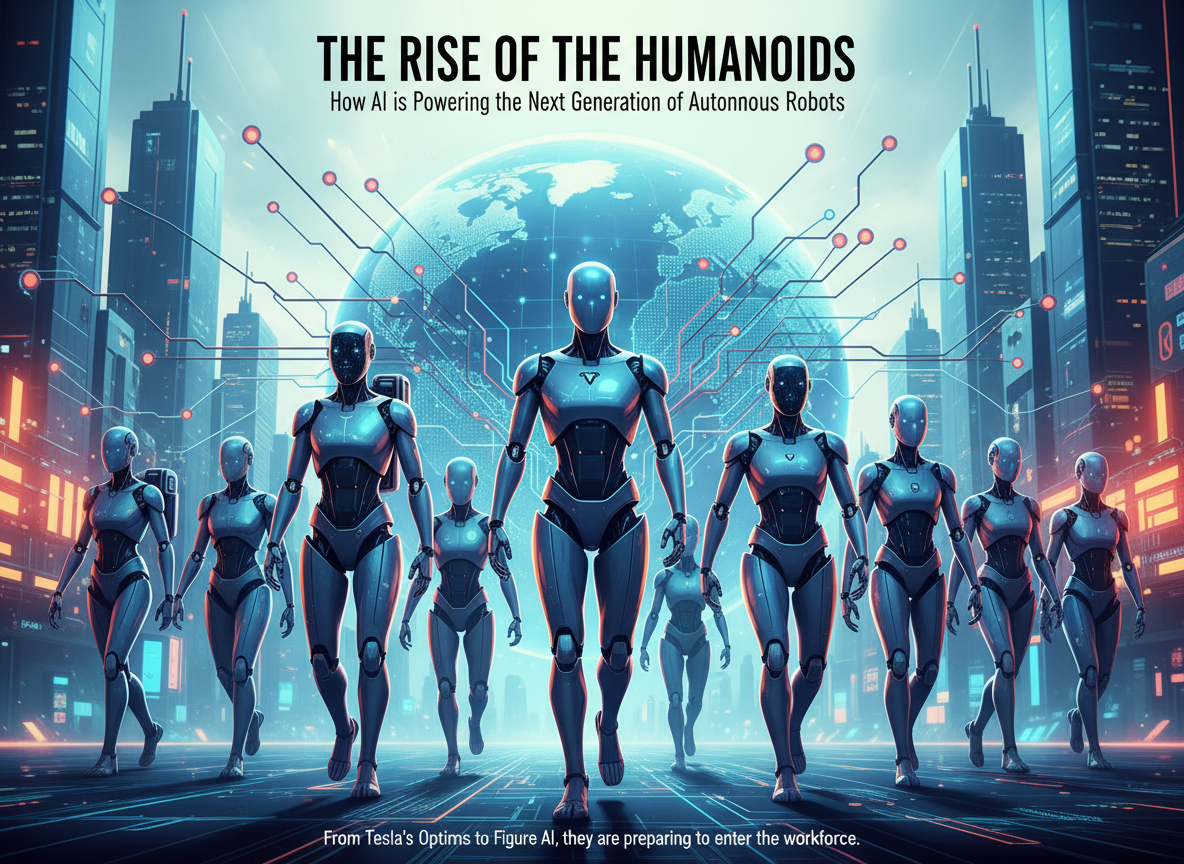
The dream of having autonomous humanoid robots working alongside humans is rapidly transitioning from science fiction to industrial reality. In recent months, breakthroughs in 'Physical AI' have allowed robots to move beyond pre-programmed routines and start learning through observation and neural network training. Companies like Figure AI and Tesla are leading the charge, developing bipedal machines that can navigate complex environments, identify objects with precision, and perform delicate tasks that were previously thought to be the exclusive domain of human hands. This evolution is driven by the convergence of high-performance hardware and the latest advancements in large language and vision models.
Figure AI recently made headlines with a demonstration of its Figure 01 robot, which uses OpenAI's models to engage in real-time conversation while performing tasks like clearing a table. This integration of 'brain' and 'body' allows the robot to understand natural language commands and execute them with a level of fluidity that is unprecedented. When asked for something to eat, the robot identified an apple, picked it up, and handed it to the human, demonstrating a seamless loop of perception, reasoning, and action. This marks a significant departure from traditional robotics, where every movement had to be meticulously coded by engineers.
Tesla's Optimus project is another major player in the field, with Elon Musk predicting that humanoid robots could eventually become more valuable than the company's automotive business. The latest Gen-2 Optimus features custom-designed actuators and sensors that give it the ability to walk faster and manipulate fragile objects, such as eggs, without breaking them. Tesla's advantage lies in its massive data pipeline from its self-driving car division and its expertise in battery technology and mass production. By treating the humanoid robot as a 'car on two legs,' Tesla aims to leverage its existing AI infrastructure to bring Optimus to market at an affordable price point.
The underlying technology enabling this rapid progress is the transition to end-to-end neural networks. Instead of using traditional heuristics and hard-coded logic for balance and movement, modern humanoids are being trained using reinforcement learning in simulated environments and through imitation learning from human demonstrations. This allows robots to develop a 'motor intuition' that helps them recover from stumbles or adapt to changing floor surfaces. As these models ingest more data, the robots become more capable and versatile, reducing the time it takes to teach them new skills from months to just a few days.
Industrial applications for humanoid robots are the primary focus for early deployment, specifically in warehousing, logistics, and manufacturing. These environments are often designed for human proportions, making humanoid forms more suitable than traditional wheeled robots or robotic arms. Humanoids can climb stairs, reach high shelves, and use the same tools that human workers use, meaning companies don't have to redesign their entire facilities to accommodate automation. As global labor shortages continue to impact the supply chain, these robots are seen as a vital solution for maintaining productivity in physically demanding roles.
Beyond the factory floor, there is significant interest in the potential for humanoid robots in the caregiving and service sectors. With an aging global population, the demand for assistants who can help with mobility, household chores, and even companionship is skyrocketing. While the social and ethical implications of using robots for care are still being debated, the technical feasibility is becoming clearer. A robot that can gently assist an elderly person in getting out of bed or remind them to take their medication could provide a level of independence and safety that is currently difficult to achieve with human staff alone.
The challenges facing the humanoid industry are still substantial, particularly regarding battery life and power density. To be truly useful, a robot needs to operate for a full shift on a single charge, which requires high-efficiency motors and lightweight materials. Additionally, the cost of the sophisticated sensors and joints remains high, though it is expected to drop as production scales up. Regulatory and safety standards also need to be established to ensure that these powerful machines can safely operate in close proximity to humans without the need for protective cages or barriers.
As we look to the future, the integration of humanoid robots into society will likely be one of the most transformative events of the 21st century. It will force us to rethink the nature of work, the value of manual labor, and the relationship between humans and machines. While we are still in the early 'mainframe' era of robotics, the pace of innovation suggests that we are not far from a 'PC' moment where humanoid robots become a common sight in both workplaces and homes. The journey from specialized tools to general-purpose autonomous assistants is well underway, and the world is about to look very different.