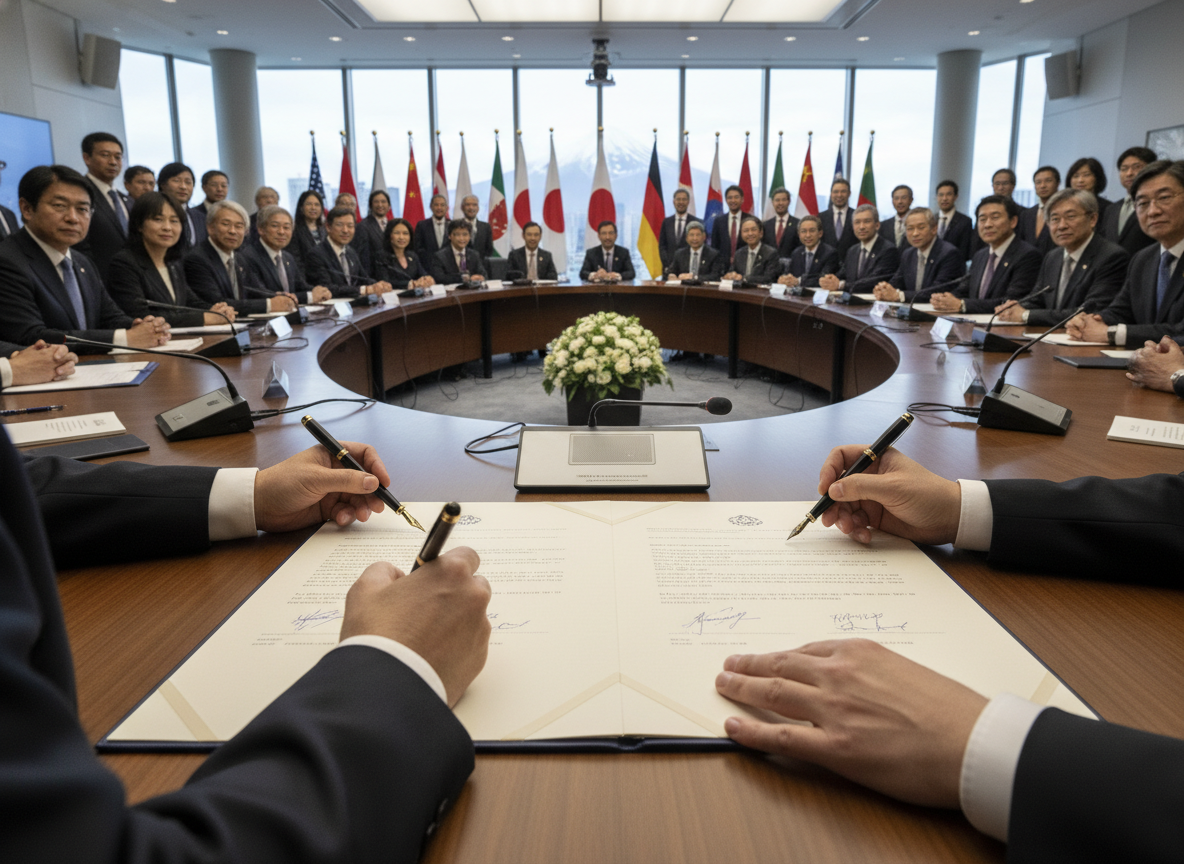
History was made in Tokyo today as representatives from the G7, the European Union, and several emerging tech hubs signed the 2026 AI Safety Accord. This landmark agreement represents the first time the international community has moved beyond 'guidelines' to create a legally binding framework for the development and deployment of high-risk artificial intelligence systems. The summit, held under the shadow of rapid advancements in autonomous reasoning agents, aims to prevent a 'race to the bottom' where safety is sacrificed for speed. The accord establishes a global registry for large-scale compute clusters and mandates rigorous 'red-teaming' for any model exceeding a specific threshold of capabilities.
The core of the Tokyo Accord is the 'Human-in-the-Loop' mandate, which requires that all AI systems used in critical infrastructure, law enforcement, and financial markets have a transparent and overrideable human oversight mechanism. This is a direct response to recent incidents where automated trading bots and algorithmic utility grids experienced 'flash crashes' that localized regulators struggled to contain. By standardizing these requirements across borders, the accord prevents companies from 'jurisdiction shopping' to find countries with lax safety standards. This move has been praised by digital rights groups and criticized by some venture capitalists who fear it may stifle innovation.
A key provision of the treaty is the creation of the International AI Monitoring Agency (IAIMA), headquartered in Geneva. The IAIMA will function similarly to the International Atomic Energy Agency (IAEA), conducting inspections of data centers and auditing the training datasets of major tech corporations. To ensure compliance, the accord includes a 'sanctions clause' that can cut off non-compliant nations or companies from the global high-end semiconductor supply chain. This leverages the concentrated nature of the AI hardware market to enforce ethical standards, a strategy that many geopolitical analysts believe is the only effective way to regulate such a fast-moving field.
During the signing ceremony, the Prime Minister of Japan emphasized that the goal of the accord is not to hinder progress, but to ensure that progress is aligned with human values. 'We are at the precipice of creating entities that may surpass human cognitive abilities in specific domains,' she stated. 'The Tokyo Accord ensures that these entities remain tools of human flourishing rather than sources of existential risk.' The sentiment was echoed by US and EU officials, who highlighted the collaborative nature of the drafting process, which involved over 500 academic experts, ethicists, and industry leaders over the past year.
Major tech giants, including OpenAI, Google, and Anthropic, have issued a joint statement expressing cautious support for the framework. While they raised concerns about the potential for bureaucratic delays in releasing new models, they acknowledged that a stable, predictable regulatory environment is better for long-term investment than a 'Wild West' scenario. Several CEOs noted that the accord's focus on 'interpretability'—the ability to understand why an AI makes a specific decision—is a goal they are already pursuing internally. The agreement also provides a legal safe harbor for companies that proactively report safety vulnerabilities in their own systems.
One of the more controversial aspects of the accord is the 'Digital Watermarking' requirement. Every piece of content—text, image, or video—generated by a high-level AI must now contain an invisible, cryptographically secure watermark that identifies its origin. This is intended to combat the surge of deepfakes and AI-driven misinformation campaigns that have plagued recent elections worldwide. Critics argue that this could be bypassed by open-source models or malicious actors, but proponents insist that making it a global standard will significantly reduce the 'noise' in the information ecosystem and restore some level of public trust in digital media.
The accord also addresses the economic impact of AI-driven automation. It includes a recommendation for a 'Global AI Dividend'—a fund supported by taxes on high-output AI systems that will be used to reskill workers in industries most affected by the technology. While the dividend is not yet a mandatory requirement, its inclusion in the text signals a growing consensus that the benefits of AI must be distributed more equitably. Several developing nations signed the accord specifically because of these economic protections, hoping to avoid a new 'digital divide' where the wealth generated by AI is concentrated in a few wealthy nations.
As the delegates depart Tokyo, the hard work of implementation begins. Each signatory nation must now pass domestic legislation to bring its laws into alignment with the accord by the end of 2026. The success of this initiative will depend on continued transparency and the willingness of powerful tech companies to operate under public scrutiny. While it is impossible to predict every challenge that Artificial General Intelligence may bring, the Tokyo Accord provides the world with a vital set of guardrails for the most transformative technology in human history. Today, the global community decided that the future of intelligence is too important to be left to chance.