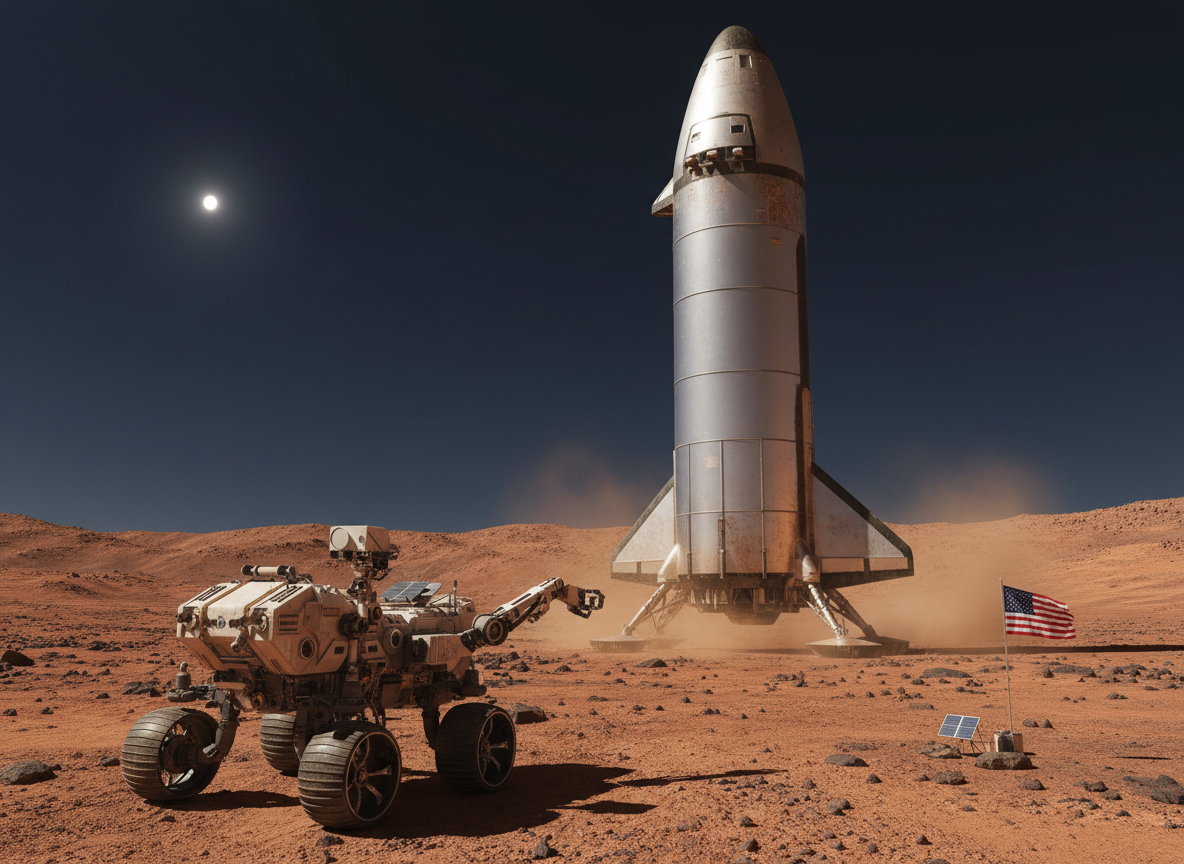
In the early hours of April 8, 2026, mission control in Boca Chica, Texas, erupted in cheers as the Starship 'Pathfinder' successfully touched down on the dusty plains of Mars. This mission, the first successful landing of a fully reusable heavy-lift vehicle on another planet, marks the beginning of a new era in interplanetary logistics. The spacecraft, which launched six months ago during the 2025-2026 Mars window, autonomously navigated the complex 'entry, descent, and landing' sequence, utilizing its signature 'belly-flop' maneuver to shed velocity before a precision landing.
The Pathfinder mission carried over 50 tons of scientific equipment and infrastructure, including a prototype oxygen generation plant and an automated solar array deployment system. Unlike previous robotic missions that delivered small rovers, Starship's massive payload capacity allows for the delivery of entire laboratories and habitats in a single flight. This successful landing validates Elon Musk's vision of a 'Mars cargo line' that can sustain a future human colony with regular deliveries of supplies and equipment.
Initial data transmitted back to Earth via the Starlink-Mars satellite constellation indicates that the ship landed within 20 meters of its intended target in the Jezero Crater, near the site of NASA's Perseverance rover. The landing leg system, which was a point of concern during development, performed flawlessly on the uneven Martian terrain. High-resolution cameras on the ship have already begun beaming back 8K footage of the landing site, providing the most detailed view of the Martian surface ever captured by a landing craft.
NASA Administrator Bill Nelson released a statement shortly after the landing, congratulating SpaceX on what he called a 'monumental achievement for all of humanity.' While this was a private mission, NASA provided critical deep-space tracking support and collaborated on several of the scientific payloads. The success of Pathfinder is seen as a major boost for the Artemis program, as NASA plans to use a modified version of Starship for its upcoming crewed lunar missions later this decade.
The oxygen generation experiment onboard, known as 'MOXIE-2,' will begin its first run tomorrow. This scaled-up version of the original MOXIE instrument is designed to produce 10 kilograms of oxygen per hour by processing the Martian atmosphere. If successful, it will prove that future astronauts can breathe and produce rocket propellant on-site, a process known as In-Situ Resource Utilization (ISRU) that is essential for any long-term Martian presence.
In addition to the oxygen plant, the Pathfinder carried a swarm of 'Mars-Drones'—small, autonomous flying vehicles designed to map the surrounding terrain in three dimensions. These drones will help identify the best locations for future Starship landings and the eventual construction of 'Mars Base Alpha.' The data gathered over the next few weeks will be crucial for the 2028 mission, which SpaceX hopes will carry the first human crew to the Red Planet.
The successful landing has also sparked a renewed debate about the ethics of Mars colonization and the protection of potential Martian microbes. Planetary protection officers at various space agencies are closely monitoring the mission to ensure that the Starship—which underwent rigorous sterilization—does not contaminate the site. As private companies take the lead in space exploration, the need for an updated 'Outer Space Treaty' has become a priority for international legal bodies.
Tonight, as the Starship Pathfinder sits silently on the cold Martian surface, the world watches the high-definition stream of a new world. The dream of becoming a multi-planetary species has never felt more tangible. With the cargo route now proven, the countdown to the first human footprints on Mars has officially begun, and the date for that historic event is likely closer than anyone would have dared to predict just a few years ago.