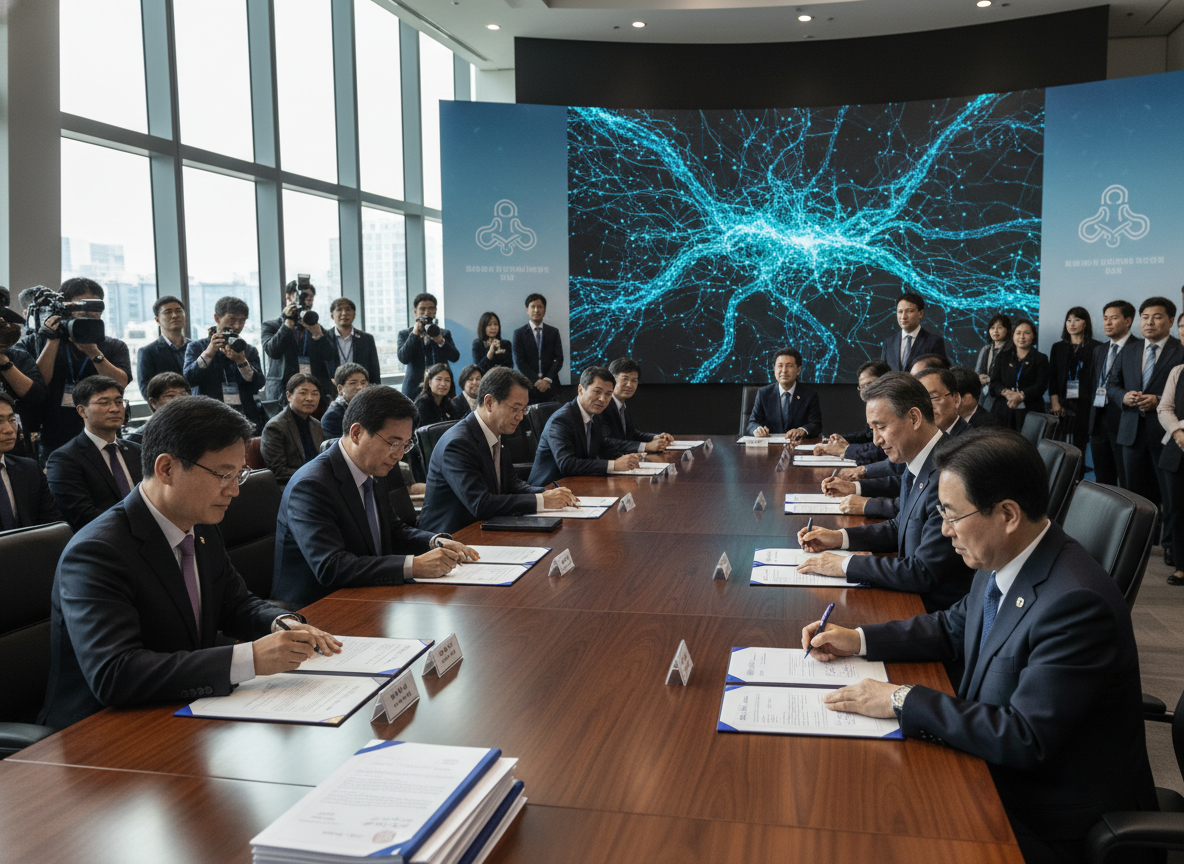
The global technology sector reached a pivotal milestone today as representatives from 32 nations and the world's leading AI laboratories signed the Seoul AI Safety Accord. This landmark treaty, finalized during the 2026 AI Safety Summit in South Korea, marks the first time that international governments have agreed upon a legally binding framework to govern the development of frontier artificial intelligence. The accord focuses specifically on preventing catastrophic risks associated with the emergence of Artificial General Intelligence (AGI).
Central to the agreement is the establishment of 'red-line' boundaries that AI developers must not cross. These include prohibitions on autonomous weaponized code, the intentional engineering of biological pathogens using LLMs, and the deployment of models capable of large-scale social manipulation without human oversight. Any organization found in violation of these standards will face severe international sanctions and the immediate revocation of their computational licenses.
A newly formed body, the International Artificial Intelligence Agency (IAIA), will be tasked with monitoring compliance. Similar to the IAEA in the nuclear sector, the IAIA will have the authority to conduct 'on-site' audits of server farms and inspect the training data of high-capability models. This level of transparency has been a point of contention for tech giants like OpenAI and Google DeepMind, who eventually conceded to the terms in exchange for limited liability protections in other regulatory areas.
The summit also addressed the growing disparity in AI access between the Global North and South. The accord includes a 'Computational Equity' clause, requiring leading tech nations to share a portion of their AI infrastructure and research with developing countries. This move is designed to ensure that the economic benefits of the AI revolution are distributed more equitably and to prevent a 'digital divide' that could destabilize global markets by late 2026.
Critically, the 2026 accord introduces the 'Kill-Switch Protocol,' a mandatory hardware-level safety mechanism for all systems operating above a certain compute threshold. This protocol ensures that human operators can safely deactivate an AI system if it exhibits runaway behavior or loss of alignment. While some engineers argue that such a measure is technically complex to implement, the consensus at Seoul was that the risk of unaligned AGI necessitates unprecedented safety precautions.
Public reaction to the accord has been largely positive, though civil rights groups have raised concerns regarding the 'surveillance' potential of the IAIA. Privacy advocates argue that monitoring AI models could inadvertently lead to the monitoring of the users who interact with them. In response, the Seoul delegates have included a 'Privacy-First' amendment that mandates the use of differential privacy and federated learning in all audit processes.
Economists predict that the clear regulatory roadmap provided by the Seoul Accord will actually boost investment in the sector. By removing the 'regulatory fog' that has plagued the AI industry since 2023, investors now have a clearer understanding of the legal landscape. The markets reacted favorably today, with major tech indices seeing a 2.5% increase following the official signing ceremony, signaling confidence in a more stable and predictable AI future.
As the summit concludes, the focus shifts to the implementation phase, which is scheduled to begin on January 1, 2027. National legislatures around the world must now ratify the treaty to bring its provisions into force. The Seoul AI Safety Accord stands as a testament to human cooperation in the face of existential technological challenges, potentially securing a safe path for humanity as it enters the era of super-intelligence.