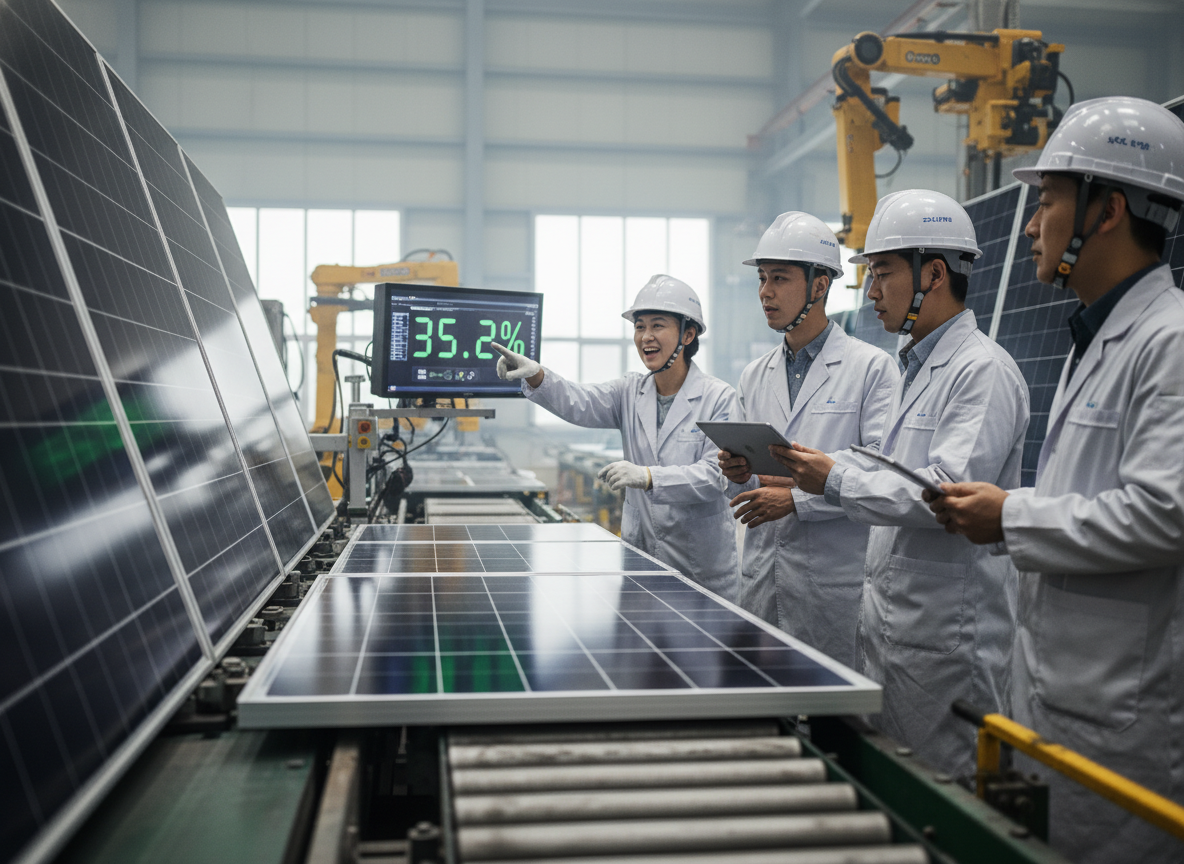
The renewable energy sector reached a significant milestone today as Seoul-based Q-Cells, in partnership with the Korea Institute of Energy Research, announced the successful pilot production of 'Tandem' solar cells reaching 35.2% efficiency. This exceeds the theoretical limit of traditional silicon-only panels, which have hovered around 26-27% for years. The new panels combine standard silicon layers with a thin film of perovskite, a material that excels at capturing different wavelengths of the solar spectrum. This breakthrough suggests that the energy density of rooftop and utility-scale solar farms could increase by nearly 30% without requiring additional land or space.
Perovskite has long been hailed as the 'miracle material' of solar energy, but its commercialization was hindered by issues with durability and moisture sensitivity. Today's announcement confirms that the research team has solved these stability challenges through a proprietary 'nano-encapsulation' process. The pilot batch has undergone rigorous 5,000-hour stress tests, maintaining 98% of its initial efficiency under extreme heat and humidity. This level of durability is considered the 'gold standard' for entering the global residential market, where panels are expected to last for 25 years or more.
The economic implications of 35% efficiency are profound. By generating more power from the same surface area, the total 'Levelized Cost of Energy' (LCOE) for solar is expected to drop below that of existing coal and gas plants in almost every region of the world. Energy analysts predict that this will trigger a massive wave of retrofitting, as homeowners and businesses swap out older 20% efficient panels for the new tandem models. This could effectively accelerate the global transition to net-zero emissions by nearly a decade, providing a much-needed boost to international climate goals.
Manufacturing experts noted that the Q-Cells pilot line uses a modified 'slot-die coating' technique, which is compatible with existing high-speed printing processes. This means that the cost of producing these high-efficiency cells will not be significantly higher than current methods once scaled up. The joint venture plans to begin full-scale mass production at its facility in Ulsan by Q4 2026, with an initial capacity of 5 gigawatts per year. This scale is sufficient to supply roughly one million homes annually, marking the beginning of a new era in high-performance photovoltaics.
The global supply chain for perovskite materials is also rapidly evolving. Unlike silicon, which requires high-heat, energy-intensive purification, perovskites can be synthesized at relatively low temperatures from abundant minerals. This reduces the carbon footprint of the manufacturing process itself, creating a 'virtuous cycle' of sustainability. However, the use of lead in some perovskite formulations remains a point of environmental concern. The South Korean team addressed this today by demonstrating a robust 'closed-loop' recycling program that ensures no heavy metals escape into the environment at the end of a panel's life.
Governments around the world are already reacting to the news, with several European nations considering new subsidies specifically for high-efficiency tandem installations. The US Department of Energy issued a statement praising the breakthrough and suggesting that domestic manufacturers may soon pivot toward similar technology to remain competitive. The move is seen as a way to bolster energy security by reducing dependence on imported fossil fuels and maximizing the output of local renewable resources. The 'Solar Gold Rush' of the mid-2020s appears to have found its next major catalyst.
In terms of grid stability, the higher output from these panels will require upgrades to local energy storage systems. To maximize the 35% efficiency, integrated 'Solar-plus-Storage' solutions are becoming the new industry standard. Companies like Tesla and BYD are reportedly in talks with perovskite manufacturers to develop next-generation home batteries that can handle the increased peak loads. This holistic approach to energy—from high-efficiency capture to high-density storage—is essential for creating the decentralized 'smart grids' of the future.
As the sun sets on a historic day for green technology, the promise of affordable, limitless clean energy feels closer than ever. The jump to 35% efficiency is not just an incremental improvement; it is a fundamental shift in the economics of power. While there is still work to be done in scaling the technology to meet global demand, the success of the Q-Cells pilot program proves that the technical barriers have been overcome. For the first time, solar power has a clear, viable path to becoming the dominant source of electricity for the entire planet within our lifetime.