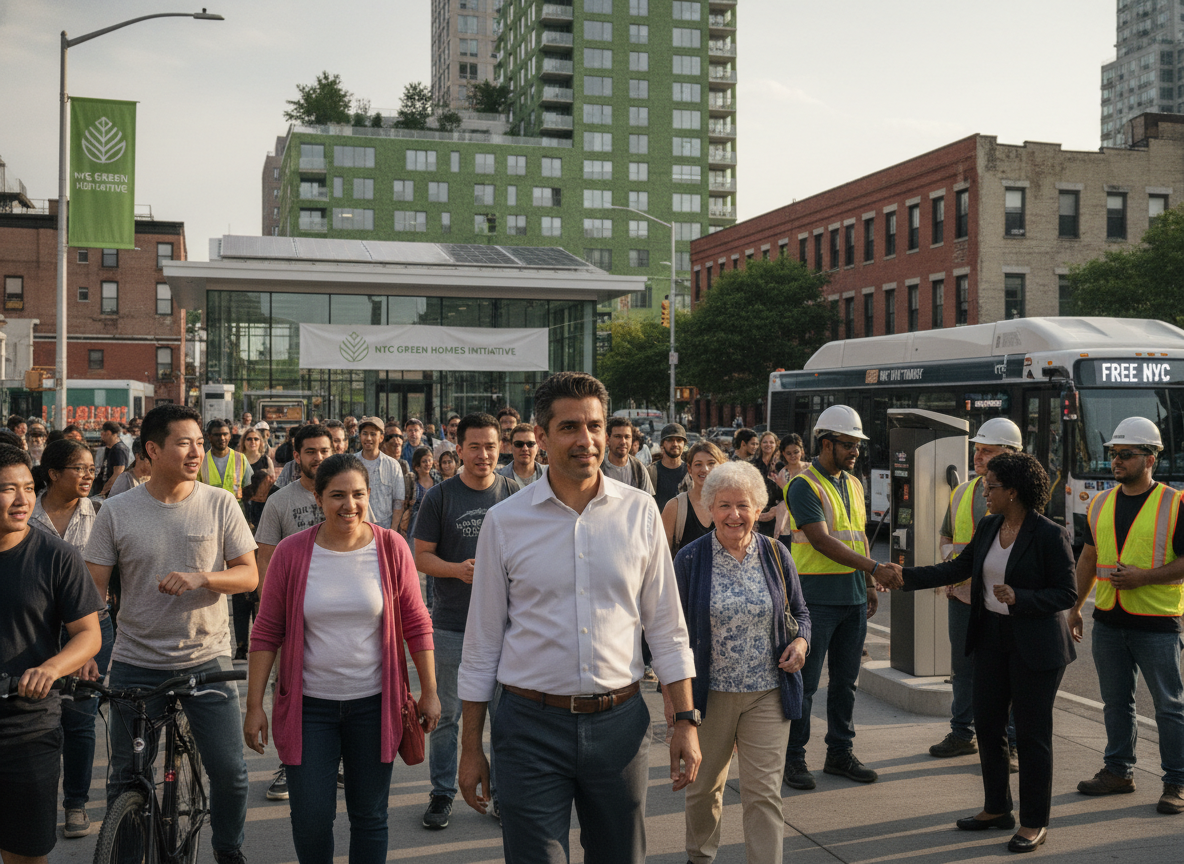
New York City Mayor Zohran Mamdani reached a significant milestone today, marking his 100th day in the city's highest office. Speaking from a community seder at Union Square, the Mayor reflected on a tenure that has been defined by a sharp pivot toward progressive urbanism. Mamdani, who rose to power on a platform of radical transparency and social equity, used the occasion to highlight the early successes of his administration in tackling the city’s most persistent challenges: housing affordability and the modernization of the MTA.
One of the hallmarks of Mamdani’s first 100 days has been the 'Open Streets, Open Minds' initiative, which has permanently pedestrianized over twenty miles of commercial corridors across the five boroughs. While the move initially faced pushback from the logistics and delivery sectors, recent data suggests that foot traffic and local retail revenue have surged. The administration has successfully framed these changes not just as environmental measures, but as vital economic engines for neighborhood-scale commerce.
The housing crisis remains the most significant hurdle for the new administration. Mamdani’s 'Public Land for Public Good' executive order, signed in his first week, has already seen the groundbreaking of three major social housing projects in Queens and Brooklyn. These projects are designed to be permanently affordable, bypassing the traditional private developer model that dominated the previous decade. Critics, however, warn that the city's budget may struggle to sustain such ambitious public construction without significant state or federal subsidies.
In terms of public safety, the Mamdani administration has shifted focus toward community-based intervention programs. The 'Neighborhood Safety Pilots' have replaced traditional policing in select high-traffic areas with multidisciplinary teams of social workers and crisis responders. Early indicators from the first quarter of 2026 show a stabilization in non-violent crime rates, though the Mayor acknowledged today that 'the work of building real safety is a marathon, not a sprint.'
Infrastructure has also been a focal point, with a renewed emphasis on 'fixing the basics.' The Mayor’s office reported today that pothole repair times have been reduced by 40% through the implementation of a new AI-driven predictive maintenance system. By analyzing traffic patterns and weather data, the Department of Transportation can now deploy crews to vulnerable roads before major damage occurs, a move that has saved millions in long-term reconstruction costs.
Mamdani’s relationship with the City Council has been surprisingly collaborative, despite his reputation as a political outsider. By building a broad coalition that includes both traditional labor unions and younger progressive activists, he has managed to pass several key legislative packages. His most recent victory was the 'Gig Worker Rights Act,' which mandates minimum hourly wages and health benefits for the city's vast network of delivery and ride-share contractors.
Despite these early wins, the administration faces looming fiscal challenges. The city’s tax revenue has seen a slight dip as some high-net-worth individuals react to proposed 'fair share' tax adjustments. Mamdani remains undeterred, stating today that the health of the city is measured by the well-being of its working class rather than the size of its billionaire class. This ideological clarity has earned him deep loyalty among his base but continues to alienate parts of the business community.
As New York looks toward the rest of 2026, the 'Mamdani Experiment' is being watched closely by urban leaders worldwide. If his policies continue to yield measurable improvements in quality of life without triggering a fiscal crisis, they could serve as a blueprint for the next generation of American mayors. For now, the 100-day mark serves as a testament to the fact that a more progressive, community-focused New York is no longer just a campaign promise—it is a governing reality.