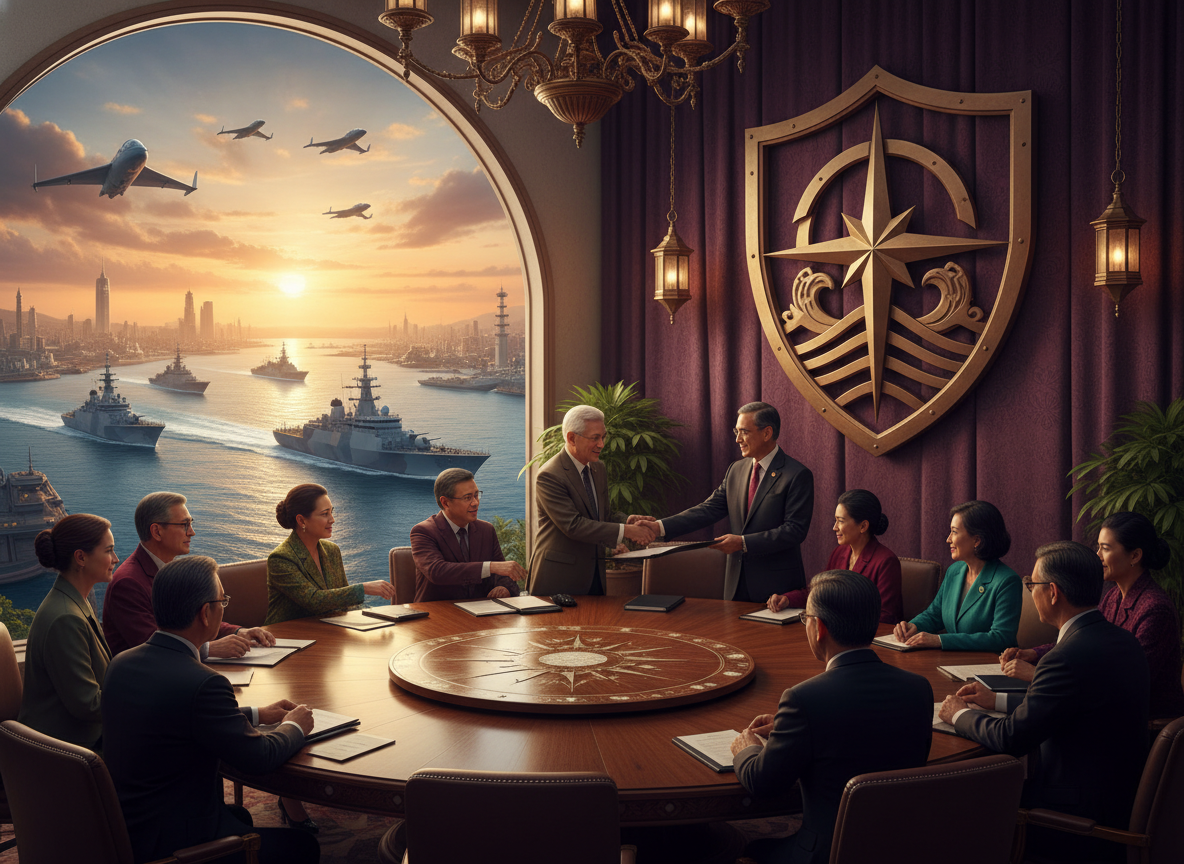
In the most significant realignment of global power since the mid-20th century, twelve nations gathered in Manila today to sign the charter for the Neo-Pacific Treaty Organization (NPTO). This new collective security framework, which includes the United States, Japan, Australia, India, Vietnam, and South Korea, among others, is designed to ensure 'freedom of navigation and economic sovereignty' across the Indo-Pacific. The move comes after years of escalating maritime disputes and the need for a more integrated regional response to security challenges.
The NPTO differs from its Atlantic predecessor, NATO, by placing a heavy emphasis on economic and technological integration alongside traditional military defense. Member states have agreed to a 'shared-resource' naval strategy, which includes joint bases and the co-development of autonomous underwater vehicles (AUVs) for monitoring critical subsea data cables and trade routes. This integrated approach aims to create a 'seamless shield' across the Pacific and Indian Oceans, deterring aggression through unified presence.
A core pillar of the NPTO is the 'Tech-Security Alliance,' which mandates that member states phase out critical infrastructure components from non-allied nations. This is particularly relevant in the areas of 6G telecommunications, artificial intelligence, and semiconductor supply chains. By creating a 'trusted trade bloc,' the NPTO hopes to insulate its members from economic coercion and ensure that the technologies of the future are built on shared democratic values and transparent standards.
The formation of the NPTO has drawn sharp criticism from non-member regional powers, who view the organization as an 'encirclement' strategy and a return to Cold War-style bloc politics. In a formal statement, several nations expressed 'grave concern' over the militarization of the region and warned that the treaty could trigger a localized arms race. Despite these warnings, the NPTO leadership maintains that the organization is defensive in nature and open to dialogue with any nation that respects international maritime law.
Economic analysts suggest that the NPTO could evolve into one of the world's largest free-trade areas. Beyond security, the treaty includes provisions for streamlining customs and digital trade among members, potentially surpassing the impact of the RCEP and CPTPP. The goal is to create a resilient supply chain that can withstand global shocks, such as pandemics or regional conflicts, by diversifying manufacturing hubs across the diverse economies of the Indo-Pacific.
The inclusion of India as a founding member is seen as a major diplomatic triumph for the organizers. India’s transition from a policy of 'strategic autonomy' to a formalized alliance member reflects the changing security perceptions in New Delhi. This shift significantly expands the NPTO’s reach, effectively bridging the Pacific and Indian Oceans into a single strategic theater. It also brings the world's most populous nation into a central role in shaping the new international order.
Public opinion across the member nations is cautiously optimistic but varied. In Australia and Japan, the treaty is seen as a necessary step for national survival in an increasingly volatile world. In contrast, in nations like Vietnam and the Philippines, there are concerns about the potential for being caught in the crossfire of great power competition. To address these fears, the NPTO charter includes a 'Development Fund' aimed at improving coastal infrastructure and disaster response capabilities for its smaller members.
As the first official NPTO summit concludes, the world is left to contemplate a radically different geopolitical landscape. The 'Neo-Pacific' era has begun, defined by a move away from globalism toward robust, values-based regionalism. Whether the NPTO will lead to lasting peace or heightened tensions remains to be seen, but its creation marks the definitive end of the post-Cold War era and the start of a new, complex chapter in human history.