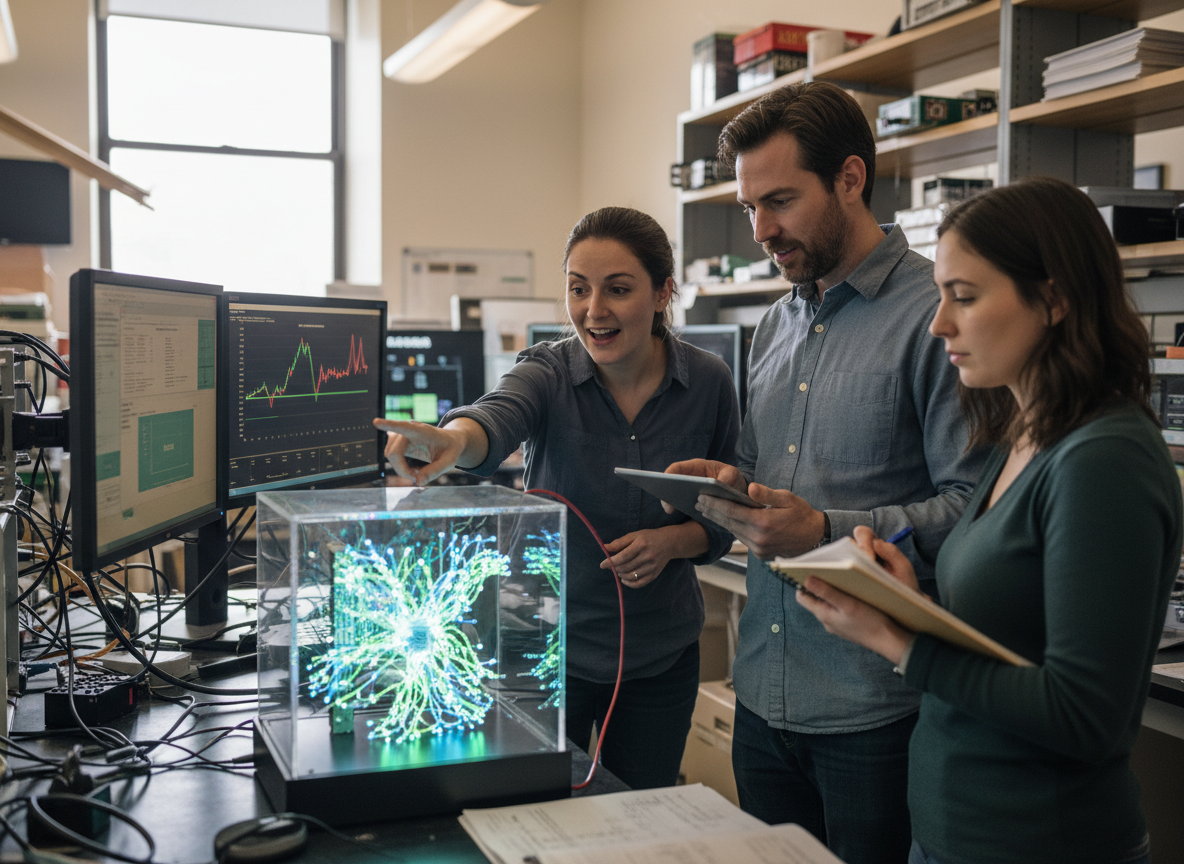
As artificial intelligence continues to consume a staggering 10% of total U.S. electricity, a team of researchers at Tufts University has announced a fundamental breakthrough that could change the industry's environmental trajectory. Led by Professor Matthias Scheutz, the team developed a 'neuro-symbolic' AI system that reduces energy consumption by up to 100 times compared to traditional large language models (LLMs). This new approach combines the pattern-recognition strengths of neural networks with the logic-driven efficiency of symbolic reasoning, mirroring how the human brain processes complex tasks.
The research, published today and set for presentation at the International Conference of Robotics and Automation in Vienna, focuses specifically on Visual-Language-Action (VLA) models. These are the AI 'brains' used to control robots, enabling them to interpret camera data and follow verbal instructions to perform physical tasks. Unlike current systems that rely on brute-force trial and error—a process that is both slow and energy-intensive—the neuro-symbolic system breaks problems down into logical steps and categories, significantly reducing the computational load.
The environmental stakes of this breakthrough are immense. Data centers and AI training facilities, such as the xAI 'Colossus' in Memphis or Microsoft’s 'Stargate' project, currently consume as much energy as mid-sized cities. The International Energy Agency predicts that AI energy demand will double by 2030, a trend that many experts call unsustainable. By introducing a system that can 'think' more logically with a fraction of the power, the Tufts team provides a viable roadmap for scaling AI without overwhelming global power grids.
Technical details of the system reveal that it utilizes a hybrid architecture. While traditional neural networks are excellent at identifying objects, they struggle with the logical relationships between them. By integrating symbolic reasoning, the AI can 'understand' that if it needs to move a glass, it must first navigate around an obstacle rather than simulating every possible movement path. This 'shortcuts' the learning process, leading to a 100-fold increase in efficiency while actually improving the accuracy of the robot's physical actions.
This development comes at a time when the tech industry is shifting toward 'agentic' systems—AI that doesn't just talk but executes complex workflows across local and cloud environments. The efficiency gains offered by neuro-symbolic AI are particularly critical for edge computing and autonomous drones. Australian firm Sparc AI has already expressed interest in the technology, as their own GPS-denied navigation systems require high efficiency to operate on low-power hardware in combat or search-and-rescue environments.
Industry analysts are comparing the impact of this breakthrough to the transition from vacuum tubes to transistors. If AI can be made 100 times more efficient, the 'economic constraints of inference'—the cost of running AI models—will be rewritten. This could democratize access to high-end AI, allowing small businesses and developing nations to run sophisticated systems on standard hardware rather than relying on expensive, energy-hungry server farms owned by tech giants.
However, some critics warn that this breakthrough might lead to the 'Jevons Paradox,' where increased efficiency leads to even greater overall consumption as the technology becomes cheaper and more ubiquitous. Despite these concerns, the immediate reaction from the tech community has been overwhelmingly positive. Tech giants like Google and Microsoft are reportedly investigating how to integrate symbolic layers into their next-generation models to mitigate the soaring costs of their current scaling strategies.
The Tufts research serves as a powerful reminder that the future of AI is not just about 'more data' and 'more parameters.' By looking back at traditional logic-based AI and merging it with modern deep learning, the scientific community may have found the key to a sustainable digital future. As we move into the second half of the decade, the focus of AI development is clearly shifting from raw power to surgical efficiency, ensuring that the AI revolution does not come at the cost of the planet's climate goals.