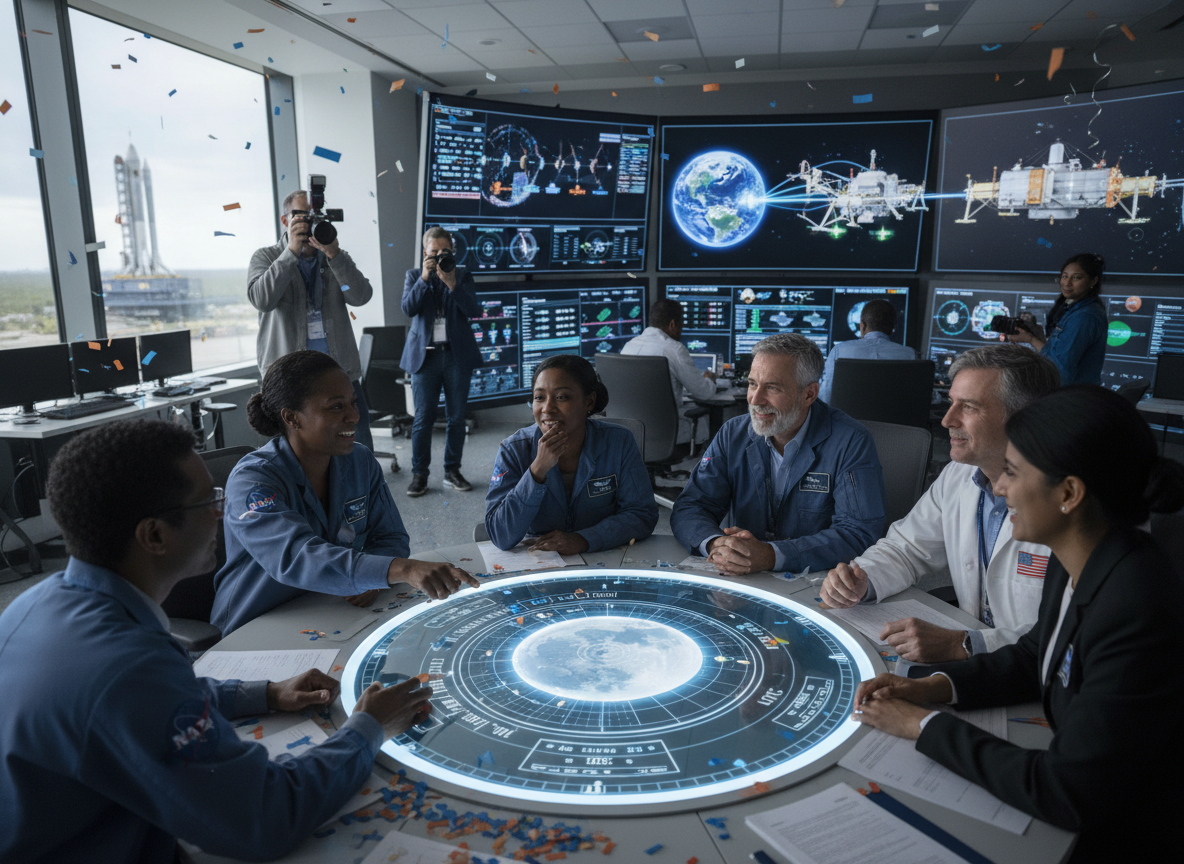
A historic milestone in human spaceflight was reached today as NASA, in collaboration with international partners, officially implemented Coordinated Lunar Time (LTC). This new temporal standard is the culmination of two years of intense scientific research and diplomatic negotiation, fulfilling a 2024 White House directive to establish a unified time zone for the Moon. As of April 10, 2026, all lunar missions, including the upcoming Artemis IV lunar base deployment, will synchronize their operations to LTC, ensuring precision in navigation and communication.
The necessity for a specific lunar time zone stems from the effects of general and special relativity. On the Moon, gravity is weaker than on Earth, causing time to move approximately 58.7 microseconds faster per day. While this difference seems negligible to humans, it is catastrophic for high-precision GPS and automated docking systems. LTC accounts for these relativistic shifts, providing a stable 'master clock' for the burgeoning lunar economy and the scientific outposts being established at the Shackleton Crater.
The implementation of LTC was not without its challenges. It required the deployment of a network of highly precise atomic clocks in lunar orbit and on the surface. These clocks are periodically synchronized with Earth’s UTC through a complex relay of laser communication satellites. This infrastructure, known as the 'Lunar Beacon Network,' now provides the backbone for all lunar positioning, navigation, and timing (PNT) services, essentially creating a 'Lunar GPS' that will be vital for future rover excursions.
International cooperation has been central to the success of LTC. The European Space Agency (ESA), JAXA of Japan, and the Canadian Space Agency (CSA) have all formally adopted the standard. This ensures that a diverse range of landers and rovers from different nations can interact seamlessly. Even private companies like SpaceX and Blue Origin have updated their software to align with LTC, signaling a maturation of the commercial space sector where operational interoperability is now a prerequisite for success.
For the astronauts currently stationed aboard the Gateway station in lunar orbit, the change is mostly technical, but it has significant psychological benefits. Having a dedicated 'Moon Time' helps crews align their circadian rhythms with the specific operational cycles of lunar exploration, which often do not correspond to the 24-hour day of Earth. The Artemis Basecamp, scheduled for permanent manning by 2027, will use LTC to schedule everything from scientific experiments to maintenance EVAs.
Critics of the move have pointed out the high cost of the infrastructure required to maintain LTC. However, NASA officials argue that the investment is foundational. Without a unified time standard, the risk of orbital collisions and landing errors would grow exponentially as more nations and companies send hardware to the lunar surface. LTC is viewed as the first step toward a broader 'Cislunar Traffic Management System' that will be necessary to keep the space between Earth and the Moon safe and orderly.
Looking toward the future, the establishment of LTC paves the way for even more ambitious projects, including the first lunar manufacturing facilities and the proposed 'Far-Side' radio telescope. These projects require extreme synchronization that only a local time standard can provide. Scientists are already beginning to discuss the possibility of a 'Martian Standard Time' (MST) as the horizon for the first crewed missions to the Red Planet begins to take shape in the 2030s.
As of midnight tonight, the first official day of Coordinated Lunar Time concludes. It marks the transition of the Moon from a distant celestial object to a structured, operational environment. By solving the 'time problem,' humanity has taken a quiet but essential step toward becoming a truly multi-planetary species. The clocks on the Moon are now ticking, and they are doing so with a precision that will guide the next century of exploration.