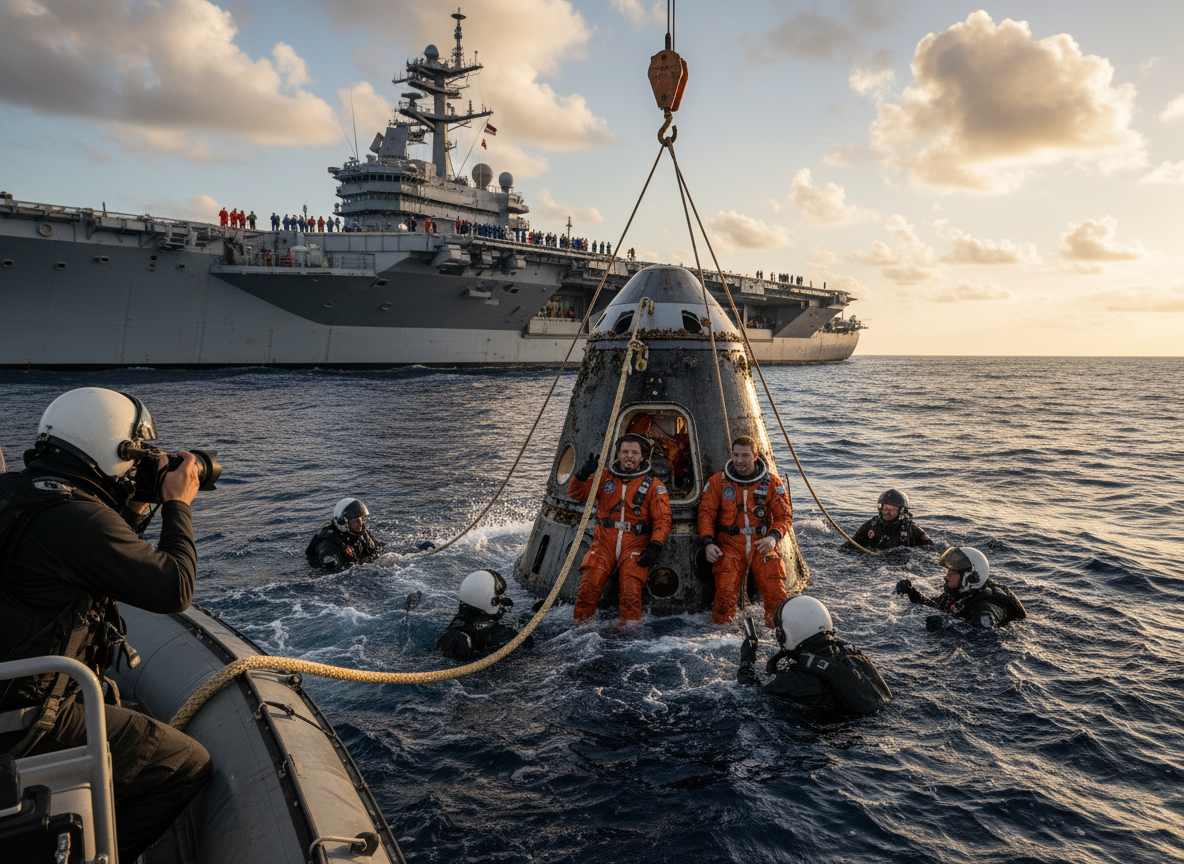
The global scientific community and space enthusiasts alike celebrated a monumental achievement today as the NASA Artemis II mission concluded with a perfect splashdown in the Pacific Ocean. After ten days of high-stakes flight, the Orion spacecraft descended through Earth's atmosphere, successfully deploying its parachutes to land safely off the coast of Baja California. This mission marks the first time in over five decades that humans have traveled to the vicinity of the Moon, signaling a definitive return to deep-space exploration and a significant leap toward a permanent human presence on the lunar surface.
The crew of four—Commander Reid Wiseman, Pilot Victor Glover, and Mission Specialists Christina Koch and Jeremy Hansen—emerged from the capsule in excellent health, according to initial medical reports from the recovery ship. Their journey was not merely a test of endurance but a series of historic firsts: Christina Koch became the first woman to travel to deep space, while Victor Glover became the first person of color, and Jeremy Hansen the first non-U.S. citizen to do so. Their success has inspired a new generation and solidified the international cooperation at the heart of the Artemis program.
On April 6, just days before today’s return, the mission achieved a staggering milestone by surpassing the distance record set by Apollo 13, becoming the farthest human spaceflight in history. By reaching thousands of miles beyond the far side of the Moon, the Artemis II crew provided unprecedented views of our celestial neighbor and tested the limits of the Space Launch System (SLS) and the Orion spacecraft. This 'free-return' trajectory was designed to prove that human-rated vehicles could safely navigate the complex gravitational dance between the Earth and the Moon.
The technical performance of the Orion spacecraft during reentry was a primary focus for NASA engineers. Entering the atmosphere at speeds exceeding 25,000 miles per hour, the craft's heat shield was subjected to temperatures nearing 5,000 degrees Fahrenheit. Early data analysis suggests the shield performed flawlessly, validating the years of engineering and testing that went into its design. This successful reentry is perhaps the most critical hurdle cleared for the upcoming Artemis III mission, which aims to land humans on the lunar South Pole.
Throughout the mission, the crew conducted a battery of scientific experiments and technical demonstrations. They tested the optical communication systems, which allowed for high-definition video streaming from lunar distance, and monitored the radiation environment within the cabin to better protect future Mars-bound astronauts. These data points are essential for the development of the Lunar Gateway, a space station that will eventually serve as a staging point for both lunar landings and missions into the deeper solar system.
With Artemis II officially in the books, NASA and its international partners, including the ESA, JAXA, and CSA, are now turning their full attention to Artemis III, currently scheduled for mid-2027. The successful conclusion of this mission has provided a wealth of telemetry and human factors data that will be used to refine training protocols and vehicle systems. The goal is no longer just a 'footprints and flags' visit but the establishment of sustainable infrastructure that will support long-term scientific research and economic activity on the Moon.
The economic implications of this success are already being felt across the aerospace industry. Private contractors such as SpaceX and Blue Origin, which are developing the Human Landing Systems for future phases, have seen a surge in confidence and investment. The successful integration of commercial and government efforts has created a robust ecosystem that is driving down the costs of access to space. Analysts predict that the 'Lunar Economy' could become a multi-billion dollar sector by the end of the decade, focusing on resource extraction and orbital manufacturing.
In conclusion, the splashdown of Artemis II represents more than just the end of a flight; it represents the start of humanity's next chapter as a multi-planetary species. The courage of the crew and the ingenuity of the thousands of people who made this mission possible have demonstrated that the moon is no longer a distant destination but a reachable frontier. As the Orion capsule is transported back to the Kennedy Space Center for a detailed post-flight analysis, the world watches with anticipation, knowing that the next time we see an Orion capsule near the Moon, it will be carrying the first explorers of the 21st century to step onto its surface.