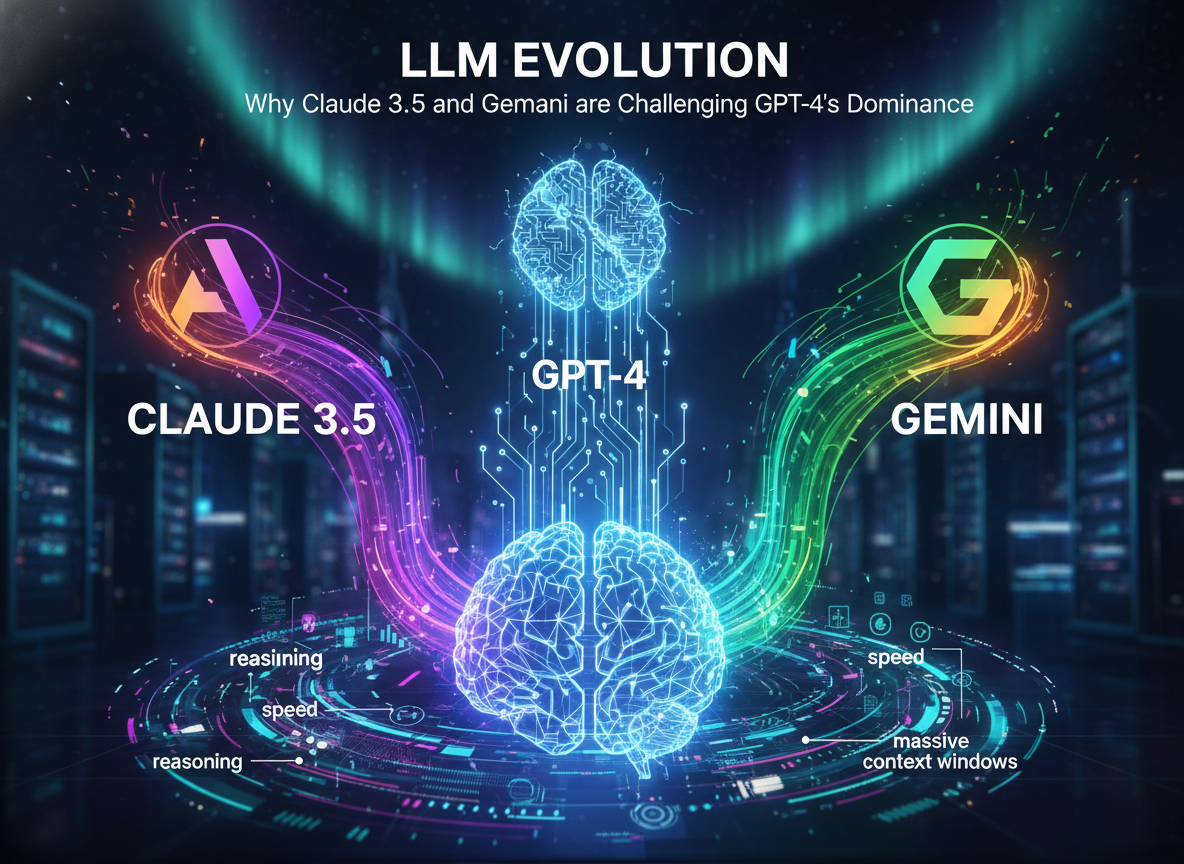
For over a year, OpenAI's GPT-4 was the undisputed king of large language models, setting the benchmark for intelligence and versatility. However, the AI landscape in late 2024 has become significantly more crowded and competitive. Anthropic’s Claude 3.5 Sonnet and Google’s Gemini 1.5 Pro have not only closed the performance gap but, in many specific domains, have overtaken OpenAI's flagship. This shift marks a transition from a winner-take-all market to a diverse ecosystem where different models excel at different tasks, forcing developers to be more strategic about which 'brain' they use for their applications.
Claude 3.5 Sonnet has gained massive traction among programmers and writers for its exceptional reasoning capabilities and more 'human' writing style. Unlike previous iterations that were often overly cautious or prone to repetitive lecturing, the new Claude displays a level of nuance and instruction-following that rivals human experts. Its 'Artifacts' feature, which allows users to view and edit code or documents in a side-by-side window, has redefined the user interface for AI chat, turning it into a collaborative workspace rather than a simple dialogue box. This focus on utility and developer experience has made Anthropic a favorite in Silicon Valley.
Google, on the other hand, is leveraging its massive data infrastructure to win the 'context window' war. Gemini 1.5 Pro boasts a staggering 2-million-token context window, allowing it to process entire libraries of books, hours of video, or massive codebases in a single prompt. This ability to 'remember' and reason across such vast amounts of information is a game-changer for enterprise users who need to analyze complex datasets without the need for intricate RAG (Retrieval-Augmented Generation) setups. Google's deep integration with Workspace also provides a significant distribution advantage, bringing AI directly into the tools millions use every day.
OpenAI has responded to these threats with GPT-4o, a multimodal model designed for speed and real-time interaction. By natively processing audio, vision, and text simultaneously, GPT-4o aims to be the ultimate digital assistant, capable of perceiving the world through a camera and responding with human-like emotional inflection. While it maintains a high level of general intelligence, the focus has shifted toward reducing latency and making the AI feel more personal. The battle is no longer just about who is the smartest, but who is the most accessible and intuitive to interact with.
One of the most significant trends in this LLM evolution is the move toward 'small' yet highly capable models. Models like Llama 3 from Meta and Mistral's latest offerings are proving that you don't always need hundreds of billions of parameters to achieve state-of-the-art results in specific tasks. These open-source or open-weight models allow researchers and smaller companies to innovate without the massive capital required to train a GPT-level model. This democratization is putting pressure on the closed-source giants to continue innovating at a breakneck pace to justify their subscription fees.
The evaluation metrics for these models are also evolving. We are moving away from simple multiple-choice tests like the MMLU toward more rigorous benchmarks that test agentic behavior and complex problem-solving. 'Agentic AI' refers to a model's ability to use tools, browse the web, and execute code to complete a multi-step goal autonomously. As Claude, Gemini, and GPT become better at being 'agents,' the focus shifts from what the AI can say to what the AI can do. This evolution is the precursor to fully autonomous digital employees that can handle workflows from start to finish.
Hallucination remains the Achilles' heel of the industry, but the latest models are showing marked improvements. Through techniques like 'Chain of Thought' prompting and improved Reinforcement Learning from Human Feedback (RLHF), developers are teaching models to be more honest about their limitations. Claude’s internal 'constitutional AI' framework, for instance, helps it adhere to a set of ethical principles, reducing the likelihood of generating harmful or incorrect content. As reliability increases, we are seeing more high-stakes industries like law and medicine begin to integrate these models into their core operations.
The next 12 months will likely see the release of GPT-5 and other 'frontier' models that promise another generational leap in reasoning and world understanding. The goal is to reach 'AGI' or Artificial General Intelligence—a point where the AI can perform any intellectual task a human can. Whether we are close to that milestone or still years away, the current competition between Anthropic, Google, and OpenAI is driving a level of progress that is unprecedented in the history of technology. The LLM wars are far from over, and the ultimate beneficiary is the user who now has access to god-like intelligence at their fingertips.