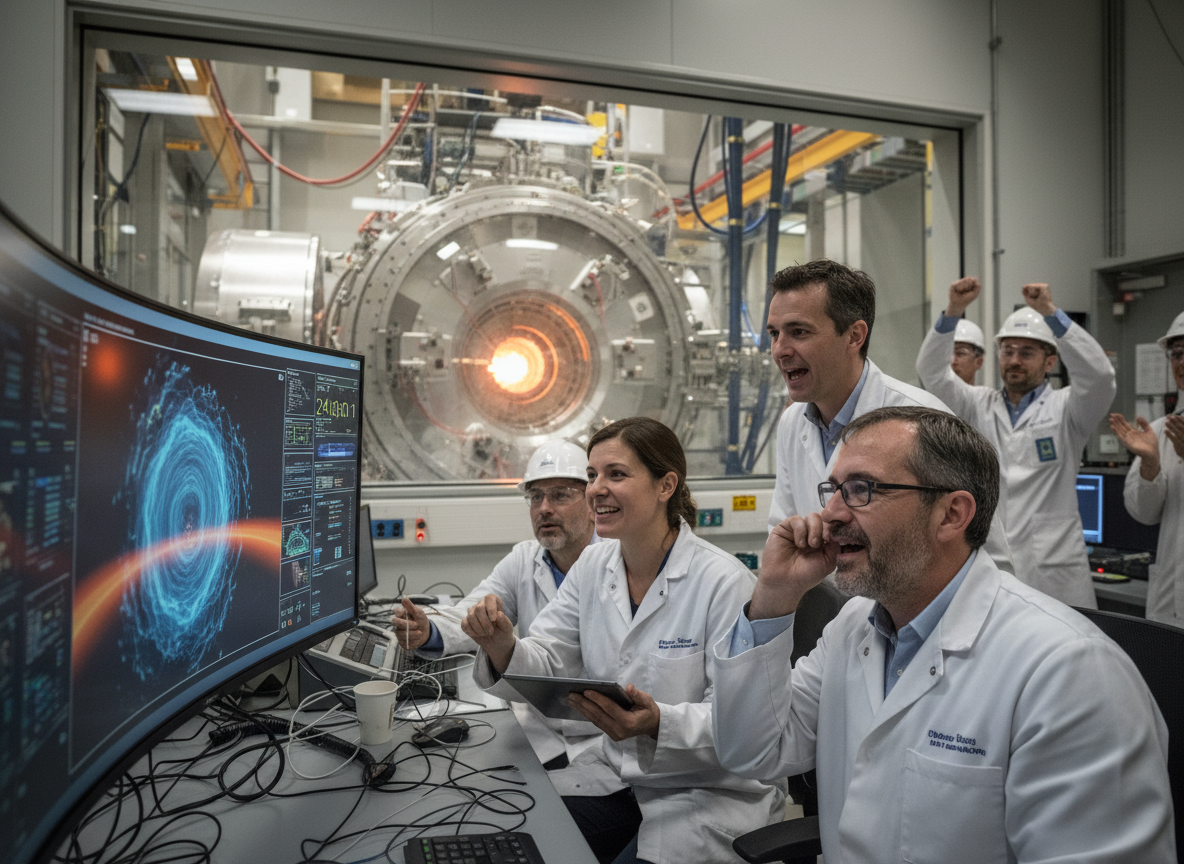
In a major leap toward limitless clean energy, the ITER facility in Saint-Paul-lès-Durance, France, announced today that it has successfully maintained a stable fusion reaction for 24 consecutive hours. This 'long-pulse' milestone is the first of its kind, proving that the magnetic confinement of plasma can be sustained indefinitely. The achievement effectively moves fusion energy from a scientific experiment to a viable engineering reality.
The reaction, which mimics the power of the sun, reached temperatures of 150 million degrees Celsius—ten times hotter than the core of our star. Scientists used a sophisticated array of superconducting magnets to hold the hydrogen isotopes in a doughnut-shaped vacuum chamber known as a tokamak. Previous records were measured in minutes; the 24-hour run demonstrates that the heat-exhaust systems can handle the immense thermal load.
Dr. Pietro Barabaschi, Director-General of ITER, described the atmosphere in the control room as electric. 'We have proven that we can tame the sun on Earth,' he told reporters. 'The stability we witnessed today confirms that our models for commercial-scale fusion are correct. We are no longer asking if fusion works; we are now perfecting how to integrate it into the global power grid.'
Fusion energy is often hailed as the 'holy grail' of the energy transition. Unlike traditional nuclear fission, fusion produces no long-lived radioactive waste and carries zero risk of a meltdown. It uses deuterium, which is abundant in seawater, as its primary fuel source. One gallon of seawater can theoretically provide the same amount of energy as 300 gallons of gasoline, making it the ultimate sustainable resource.
The breakthrough has immediate implications for global climate goals. As countries struggle to phase out coal and gas, fusion provides a carbon-free base-load power source that can complement intermittent renewables like wind and solar. Several private fusion startups, including Helion and Commonwealth Fusion Systems, saw their stock valuations soar today as the ITER success validates the underlying physics of their own designs.
Engineering the containment vessel was the primary challenge overcome during this run. The team utilized a new tungsten-based armor for the divertor, the part of the reactor that handles the most intense heat. This material showed zero signs of degradation after the 24-hour test, solving one of the most persistent hurdles in fusion research: finding materials that can survive the punishing environment inside the tokamak.
While a commercial fusion plant is still projected to be at least a decade away, the ITER success has prompted the European Union and its partners to fast-track the 'DEMO' phase—the design of a demonstration power plant that will actually feed electricity into the grid. Governments are expected to increase funding for fusion research in the upcoming fiscal cycle, viewing it as a cornerstone of national energy security.
As the sun sets over the French countryside, the glow from the ITER facility symbolizes a new dawn for human ingenuity. The path to a world powered by clean, abundant energy is finally clear. Today’s success is a testament to what international cooperation can achieve when focused on the survival and prosperity of future generations.