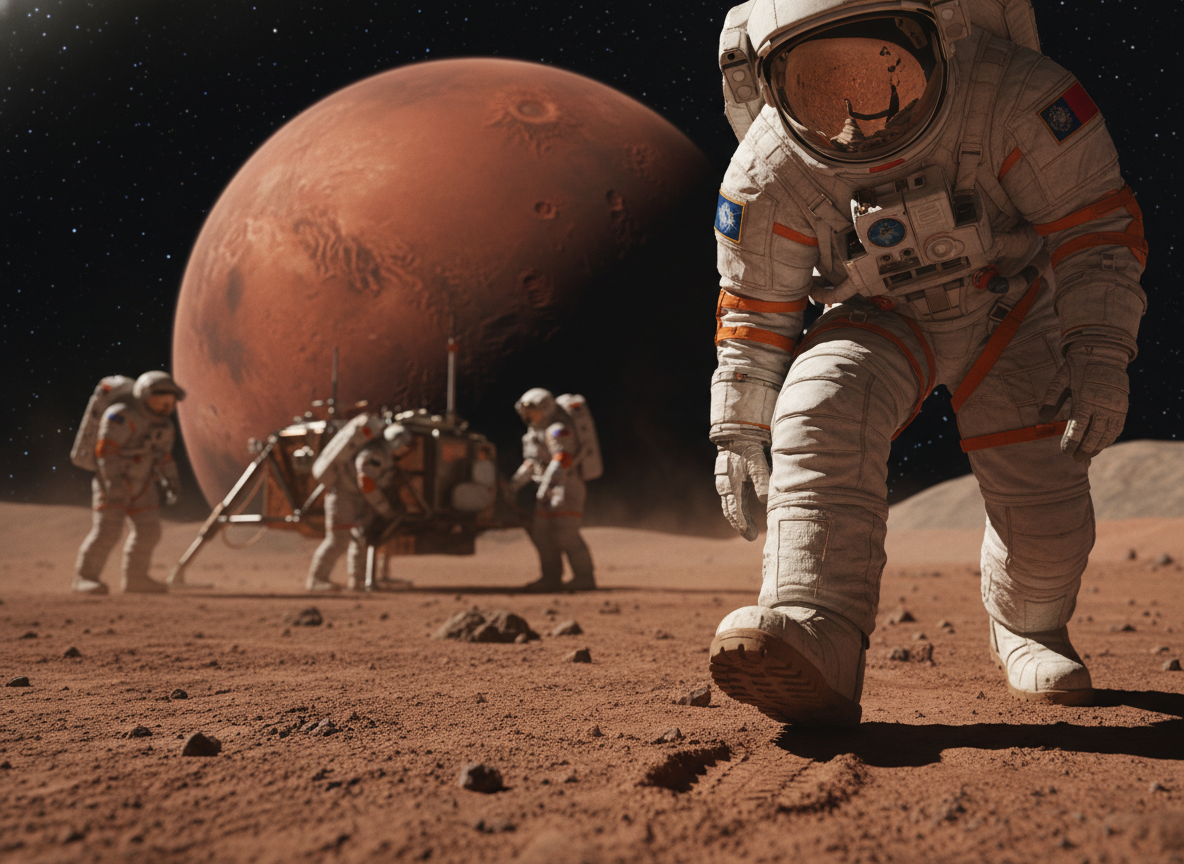
The early hours of April 10, 2026, will be etched into history as the moment humanity officially touched the Martian system. At exactly 00:42 UTC, the 'Pathfinder III' descent module, a joint venture between NASA, the ESA, and SpaceX, touched down on the dusty, cratered surface of Phobos, the larger of Mars' two moons. Commander Sarah Jenkins and Pilot Hiroshi Tanaka became the first humans to step onto the satellite, broadcasting high-definition footage back to a captivated audience on Earth. The mission marks the most significant achievement in deep space exploration since the Apollo program and serves as the final staging ground for the crewed Mars landing scheduled for next year.
The landing was not without its challenges, as the extremely low gravity of Phobos—roughly 1/1700th of Earth's—required a revolutionary 'tether-and-anchor' system to prevent the module from bouncing back into orbit. Engineers at Mission Control in Houston reported that the RCS thrusters performed flawlessly, maintaining a descent velocity of less than 0.1 meters per second. Once anchored, the crew spent several hours conducting pressure checks and deploying the first permanent lunar-style habitat on a non-terrestrial moon. This habitat will serve as a radiation shield and a laboratory for the next six months.
Scientific objectives for the Phobos mission are extensive, focusing primarily on the moon's mysterious origins. Scientists have long debated whether Phobos is a captured asteroid or a remnant of a massive impact on Mars. Preliminary spectroscopic analysis performed by Tanaka within the first hour of EVA suggests a composition similar to carbonaceous chondrite meteorites, but with unexpected isotopic signatures that could link it directly to the Martian crust. These findings are expected to reshape our understanding of the early solar system's formation and the evolution of the rocky planets.
Beyond geological curiosity, Phobos serves a vital strategic role as a 'gravity-well station' for future Mars descents. By establishing a base here, space agencies can store fuel and supplies without the massive energy cost of lifting them from the Martian surface. The Pathfinder III mission has already deployed a prototype robotic refinery designed to extract water ice from the regolith. If successful, this technology will allow for the production of hydrogen fuel in situ, drastically reducing the cost and complexity of the upcoming 'Mars Alpha' colony mission.
The global reaction to the landing has been one of unprecedented unity and celebration. From Times Square to Tokyo, crowds gathered to watch the live feed, which featured a surprisingly low latency of only 14 minutes due to the new deep-space laser communication relay network. International leaders have hailed the event as a victory for diplomacy as much as science, noting that the collaboration between formerly rival nations in the coalition represents a new era of peaceful space exploration. The 'Phobos Accord,' signed last year, ensures that the resources found on the moon will be shared among all participating nations.
Safety remains a primary concern for the crew as they navigate the harsh environment. Radiation levels on Phobos are significantly higher than on the Moon due to the lack of a protective magnetic field and the proximity to the Martian magnetosphere's interactions. The Pathfinder III habitat is buried under three meters of Phobos regolith to provide passive shielding. Additionally, the astronauts are testing new 'Smart-Skin' EVA suits that utilize magnetic fields to deflect high-energy solar particles, a technology that could be essential for long-term survival on the Martian surface.
As the crew begins their 180-day stay, the focus shifts to the psychological and physiological effects of extreme isolation and low gravity. While the ISS provided data on microgravity, the Phobos mission is the first time humans have lived on a solid body with such negligible weight. The crew is following a rigorous exercise regimen involving high-resistance electromagnetic machines to prevent bone density loss. Their health data is being monitored in real-time by an AI-driven medical suite that can perform minor surgical procedures and synthesize medications if necessary.
Looking forward, the success of today's landing confirms that the technical hurdles of interplanetary travel are being overcome at an accelerated pace. The Phobos base will soon welcome a secondary crew of engineers who will begin assembling the Mars Ascent Vehicle (MAV). This mission has proven that the spirit of exploration remains a core human drive, pushing the boundaries of what was once thought impossible. As Commander Jenkins stated during her first walk, 'We didn't come here just to see the view; we came here to build a bridge to the red planet and beyond.'