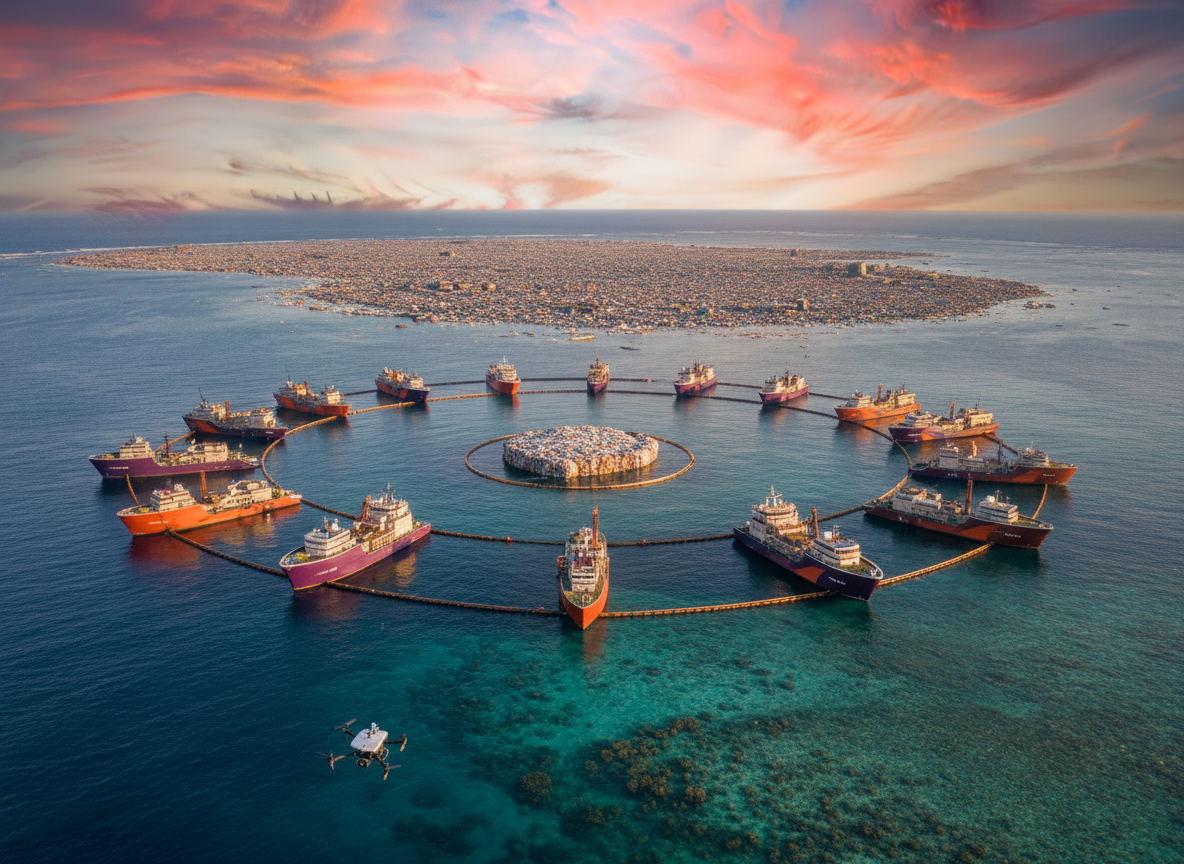
The vast expanse of the North Pacific Ocean is looking remarkably clearer today. The Ocean Cleanup, a non-profit organization that has spent years developing advanced filtration technologies, has officially declared a 100,000-square-kilometer sector of the Great Pacific Garbage Patch as 'Plastic-Free.' This is the first time in history that a significant portion of the world's most infamous accumulation of marine debris has been restored to its natural state, proving that large-scale environmental remediation is possible.
The breakthrough was achieved using the 'System 004' fleet, a network of massive, U-shaped floating barriers that use ocean currents to concentrate plastic waste into a central collection zone. These barriers are equipped with AI-driven sensors that differentiate between plastic and marine life, ensuring that fish and mammals can swim beneath the nets unharmed while the surface-level debris is captured. The collected plastic is then hauled back to shore by low-emission vessels to be recycled into durable consumer goods.
Marine biologists monitoring the area have reported an immediate resurgence in local biodiversity. In the zones cleared of plastic, plankton levels have stabilized, and migratory species like sea turtles and albatrosses are no longer found with stomachs full of microplastics. The removal of 'ghost nets'—abandoned fishing gear that continues to kill marine life—has also led to a noticeable increase in the populations of several endangered fish species within the remediation zone.
The success of the 2026 mission is also a result of the 'Global Plastic Tax' implemented in 2024, which provided the consistent funding necessary to scale the operation. This tax, levied on the production of virgin plastics, has shifted the economic incentive toward recycled materials. The Ocean Cleanup has partnered with several multinational corporations to create 'Certified Ocean Plastic' lines of products, ranging from sunglasses to computer casings, turning the recovered waste into a valuable resource.
Despite the celebration, the organization’s founder warned that the job is far from finished. The Great Pacific Garbage Patch is estimated to cover 1.6 million square kilometers, meaning only about 6% has been cleared so far. However, the 2026 milestone proves that the technology works at scale. With the recent addition of twelve more cleaning systems, the organization projects that it can remove 90% of the remaining floating plastic in the North Pacific by 2035, provided global support remains strong.
Parallel to the ocean-based efforts, the 'Interceptor' program has been successfully deployed in the world's most polluting rivers. By stopping plastic at the source before it ever reaches the ocean, these automated solar-powered barges have reduced the inflow of new waste by an estimated 40% since 2023. This two-pronged approach—cleaning the existing mess while preventing new pollution—is seen as the only viable strategy for long-term ocean health.
The psychological impact of this victory is profound. For decades, the garbage patch was seen as an insurmountable symbol of human negligence and the 'death' of the oceans. The 100,000-square-kilometer clearance serves as a powerful proof of concept for 'Restorative Environmentalism.' It demonstrates that humanity can be an active force for planetary healing, rather than just a source of destruction, inspiring similar projects for reforestation and atmospheric repair.
As the cleaning fleet moves into its next sector, the world watches a tangible example of hope. The Great Pacific Cleanup is no longer a futuristic dream but a proven reality. On this April 1, 2026, we are reminded that while the challenges of the 21st century are immense, our capacity for innovation and collective action is even greater. The tides are finally turning in the fight for a clean and healthy ocean.