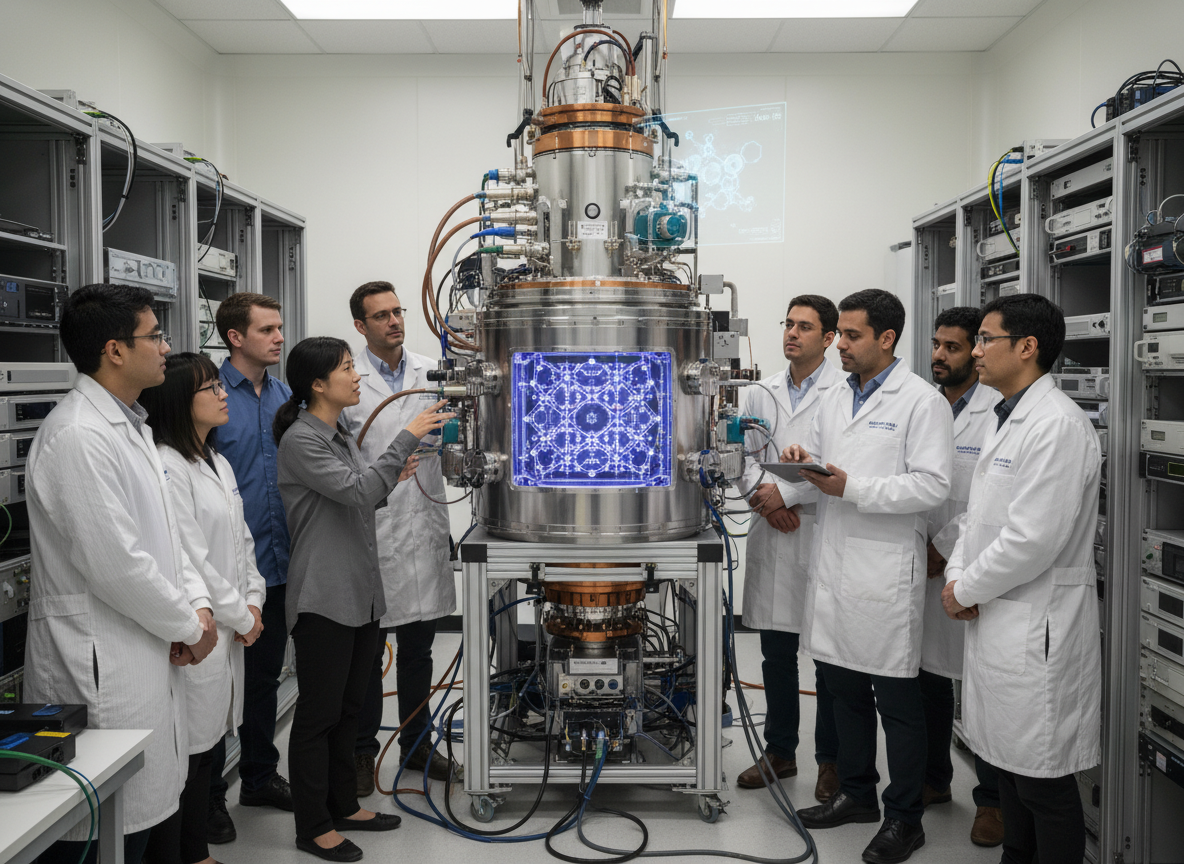
The tech world was rocked today as Google’s Quantum AI laboratory in Santa Barbara officially unveiled 'Centurion,' a quantum processor boasting 10,000 stable qubits. This leap represents a ten-fold increase over the previous industry standard and moves quantum computing from the realm of experimental prototypes into the era of practical utility. The announcement confirms that the 'noisy intermediate-scale quantum' (NISQ) era is officially over.
Centurion’s primary breakthrough lies in its error-correction architecture. Unlike previous chips that suffered from high decoherence rates, Centurion utilizes a new topological qubit design that significantly reduces environmental noise. This allows the processor to maintain quantum states for minutes rather than milliseconds, enabling complex calculations that were previously impossible even for the world's fastest supercomputers.
The implications for global cybersecurity are immediate and profound. Centurion has demonstrated the ability to factor large integers at speeds that could bypass current RSA encryption standards. In response, the National Institute of Standards and Technology (NIST) has accelerated the rollout of post-quantum cryptographic protocols, urging financial institutions and government agencies to transition their data protection layers immediately.
Beyond security, the pharmaceutical industry is expected to be the biggest beneficiary of this milestone. Centurion can simulate molecular interactions at an atomic level with perfect precision. This will allow researchers to design new drugs and catalysts in digital environments, potentially shortening the drug discovery timeline from years to weeks. Early tests have already identified three promising compounds for treating neurodegenerative diseases.
Materials science is also poised for a revolution. Google’s team showcased Centurion’s ability to model high-temperature superconductors, a feat that has eluded classical physics for decades. If these models lead to the creation of room-temperature superconductors, the world could see a total transformation of the energy grid, with zero-loss power transmission and hyper-efficient electric motors becoming a reality.
The competitive landscape of the 'Quantum Race' has shifted dramatically with this release. While IBM and Rigetti are expected to announce their own milestones later this year, Google's Centurion currently stands alone in terms of raw power and stability. This lead has prompted calls for new international regulations to ensure that quantum capabilities are used ethically and transparently across borders.
Critics, however, point to the massive energy requirements needed to keep the Centurion chip at near-absolute zero temperatures. The dilution refrigerators required for the processor consume as much electricity as a small town. Google has countered these concerns by integrating the quantum data center with a dedicated geothermal power plant, aiming for a carbon-neutral footprint for all its quantum operations by 2028.
As we look toward the end of the decade, the launch of Centurion marks the moment when the 'impossible' became 'computable.' We are entering an age where the fundamental mysteries of nature can be decoded through the language of qubits. The digital revolution of the 20th century is being eclipsed by the quantum revolution of the 21st, and today, we have seen its first true engine.