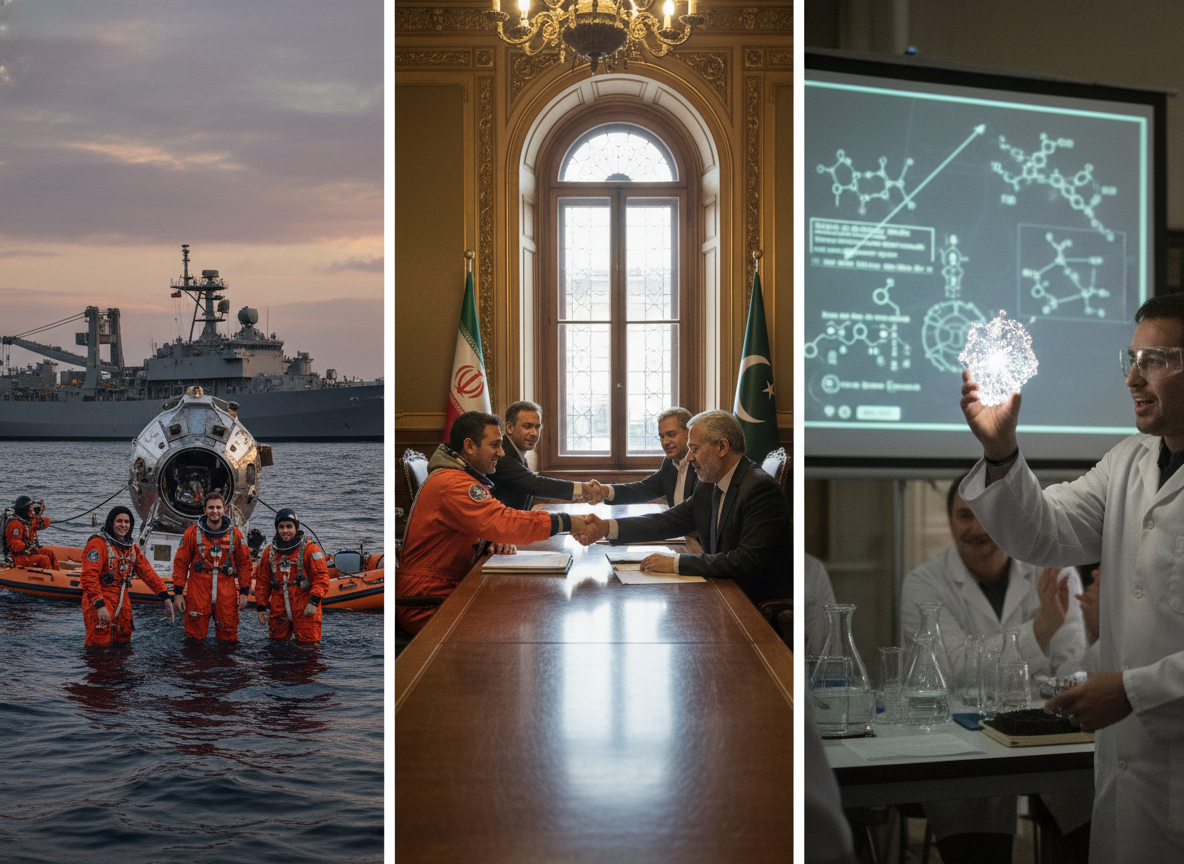
Today, April 10, 2026, marks a monumental milestone in human history as NASA's Artemis II mission concludes with a scheduled splashdown in the Pacific Ocean. After ten days in space, the crew—Commander Reid Wiseman, Pilot Victor Glover, and Mission Specialists Christina Koch and Jeremy Hansen—is set to return to Earth at approximately 8:07 PM PDT. This mission represented the first time humans have ventured beyond low Earth orbit since the Apollo era, successfully performing a lunar flyby that brought the crew further from Earth than any previous mission. Global viewers have been glued to live streams, watching the Orion spacecraft's descent as it maneuvers through a high-stakes atmospheric re-entry, testing critical heat shield technology that will pave the way for future Mars expeditions.
In the geopolitical arena, all eyes are on Islamabad, Pakistan, where Vice President JD Vance is arriving for urgent negotiations aimed at de-escalating the ongoing conflict with Iran. The diplomatic mission follows the recent death of Iranian Supreme Leader Ayatollah Ali Khamenei, whose 40th-day mourning ceremony was held just yesterday amidst widespread regional tension. The United States and its allies are pushing for a sustainable ceasefire agreement following weeks of precision strikes and retaliatory drone attacks. The talks in Pakistan are viewed as a 'make-or-break' moment for Middle Eastern stability, with the international community hoping that the leadership transition in Tehran might offer a narrow window for a historic peace accord.
The global economy is currently navigating a period of intense volatility as the Trump administration continues its aggressive 'liberation day' trade policies. Markets saw a dramatic 'relief rally' today after the White House announced a temporary 90-day pause on several new tariffs, though a staggering 125% duty on Chinese imports remains in effect. This move comes as a response to Beijing’s own retaliatory measures, creating a complex trade landscape that has forced multinational corporations to rapidly overhaul their supply chains. Despite the trade friction, the S&P 500 and Nasdaq experienced their largest single-day gains in years, reflecting investor optimism that a full-scale global trade war might still be averted through negotiation.
On the scientific front, researchers at Flinders University have announced a groundbreaking breakthrough in environmental protection. A new water filtration system utilizing nano-sized molecular 'cages' has demonstrated the ability to remove up to 98% of 'forever chemicals' (PFAS) from contaminated water supplies. This discovery is particularly significant as it targets short-chain PFAS, which have historically been the most difficult to isolate and remove. As groundwater contamination continues to be a major health concern across the globe, this technology offers a scalable and reusable solution that could be integrated into municipal water systems within the next few years, potentially saving millions from long-term chemical exposure.
Medical science has also reached a historic turning point with the release of final results from a massive clinical trial in the United Kingdom. A single blood test capable of detecting over 50 types of cancer before symptoms appear has been deemed a success by health authorities. With over 140,000 participants involved, the test uses DNA fragments in the bloodstream to identify early-stage malignancies with unprecedented accuracy. The UK National Health Service (NHS) has already begun drafting plans to roll out the test as a standard screening tool, a move that oncologists predict could increase survival rates by as much as 30% by the end of the decade through early intervention.
Domestic policy in the United States remains contentious as the administration intensifies its legal and financial standoff with Harvard University. The Department of Homeland Security recently announced a freeze on the university's ability to enroll international students, citing concerns over campus safety and ideological neutrality. This follows a previous cut of over $2 billion in federal research funding. The conflict has sparked a nationwide debate over the role of federal oversight in higher education, with university administrators warning that such measures could stifle innovation and diminish the global standing of American academic institutions. Similar tensions are rising at other Ivy League schools as the administration demands increased transparency regarding foreign influence.
Environmental reports released today indicate that the climate crisis remains at the forefront of global challenges. Data confirms that 2025 was the third hottest year on record, following the unprecedented heat of 2024. Arctic sea ice levels have reached new lows, prompting renewed calls for international cooperation at the upcoming UN Climate Summit. In response to rising sea levels, several coastal nations are accelerating the construction of advanced sea walls and floating urban infrastructures. The transition to renewable energy is accelerating, but experts warn that the current pace of decarbonization may still be insufficient to meet the 1.5-degree Celsius target established by the Paris Agreement.
As the day draws to a close, the mood remains one of cautious optimism. From the successful return of the Artemis II astronauts to the potential for peace in the Middle East, April 10, 2026, will be remembered as a day when humanity looked both to the stars and toward its own internal stability. In the world of sports, preparations are in full swing for the 2026 FIFA World Cup, with Japan and Tunisia announcing a commemorative partnership ahead of their high-profile match this June. Whether in the fields of science, diplomacy, or exploration, the events of today underscore a world in rapid transition, striving to balance technological advancement with the timeless pursuit of global harmony.