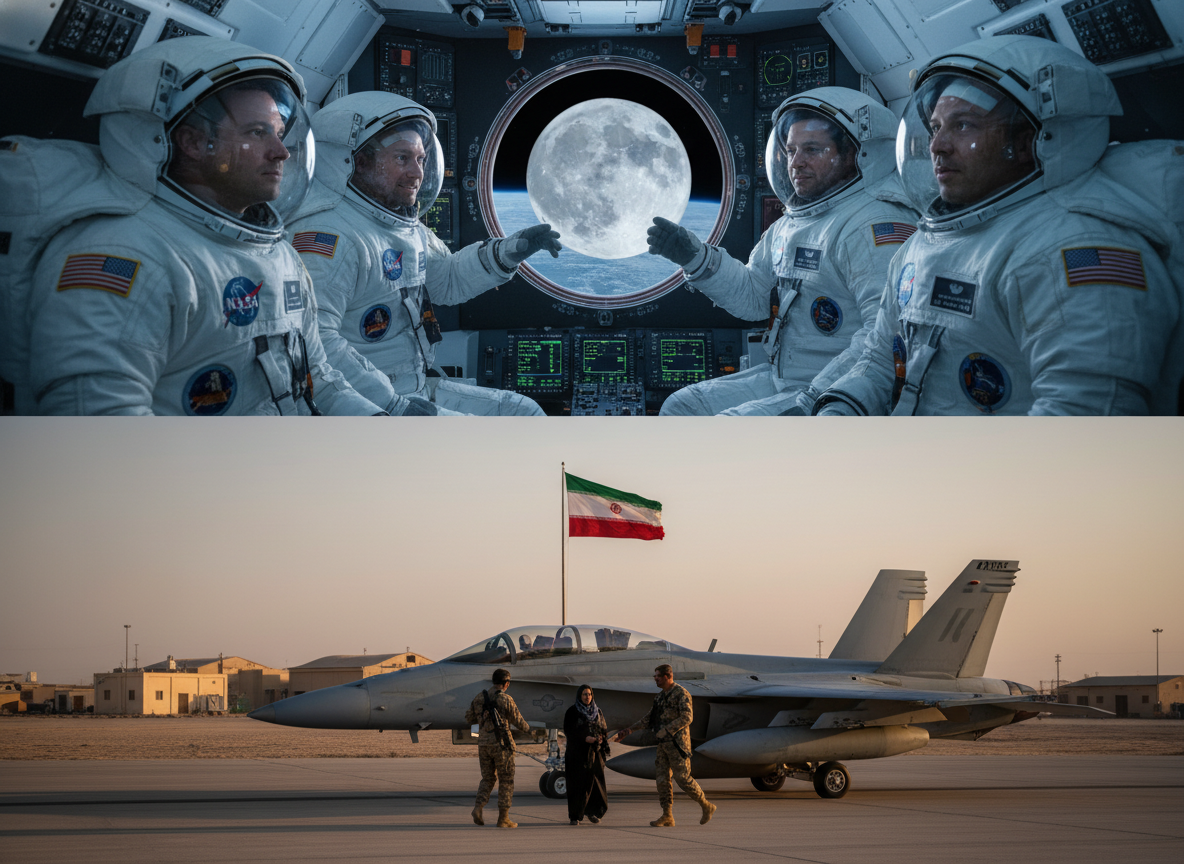
The world finds itself at a historic crossroads this Sunday, April 5, 2026, as the duality of human progress and terrestrial discord takes center stage. On one hand, the Artemis II mission—the first crewed lunar flyby in over half a century—has successfully completed its initial Earth-orbit phase and is now hurtling toward the Moon. On the other, a high-stakes military rescue operation in the mountains of Iran and escalating strikes on Middle Eastern energy infrastructure have pushed global geopolitical tensions to their highest point in decades. This convergence of events highlights a planet simultaneously reaching for the stars and struggling with the volatility of its own borders.
In a major development confirmed early this morning, a U.S. service member who had been missing since an F-15E Strike Eagle was downed over Iranian territory on Friday has been successfully rescued. President Donald Trump announced the success of the mission via social media, describing a 'frantic and diligent' search-and-rescue operation involving dozens of aircraft. The pilot, who had been evading capture in the treacherous Iranian highlands while being hunted by local forces, is reported to be in stable condition despite minor injuries. This rescue follows days of intense diplomatic and military posturing, providing a temporary sigh of relief for Washington even as the broader conflict shows no signs of abating.
The regional situation remains critical as Iranian drone and missile strikes have expanded to target energy hubs across the Persian Gulf. In Kuwait, the Ministry of Electricity reported significant damage to two major power plants and the temporary loss of a desalination station, leading to localized water and power rationing. Meanwhile, in the United Arab Emirates, air defenses successfully intercepted several projectiles aimed at the Borouge petrochemical complex, though falling debris forced a precautionary halt in production. These targeted attacks on the world’s energy supply chains have sent Brent crude prices soaring, prompting European Union officials to urge citizens to minimize non-essential travel and work from home as the 'energy shock' intensifies.
Naval security has also reached a breaking point, with Iran’s military command rejecting a 48-hour ultimatum from the White House to reopen the Strait of Hormuz to all international shipping. The maritime blockade, which began in late March, has already disrupted nearly 20% of the world’s oil supply. Complicating matters further, veiled threats have emerged regarding the Bab el-Mandeb strait, a move that would effectively sever the primary artery for container ships moving between Asia and Europe. While a Maltese-flagged container ship successfully crossed the Strait of Hormuz today—the first Western vessel to do so since the conflict began—the threat of a total maritime shutdown continues to loom over global markets.
High above the fray, the four-person crew of Artemis II is making history. NASA confirmed this morning that the Orion spacecraft has entered the Trans-Lunar Injection phase, setting the stage for a lunar flyby that will take the crew further into deep space than any human in history. Commander Reid Wiseman and his crew, including Canada’s Jeremy Hansen, have maintained regular communication with Houston, providing stunning high-definition video of the Earth receding into the distance. The mission is seen as a crucial proof-of-concept for the upcoming Artemis III landing, though the political instability on Earth has cast a somber shadow over what would otherwise be a moment of pure global celebration.
In the realm of scientific innovation, researchers from RMIT University and the CSIRO in Australia have announced a groundbreaking prototype for a 'quantum battery.' Unlike traditional batteries that rely on chemical reactions, this device utilizes quantum entanglement and light-electron interactions to store energy. The most startling discovery reported today is that these batteries actually charge faster as they increase in size—the inverse of how current lithium-ion technology behaves. This breakthrough could revolutionize the electric vehicle market and long-range wireless power transmission, offering a glimpse into a post-fossil fuel future that the world desperately needs amidst the current Middle Eastern energy crisis.
Domestic politics in the United States are equally turbulent as the administration’s Fiscal Year 2027 budget proposal draws sharp criticism. The proposal, which prioritizes historic levels of defense spending to sustain the ongoing military operations in the Middle East, suggests significant cuts to social programs and the total elimination of federal funding for the Institute of American Indian Arts (IAIA). Indigenous leaders and tribal boards have condemned the move as a violation of federal trust responsibilities. This budgetary shift reflects a nation shifting toward a total war footing, even as public outcry grows over the economic strain of the conflict and the rising cost of living.
As millions celebrate Easter Sunday today, the messages of peace and renewal coming from world religious leaders contrast sharply with the headlines of drone strikes and naval blockades. From the Vatican to the small community parishes in the Philippines, sermons have focused on 'translating faith into action' to mitigate the suffering of those caught in the crossfire of the 2026 Iran war. Whether the coming week brings a de-escalation of hostilities or a further expansion of the conflict remains to be seen, but for now, the world remains suspended between the promise of a lunar future and the harsh realities of a fractured present.