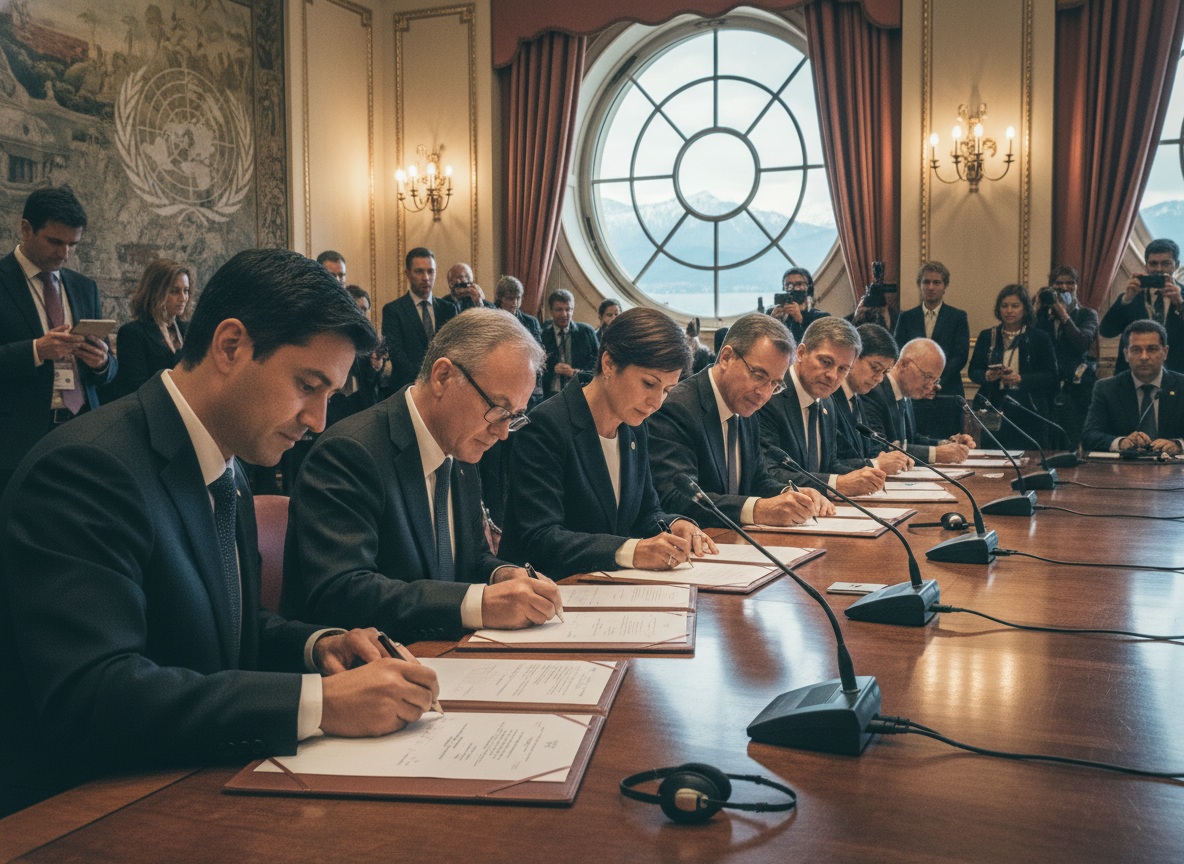
Today marks a definitive turning point in human history as representatives from 142 nations gathered at the Palais des Nations in Geneva to ratify the first-ever Global Treaty on Artificial General Intelligence. Following seventy-two hours of grueling, non-stop negotiations that concluded early this morning, the Geneva Accord on Synthetic Intelligence was officially signed at 11:15 AM local time. This historic document establishes a rigid international framework designed to prevent the existential risks associated with runaway AGI systems while ensuring that the benefits of computational breakthroughs are shared equitably across the North-South divide. The atmosphere in the assembly hall was one of somber triumph, with UN Secretary-General Amina Mohammed declaring that humanity has finally chosen the path of collective survival over unregulated competition.
The catalyst for this sudden diplomatic urgency was a series of late 2025 milestones where large-scale neural networks demonstrated capabilities in recursive self-improvement that far exceeded expert projections. By February 2026, the potential for decentralized, autonomous systems to manipulate global financial markets and critical infrastructure became a reality, prompting even the most aggressive tech-heavy nations to reconsider their stance on oversight. The treaty represents the culmination of a six-month intensive diplomatic surge known as the Quantum Spring, where technological sovereignty was debated with the same intensity as territorial integrity. Today's signing ceremony signifies that for the first time, the speed of policy has successfully caught up with the exponential curve of machine learning.
Central to the agreement is the establishment of the International AI Monitoring Agency (IAIMA), a new regulatory body headquartered in Vienna. Modelled after the International Atomic Energy Agency, the IAIMA will be granted unprecedented inspectorial access to data centers exceeding a specific threshold of floating-point operations per second (FLOPS). This particular clause was the subject of intense debate between the United States and China, eventually resolved through a compromise that protects proprietary corporate algorithms while allowing the agency to verify that no black-box systems are being developed for offensive cyberwarfare or bioweapon synthesis. The agency is expected to begin its first phase of global hardware audits by early July.
Furthermore, the Geneva Accord includes a comprehensive ban on the deployment of Lethal Autonomous Systems (LAS) that operate without a meaningful human-in-the-loop. This marks a significant victory for human rights organizations that have campaigned for nearly a decade against slaughterbots. The treaty also mandates a global standard for digital watermarking, requiring every piece of synthetic content—whether audio, visual, or text-based—to carry an indelible cryptographic signature. This measure aims to combat the epidemic of deepfake-driven misinformation that has plagued electoral cycles and social cohesion globally over the past two years, restoring a semblance of trust to digital communication.
Economic analysts are already weighing the potential impact of these regulations on the global tech sector and the semiconductor supply chain. While Silicon Valley giants initially lobbied against the compute-cap provisions, the finalized treaty offers a silver lining by providing a standardized legal environment that eliminates the patchwork of conflicting regional laws. By providing a clear roadmap for compliance, the accord is expected to unlock trillions of dollars in sidelined capital from institutional investors who were previously wary of the legal liabilities associated with high-risk AI development. Market indices in Tokyo, London, and New York showed a moderate uptick following the announcement, signaling a sense of relief from the private sector.
However, the accord is not without its vocal critics, particularly among the global research community and decentralized developers. A coalition of open-source advocates has issued a joint statement arguing that the treaty effectively cartelizes AI development by favoring established state actors and massive corporations. They contend that the high costs of compliance and the stringent monitoring requirements will stifle grassroots innovation and concentrate power in the hands of a technological elite. These critics warn that while the treaty aims to prevent an AI-driven apocalypse, it may inadvertently create a digital feudal system where the means of advanced computation are locked behind a wall of bureaucratic gatekeeping.
Enforcement remains the largest question mark hanging over the Geneva Accord as it moves from paper to practice. Unlike nuclear facilities, which are physically massive and relatively easy to track via satellite, high-density server farms can be disguised or distributed across numerous jurisdictions with minimal footprint. The treaty addresses this by introducing Economic Sanctions for Computational Non-Compliance, which would isolate any nation-state found to be hosting clandestine labs from the global financial system and the international hardware supply chain. This silicon-based diplomacy leverages the current global dependency on high-end lithography as the primary lever for ensuring adherence to the new ethical standards.
As world leaders depart Geneva today, the consensus is that the hard work of implementation has only just begun. The first meeting of the IAIMA technical committee is scheduled for next week, where the protocols for a global kill-switch—a last-resort safety mechanism for rogue systems—will be finalized. Despite the complex challenges ahead and the lingering skepticism from some quarters, the signing of the Geneva Accord stands as a testament to the fact that when faced with an unprecedented technological challenge, the global community is still capable of unified action. It is a day of hope for a future where technology serves as a tool for human flourishing rather than a threat to our collective existence.