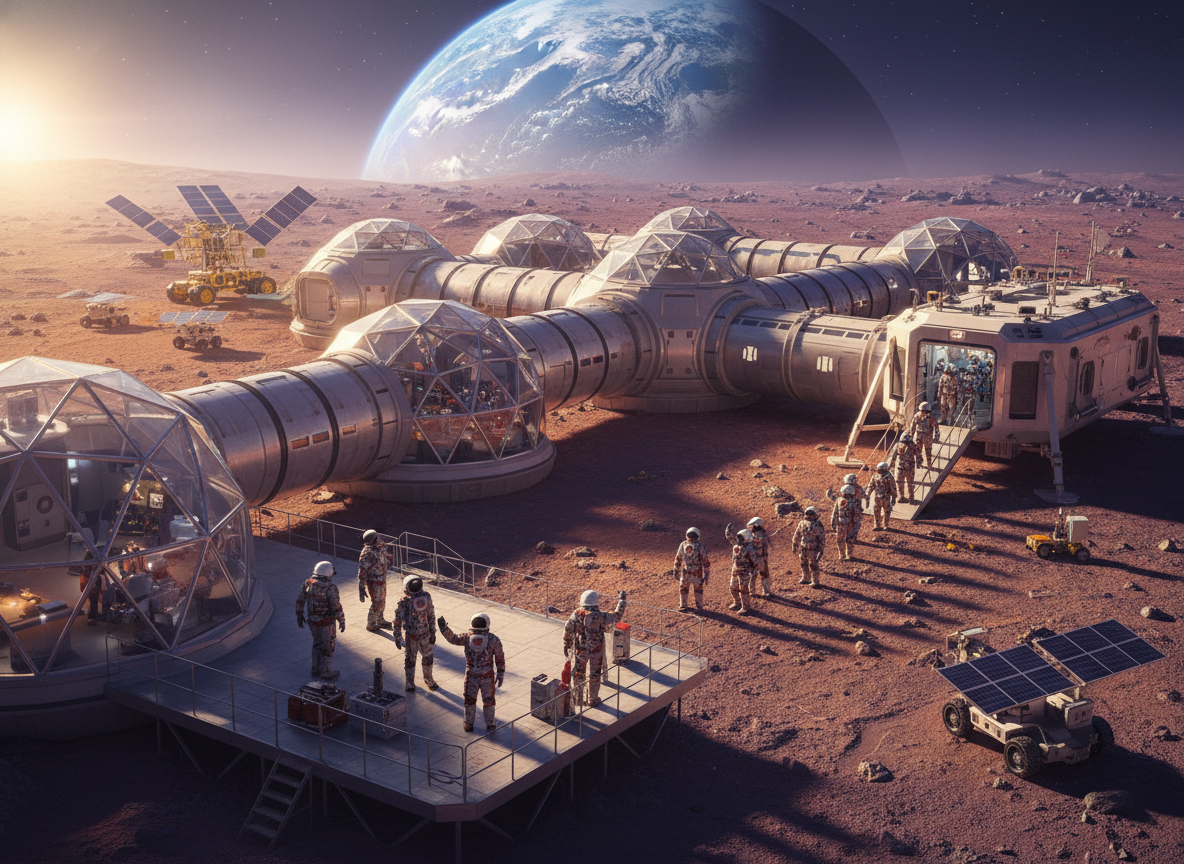
In a move that mirrors the historic Apollo 11 landing of the last century, humanity has officially established its first permanent residence beyond Earth. As of this morning, April 1, 2026, the Artemis Base Camp located near the lunar South Pole has transitioned from an automated construction site to a fully inhabited research station. This achievement represents the culmination of a decade-long international collaboration involving NASA, the ESA, and private aerospace partners who have worked tirelessly to overcome the harsh lunar environment.
The first crew, a diverse team of six astronauts and scientists, docked their Orion capsule at the Lunar Gateway orbital station before descending via the Starship HLS. Their arrival signals the start of the 'Unity Mission,' a two-year deployment focused on testing long-term life support systems and mining lunar ice. This ice is critical for the mission's sustainability, as it will be processed into breathable oxygen and liquid hydrogen fuel, effectively turning the Moon into a cosmic refueling station for future deep-space voyages.
Technologically, the base is a marvel of 2026 engineering. It features modular living quarters protected by thick layers of lunar regolith to shield inhabitants from solar radiation and micrometeoroid impacts. The energy needs of the facility are met by a revolutionary kilopower nuclear fission system and high-efficiency solar arrays that track the sun across the Shackleton Crater's peaks of eternal light. These systems ensure that the base remains powered even during the long lunar nights that have traditionally hindered solar-dependent missions.
The psychological impact of this milestone cannot be overstated. For the first time in history, children looking up at the night sky will know that people are living and working on that silver orb. This permanent presence is expected to inspire a new generation of STEM professionals, much like the original Space Race did in the 1960s. The 'Moon-to-Mars' strategy is now no longer a theoretical roadmap but a physical reality that establishes the Moon as a proving ground for the eventual colonization of the Red Planet.
Economic analysts suggest that the activation of the Artemis Base Camp will trigger a 'Lunar Gold Rush.' Several private corporations have already secured permits for mineral prospecting, targeting Rare Earth Elements (REEs) and Helium-3, which are abundant on the Moon and scarce on Earth. While the legalities of lunar property rights remain a topic of heated debate at the United Nations, the physical presence of humans on the surface creates a 'de facto' administrative zone that will likely shape future space law.
Geopolitically, the success of the base has led to a flurry of new space treaties. Rival space programs are now accelerating their own lunar plans, leading to what some are calling the 'Second Space Age.' However, the Artemis Accords, which govern this specific mission, emphasize transparency and the peaceful use of space. The international nature of the current crew—representing three different continents—serves as a beacon of cooperation in an era often defined by terrestrial friction.
Scientific research conducted in the coming months will focus on the effects of low gravity on human biology over extended periods. While the International Space Station provided data on microgravity, the Moon's 1/6th gravity presents a unique physiological challenge. Data gathered here will be vital for the multi-year transit required for a Mars mission. Additionally, the far side of the Moon is being prepared for a massive radio telescope array, shielded from Earth's electronic noise, which promises to peer deeper into the early universe than ever before.
As the sun sets on the first official day of permanent lunar habitation, the global community watches with bated breath. This is not just a victory for the agencies involved, but a victory for the human species. We are no longer a single-planet civilization. The challenges ahead are immense, ranging from technical failures to the isolation of the void, but for today, the lights are on at the Artemis Base Camp, and humanity is finally home among the stars.